Month: August 2009

Management Consulting for Humanities Ph.D.s

Ezra Klein referred me to a 2006 article, “The Management Myth,” by Matthew Stewart, which has just led to a new book by the same name. Stewart has a Ph.D. in nineteenth-century German philosophy and was a founding partner of a management consulting firm; I have a Ph.D. in twentieth-century intellectual history and spent three years as a management consultant (at McKinsey) before co-founding a software company, so I thought I might find a kindred soul. Also, I’ve been thinking for years that I should write a book about my strange journey through the business world, but will probably never get around to it, so I was wondering what that book might have looked like.

Well, we’re not so kindred after all, although my criticisms of the management consulting industry certainly overlap with his. One difference: I have never, ever found myself thinking, “I’d rather be reading Heidegger!,” although (or perhaps because) I read my share of Heidegger back in the day – Being and Time was on my orals list. (That said, I have also never read books about management, which is what Stewart was doing when he was wishing for Heidegger.)

Continue reading “Management Consulting for Humanities Ph.D.s”
An Inside Perspective on Regulatory Capture

We received the following email from James Coffman in response to Bond Girl‘s recent guest post, “Filling the Financial Regulatory Void.” Coffey agreed to let us publish the email. As he says below, he spent 27 years in the enforcement division of the SEC.

Bond Girl’s “Filling the Financial Regulatory Void” provided insight into human deficiencies in the current financial regulatory system. But it overplays the human failings of regulators and concludes with a proposed solution that, in all likelihood, would turn out worse than the current situation. But first, in the interest of full disclosure, I should tell you that I retired two years ago from a management position in the enforcement division at the SEC after 27 years. So I was (and in my heart, I suppose I still am) a financial regulator. That background probably should be taken into account by anyone who reads this response.

There is no doubt that “regulatory capture” exists and is a meaningful factor in the recent failures of our regulatory system. Many of us in the enforcement division dealt with the problem regularly when we sought input from those in the agency who were responsible for regulating aspects of the securities markets. Over time, regulatory policies and practices had emerged that seemed to contradict the purpose if not the letter of the law. In other cases, over-arching issues (e.g., increases in fees charged by investment companies despite growth that should have resulted in economies of scale and decreasing fees) simply were not addressed in any meaningful way.

Continue reading “An Inside Perspective on Regulatory Capture”

Waiting For The Federal Reserve’s Next Apology

In November 2002, Ben Bernanke apologized – for the Fed’s role in causing the Great Depression of the 1930s.  “I would like to say to Milton [Friedman] and Anna [Schwartz]: Regarding the Great Depression. You’re right, we did it. We’re very sorry. But thanks to you, we won’t do it again” (conclusion of this speech).

Bernanke’s point, of course, is that the Fed tightened monetary policy inappropriately – and allowed banks to fail – in 1929-33.  And much has been made of his strong focus, over the past year, on avoiding a repeat of those or closely related mistakes (including here).

But today we need a different kind of apology, or at least a statement of responsibility, from Ben Bernanke and the Fed. Continue reading “Waiting For The Federal Reserve’s Next Apology”

Health Care’s Senior Moment

Seniors have recently emerged as an important battleground in the health reform war. Katharine Seelye of the New York Times has a post on the “new generation gap” separating the elderly from the not-so-elderly, and multiple polls have shown that seniors are more resistant to reform, at least when it is phrased broadly. In addition, the nonsense about “death panels” has worried at least some seniors, enough for the AARP to pitch in to try to shoot it down.*

This should seem ironic, given that people over 65 are the one group that has already most benefited from health care reform – only their reform happened in the 1960s, when Medicare was created. But hey, it’s a democracy, and people don’t have to wish for others the benefits they themselves enjoy.

Continue reading “Health Care’s Senior Moment”

Can the Federal Reserve Protect Consumers?

Ben Bernanke, chairman of the Federal Reserve, insists that the Fed can protect consumers effectively against defective or dangerous financial products.  He and his allies are therefore signaling opposition to – and even defiance of – key parts of the Treasury’s plan for regulatory reform, which involve setting up a new Consumer Financial Protection Agency.

The Fed is a well-regarded institution in general and Bernanke is currently riding a wave of personal popularity and prestige, but are these claims vis-à-vis consumers plausible?

Not really. Continue reading “Can the Federal Reserve Protect Consumers?”

The Problem with Disclosure

Felix Salmon has a good example of why disclosure (the preferred consumer-protection regime of free-market conservatives and bankers) doesn’t work, courtesy of Ryan Chittum. The topic is no-interest balance transfers offered by credit card companies.

As Salmon points out, most people probably realize what the game is. That is, most people know that banks aren’t in the business of lending money for free; they know that the bank is betting that it can raise the interest rate before they pay off the balance. It’s possible that you will end up getting a free loan: “If you’re smart and disciplined and lucky, you might be able to game the system and pay no interest at all on that balance. Bank of America, for its part, does its very best to make you think that you’ll be able to do just that, essentially getting one over on The Man.” But the bank knows it has the numbers on its side; and most consumers know it too, because they know that’s the only reason the bank would make the offer.

Continue reading “The Problem with Disclosure”

Richard Parsons’s Portfolio

According to Bloomberg, Richard Parsons – the chair of Citigroup since February – now owns stock in the company worth, at yesterday’s close, about $350,000 (96,298 shares at $3.69).  For such a well-established and highly remunerated corporate executive, we can reasonably refer to such an amount as “chump change.”  In May, Forbes estimated Mr. Parsons’ net worth as a little under $100m.

I have no particular complaint about Mr. Parsons; he is an experienced banker, with the very best political connections.  But I would point out that while Wall Street likes to talk big about people having “skin in the game,” when it comes to putting their personal net worth on the line, many finance executives prefer a different kind of arrangement.  Specifically, they are attracted to compensation structures in which they have a lot of upside but very little downside.

If you had such a deal, how would this affect your relative interest in risk-taking and careful supervision of subordinates? Continue reading “Richard Parsons’s Portfolio”

Yet More on Health Insurance

Simon and I have a kind of synthesis of our recent thoughts on health care reform, along with some more data and thoughts about the employer-based system, up at The Hearing. It seems to have 167 comments – people really like to talk about health care, don’t they?

On a related note, we will be modifying the format of our Washington Post gig. We’re moving in the direction of a weekly, substantive opinion and analysis piece, rather than trying to keep up with Congressional hearings from day to day. We’ll get you a new link when that is fully up and running.

By James Kwak

China Rising, Rent-Seeking Version

The usual concern about the US-China balance of economic and political power is couched in terms of our relative international payments positions.  We’ve run a large current account deficit in recent years (imports above exports); they still have – by some measures – the largest current account surplus (exports above imports) even seen in a major country.  They accumulate foreign assets, i.e., claims on other countries, such as the US.  We issue a great deal of debt that is bought by foreigners, including China.

There are some legitimate concerns in this framing of the problem – no country can increase its net foreign debt (relative to GDP) indefinitely without facing consequences.  And the Obama administration, ever since the Geithner-Clinton flipflop on China’s exchange rate policy early in 2009, seems quite captivated by this way of thinking: Will they buy our debt? Can we control our budget deficit? What happens if China dumps its dollars?.

The reason real to worry about China, however, has very little to do with external balances, China’s dollar holdings, or even capital flows.  It’s about productivity and rent-seeking. Continue reading “China Rising, Rent-Seeking Version”

Credit Conditions In The Absence Of Consumer Protection

Even some of our most sophisticated commentators doubt a link between consumer protection and any macroeconomic outcomes.  Consumer protection, in this view, is microeconomics and quite different from macroeconomic issues (such as the speed and nature of our economic recovery).

Officially measured interest rates are down from their height in the Great Panic of 2008-09 and the financial markets, broadly defined, continue to stabilize.  But are retail credit conditions, i.e., the terms on which you can borrow, getting easier or tougher?

On credit cards, there’s no question: it’s getting more expensive to borrow, particularly because new fees and charge are appearing.  Of course, lenders have the right to alter the terms on which they provide credit.  We could just note that this tightening of credit does not help the recovery and flies in the face of everything the Fed is trying to do – although it fits with Treasury’s broader strategy of allowing banks to recapitalize themselves at the expense of customers.  

But there is an additional question: will these changes in lending conditions be reflected in the disclosed Annual Percentage Rate (APR)?  Historically, the rules around the APR – overseen by the Federal Reserve – have not forced lenders to include all charges in this calculation.  Why is this OK? Continue reading “Credit Conditions In The Absence Of Consumer Protection”

What Do the People Want?

To the New York Times’s credit, they asked them. And this is what they found (from the beginning of the article, entitled “New Poll Finds Growing Unease on Health Plan”):

President Obama’s ability to shape the debate on health care appears to be eroding as opponents aggressively portray his overhaul plan as a government takeover that could limit Americans’ ability to choose their doctors and course of treatment, according to the latest New York Times/CBS News poll.

Americans are concerned that revamping the health care system would reduce the quality of their care, increase their out-of-pocket health costs and tax bills, and limit their options in choosing doctors, treatments and tests, the poll found. The percentage who describe health care costs as a serious threat to the American economy — a central argument made by Mr. Obama — has dropped over the past month.

The article does cite several statistics from the poll, and does show several signs that are favorable to President Obama, including that the public overwhelmingly favors him over the Republicans when it comes to health care, and overwhelmingly thinks that he is trying to work with Republicans more than the converse. But the overall impression you get is that Americans are afraid of health care reform.

But are they?

Continue reading “What Do the People Want?”

Filling the Financial Regulatory Void

This guest post was contributed by Bond Girl, a frequent commenter on this site and author of The Bond Tangent, a very good blog on the esoteric but important world of municipal bonds. I invited her to write it after reading her comments on the topic of financial regulation on this post.

In June, the Obama administration released a report outlining various financial regulatory reforms. The proposed reforms are intended to meet five objectives, essentially: (1) to eliminate regulators’ tunnel vision; (2) to regulate certain financial products and market participants that have so far evaded supervision; (3) to protect consumers from unfair and deceptive sales practices; (4) to provide a framework for responding to financial crises and the failure of major financial institutions; and (5) to promote these efforts globally. Much of the subsequent policy debate has been focused on whether or not the reforms detailed in the report address these objectives. This is a political triumph for the administration because it distracts from the report’s one glaring omission – how to address a culture of sustained affinity between the supervisors and the supervised.

The administration’s proposal appears to portray the financial crisis as nothing more than an accident of reasoning. Because financial regulation in our country evolved in a fragmented manner, regulators’ perceptions of risk were determined by their respective niches when a holistic understanding of risk was required to predict a market failure of this magnitude. It logically follows then that the administration’s preference would be to create a meta-regulator (in this case, by extending the powers of the Federal Reserve and establishing an advisory council) to oversee the supervisory project as a whole and seek out system-wide threats.

Continue reading “Filling the Financial Regulatory Void”

The Problem That Won’t Go Away

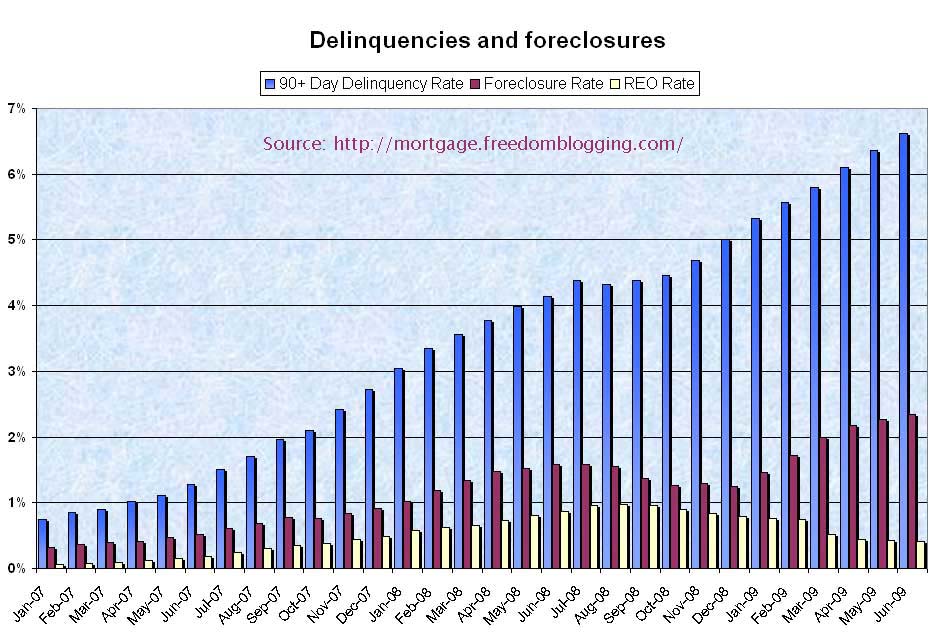
With everyone hoping for positive GDP growth in Q3 and Goldman Sachs analyst Jan Hatzius now predicting growth at an annual rate of three percent in the second half of the year, the banks, investors, and politicians are all hoping that that nasty problem of foreclosures would just go away already. Unfortunately for everyone – especially the people losing their houses – there’s no reason for it to go away.

Unemployment is always a lagging indicator, and given the record low number of average hours worked, it will turn around especially slowly this time. Until then, people will continue to lose their jobs and wages will remain flat, and any small rebound in housing prices is unlikely to help more than a few people refinance their way out of unaffordable mortgages. So unless the other part of the equation – monthly payments – changes, the number of foreclosures should just continue to rise.

Calculated Risk provides this great chart from Matt Padilla (see the CR post for definitions of the categories):

90-day-chart-big

Continue reading “The Problem That Won’t Go Away”

How To Blow A Bubble

Matt Taibbi has rightly directed our attention towards the talent, organization, and power that together produce damaging (for us) yet profitable (for a few) bubbles.  Most of Taibbi’s best points are about market microstructure – not the technological variety usually studied in mainstream finance, but more the politics of how you construct a multi-billion dollar opportunity so that you can get in, pull others after you, and then get out before it all collapses.  (This is also, by the way, how things work in Pakistan.)

In addition, of course, all good bubble-blowing needs ideology.  Someone needs to persuade policymakers and the investing public that we are looking at a change in fundamentals, rather than an unsustainable and dangerous surge in the price of some assets.

It used to be that the Federal Reserve was the bubble-maker-in-chief. In the Big Housing Boom/Bust, Alan Greenspan was ably assisted by Ben Bernanke – culminating in the latter’s argument to cut interest rates to zero in August 2003 and to state that interest rates would be held low for “a considerable period”.  (David Wessel’s new book is very good on this period and the Bernanke-Greenspan relationship.)

Now it seems the ideological initiative may be shifting towards Goldman Sachs. Continue reading “How To Blow A Bubble”

Larry Summers, Economic Recovery, And Ben Bernanke

In a memo to Congress on Tuesday, Larry Summers – the head of the White House National Economic Council – laid out his view of where we are and what is likely to happen next in our economic recovery.

His tone was more upbeat than we’ve heard in recent utterances, although he has been heading in this direction for a while – contrast this April speech with this appearance in July.

What is beginning to turn the economy around?  Summers claims great effects from the fiscal stimulus Recovery Act, but much of that money has not yet been spent. 

He also puts weight on “an aggressive effort to tackle the foreclosure crisis.”  There have been sensible steps in that direction, but so far the effects have been decidedly modest.

The main explanation has to be that the administration prevented the financial system from collapsing.  In an economy as large and diverse as that of the United States – with much more government spending than at the time of the Great Depression – as long as the entire provision of credit does not disintegrate, we will recover.

Summers refers to “A Financial Stabilization Plan”, but this is ex post grandiosity.  In fact, the government simply demonstrated unflinching support for all big financial firms as currently constituted.  We the taxpayer effectively guaranteed all these firms debts, unconditionally.  Once the market figured out that the Treasury, Federal Reserve and other officials could pull this off, the panic was over.

But this victory brings also real danger. Continue reading “Larry Summers, Economic Recovery, And Ben Bernanke”