Month: March 2014

Good Times for Capital

By James Kwak

Last week, the Wall Street Journal highlighted a Federal Reserve report on total household net worth. Surprise! Americans are richer than ever before, both in nominal and real terms.

At the same time, though, wealth inequality is increasing from its already Gilded Era levels. The main factor behind increasing household net worth over the past year was the rising stock market (followed far behind by rising housing prices). These obviously only help you if you own stocks—not if, say, you never had enough money to buy stocks, or you had to cash out your 401(k) in 2009 because you were laid off. Put another way, rising asset values help you if you are a supplier of capital more than a supplier of labor.

Is there anything we can do about this? The conventional wisdom from the political center all the way out to the right fringe is that we shouldn’t tinker too much with the wealth distribution—otherwise people won’t work as hard, which is bad for everyone. But perhaps it isn’t true.
Continue reading “Good Times for Capital”

The Fallacy of Financial Education

By James Kwak

In White House Burning, there is a section on the rise and political influence of the conservative media. At one point, I looked up the top ten talk radio shows by audience. Nine of them were unabashedly right-wing, politically oriented shows. The tenth was Dave Ramsey. Ramsey has plenty of conservative elements: religion, moralism, glorification of wealth. But his show isn’t about conservative politics. It’s about personal finance.

Ramsey is a huge success because—in addition to his charisma and marketing skills—he is peddling one of the huge but popular illusions of American culture: that people can become rich by making better financial decisions. He’s also one of the characters skewered by Helaine Olen in her recent book, Pound Foolish, which describes the fallacies, hypocrisies, and borderline-corrupt schemes of personal finance gurus like Ramsey and Suze Orman. It’s a fun read—a bit repetitive, but that’s largely because all personal finance “experts” are pushing a small handful of myths.*

Continue reading “The Fallacy of Financial Education”

Posturing from Weakness

By James Kwak

President Obama’s 2015 budget proposes a number of tax increases that will mainly affect the rich. They include:

  • Limiting the tax savings on deductions to 28 percent of the deduction amount (and applying this limit to exclusions as well, such as the one for employer-provided health benefits)
  • Requiring a minimum 30% income tax on income less charitable contributions, which is intended to limit the benefit of tax preferences on capital gains and qualified dividends
  • Reducing the estate tax exemption from $5.34 million to $3.5 million and raising the estate tax rate from 40% to 45%
  • Eliminating tax preferences for retirement accounts once someone’s account balance is enough to fund a $200,000 annuity in retirement (simplifying slightly)

These are all good things, given the size of the projected national debt and the urgent needs elsewhere in society. But, of course, they have no chance of actually happening.

If President Obama really wanted these outcomes, there was a way to get them. He could have let the Bush tax cuts expire for good a year ago, making high taxes on the rich a reality. Then, a year later, he could have proposed a middle-class tax cut and dared the Republicans to block it in an election year. (He could also have traded a reduction in the top marginal rate—from the 39.6% that would have resulted, not counting the 3.8% Medicare tax—for the reforms he is now proposing.)

But no. Instead, he locked in low marginal rates, including low rates on dividends, that cannot be budged so long as Republicans have 41 votes in the Senate. And today he’s left waving a “roadmap” that has no chance of becoming reality.

“Retirement Security in an Aging Society,” or the Lack Thereof

By James Kwak

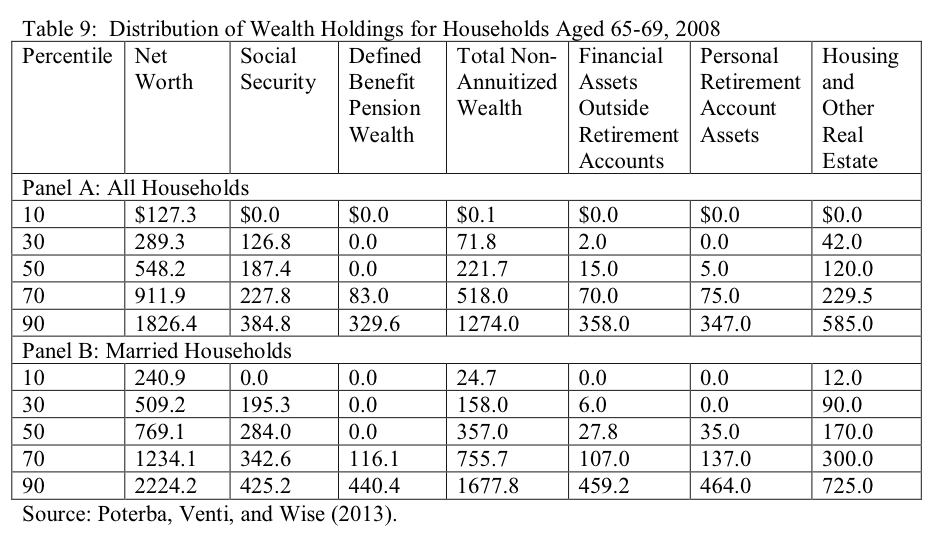
James Poterba wrote up a very useful overview of the retirement security challenge in a new NBER white paper. (I think it’s not paywalled, but I’m not sure.) He provides overviews of much of the recent research and data on life expectancies, macroeconomic implications of a changing age structure, income and assets of people at or near retirement, and shifts in types of retirement assets.

In the past, I’ve used the Federal Reserve’s Survey of Consumer Finances as my source for data about the inadequacy of many households’ retirement savings. Poterba has a new, perhaps even more stark snapshot:

Screen shot 2014-03-04 at 2.20.32 PM

Continue reading ““Retirement Security in an Aging Society,” or the Lack Thereof”

Ukrainian Chess

By Peter Boone and Simon Johnson

U.S. Secretary of State John Kerry arrived in Kiev on Tuesday.  The Obama administration is feeling real pressure from across the political spectrum to “do something”, but the US has no military options and little by way of meaningful financial assistance it can offer to Ukraine.  The $1 billion in loan guarantees offered today by Mr. Kerry means very little.

Millions of people have a great deal to lose if the situation gets out of control, and the Russian leadership is behaving in an unpredictable manner.  The sharp drop in the Russian stock market index on Monday morning, alongside an emergency hike in interest rates by the Central Bank, demonstrates that Russia’s financial elite was also caught completely off guard.

Mr. Kerry can and has made threats, but it would be better to join the Europeans in helping to calm the situation.  There is a completely reasonable and peaceful path to a solution available, but only if everyone wants to avoid a major conflict. Continue reading “Ukrainian Chess”

Politics: Another Way To Waste Shareholder Money

By James Kwak

I don’t often go to academic conferences. My general opinion is that at their best, sitting in a windowless room all day listening to people talk about their papers is mildly boring—even when the papers themselves are good. And it takes a lot to justify my spending a night away from my family.

Despite that, a little over a year ago I attended a conference at George Washington University on The Political Economy of Financial Regulation. I went partly because my school’s Insurance Law Center was one of the organizers, partly because there was a star-studded lineup (Staney Sporkin, Frank Partnoy, Michael Barr, Anat Admati, Robert Jenkins, Robert Frank, Joe Stiglitz (who ended up not showing), James Cox, and others, not to mention Simon), and partly because I have friends in family in DC whom I could see. It was one of the best conferences I’ve been to, both for the quality of the ideas and the relatively non-soporific nature of the proceedings.

Many of the papers and presentations from the conference are now available in an issue of the North Carolina Banking Institute Journal (not yet on their website), which should be of interest to financial regulation junkies. My own modest contribution was a paper on the issue of corporate political activity. (In a moment of unwarranted self-confidence, I told one of the organizers I could be on any of three different panels, and they put me on the panel on “political accountability, campaign finance, and regulatory reform.”)

Continue reading “Politics: Another Way To Waste Shareholder Money”