Tag: politics

Pure Spite

By James Kwak

In my Atlantic column on Thursday, I wrote the following about the Roberts Court’s decision to allow states to opt out of Medicaid expansion without losing their existing Medicaid funding:

“What we are going to see is Republican-controlled state governments refusing to expand Medicaid out of bitter hatred toward President Obama and spite for the working poor who need access to health care.”

For those who aren’t up to speed, the deal is basically this. Medicaid is administered by states (which often outsource it to third parties), but the federal government sets certain minimum coverage requirements that states must meet in order to receive federal funding. Those requirements are pretty low, states can choose not to cover able-bodied adults without children, regardless of their income. The Affordable Care Act required states to dramatically increase their Medicaid coverage, with the federal government kicking in 90 percent of the additional funding required (100 percent in the early years).

Continue reading “Pure Spite”

The “Me, Too” Party

By James Kwak

In the current issue of Democracy, Elbert Ventura discusses the history of a problem that I’ve brought up as well: the transformation of the Democratic Party into the party of tax cuts. Except, that with the Republican Party as the real party of Texas-sized tax cuts, the Democrats can never be more than the kid brother, half-hearted, talking-out-of-both-sides-of-its-mouth party of tax cuts.

Continue reading “The “Me, Too” Party”

Once More, With Feeling*

By James Kwak

Peter Orszag wrote an article for the latest Democracy** about political dysfunction and the “looming fiscal showdown” at the end of this year. A lot of it is a warmed-over description of political polarization, although Orszag ignores one of its most important causes: the growing influence of money in politics and the resulting need for politicians to go chasing after contributions from extremist billionaires. (Orszag instead subscribes to the theory that political polarization results from public polarization, which has been pretty well debunked by Fiorina and Abrams.)

Orszag’s recommendation, however, is spot-on: First let the Bush tax cuts expire; then, assuming that economic stimulus is necessary, push for a big, across-the-board, temporary tax cut. (Orszag proposes a payroll tax cut and an increase in the standard deduction; I’ve previously proposed a payroll tax cut.)

Continue reading “Once More, With Feeling*”

Why Raise Taxes on Poor People?

By James Kwak

My Atlantic column today is on the bizarre fixation that some conservatives have with taxing poor people, pointed out by Bruce Bartlett in his latest column. Here’s one explanation:

The other, even-more-disturbing explanation, is that Republicans see the rich as worthy members of society (the “producers”) and the poor as a drain on society (the “takers”). In this warped moral universe, it isn’t enough that someone with a gross income of $10 million takes home $8.1 million while someone with a gross income of $20,000 takes home $19,000. That’s called “punishing success,” so we should really increase taxes on the poor person so we can “reward success” by letting the rich person take home even more. This is why today’s conservatives have gone beyond the typical libertarian and supply-side arguments for lower taxes on the rich, and the campaign to transfer wealth from the poor to the rich has taken on such self-righteous tones.

Also, in some housekeeping news, I’ve switched to a personal Twitter account, @JamesYKwak. My blog posts should generate tweets in that account; Simon’s should generate tweets in the old account, @baselinescene. I’ll try to aggregate all the stuff I write in various places in my new Twitter stream.

The Baseline Scenario Facebook page should be aggregating both of our Twitter streams, but I had a little difficulty with it on Monday, so who knows. It seems like Facebook changes the way everything works every other Tuesday, so you never know when something will break.

Because They Can

By James Kwak

It seems as if the Republicans, meaning both John Boehner and Mitt Romney, are trying to turn the national debt back into a major political issue. Now, a visitor from Mars might wonder how this is possible. How could a party that (a) passed the massive tax cuts that were the single largest legislative contributor to today’s record deficits, (b) increased spending rapidly the last time it controlled the federal government, and (c) cannot talk in detail about anything except deficit-increasing tax cuts possibly think that calling attention to deficits could be a political winner?

Well, despite the Republican Party’s abysmal record when it comes to fiscal responsibility, it could still turn out to be smart politics, for a few reasons. One is that many Americans reflexively associate large deficits with excessive spending, even though reductions in tax revenues have played just as big a role since George W. Bush became president. (Compare, for example, receipts and outlays in 2000 and 2011 as a percentage of GDP.) Then they associate excessive spending with Democrats, although the only president to reduce spending significantly in the past forty years was Bill Clinton. It turns out that if you repeat the same tired attack lines year after year—Democrats are all tax and spend liberals, for example—people believe them.

The other, more important reason why Republicans like talking about the national debt is that Democrats don’t have a good response. Sure, Democrats have lots of policy proposals, and theirs make a good deal more sense than the Republicans’; it was President Obama who proposed trillions of dollars in spending cuts and tax increases, which is what people supposedly want (according to opinion surveys, at least).

But most Democrats just don’t like talking about deficits and the national debt. They think it’s a distraction from talking about jobs and unemployment, or they think simply broaching the subject is succumbing to a vast right-wing conspiracy to slash entitlements, or both. The result is that there is no liberal progressive position on the national debt. There’s the Republican one (Romney, Boehner, Ryan), which is to cut taxes (boggle); and there’s the Obama one, which is basically the Republican-Lite position of George H. W. Bush, and which many liberal Democrats run away from. On the left, all there is is a vague belief that you can balance the budget by increasing taxes on the rich, but no one really wants to come out and say it. (Also, the numbers don’t add up unless you’re willing to boost the tax rates on millionaires to very high levels; just, say, repealing the Bush tax cuts for the rich won’t cut it.) Instead, the strategy is to demonize RyanCare, which is effective as a short-term tactic, but doesn’t really amount to a coherent message on the national debt.

This is one reason why I wrote White House Burning. I say “I” because Simon probably wouldn’t call himself a liberal, but I do call myself a liberal, and I think liberals need to have a coherent message on the national debt. I think the message should be something like this: the national debt is a real problem that needs to be addressed; we need to address it in the way that’s best for the American people as a whole; that means preserving the social insurance programs that almost everyone depends on; and we can preserve those programs, while bringing the debt under control, through a set of policy changes that make sense on their own grounds (eliminating distorting subsidies, eliminating tax expenditures, introducing Pigovian  taxes like a carbon tax and a financial activities tax).

You don’t have to agree with our recommendations. But as long as the liberal wing of the Democratic Party has nothing to say about the national debt, conservatives will be free to lead the debate, and the most likely outcome will be some sort of compromise between the moderate Republican Barack Obama an the now-“severe” conservative Mitt Romney. And you can expect the Republicans to bang on this drum from now until November.
Is the GOP Still the Party of Business?

By James Kwak

Jonathan Weisman of the Times wrote an article about the reluctance of many Republicans in Congress to extend policies that are traditionally favored by big business (and the Chamber of Commerce), such as infrastructure spending and funding for the Export-Import Bank. This points to a split between the traditional corporate wing of the GOP and the newer, ultra-conservative tax revolt wing.

My guess is that this will blow over and the Republicans will figure out a way to keep big business happy without upsetting the Tea Party too much. But it points out a potential shift among the people who fund the GOP.

Continue reading “Is the GOP Still the Party of Business?”

Who’s a Freeloader?

By James Kwak

A year ago, Vanessa Williamson, Theda Skocpol, and John Coggin published a paper based on their in-depth interviews of Tea Party activists. A longer presentation of their research was published as a book a few months ago, and I was reminded of it by historian Daniel Rodgers’s review in Democracy.*

Rodgers’s review is titled “‘Moocher Class’ Warfare,” picking up on one of their key findings: in general, Tea Party members like Medicare and Social Security, which they think they have earned through their work, but don’t like perceived freeloaders who live off of other peoples’ work. From the paper (p. 33):

The distinction between “workers” and “people who don’t work” is fundamental to Tea Party ideology on the ground. First and foremost, Tea Party activists identify themselves as productive citizens. . . . This self-definition is posed in opposition to nonworkers seen as profiting from government support for whom Tea Party adherents see themselves as footing the bill. . . . Tea Party anger is stoked by perceived redistributions—and the threat of future redistributions—from the deserving to the undeserving. Government programs are not intrinsically objectionable in the minds of Tea Party activists, and certainly not when they go to help them. Rather, government spending is seen as corrupted by creating benefits for people who do not contribute, who take handouts at the expense of hard-working Americans.

Let’s leave aside the self-serving nature of this distinction—I deserve my entitlement programs, but you don’t deserve yours. Does it even make any sense?

Continue reading “Who’s a Freeloader?”

Americans Like Regulation

By James Kwak

It’s a well-known fact that Americans oppose government spending in the abstract yet favor virtually every government spending program. For example, last April Gallup reported that 73 percent of Americans blame the deficit on excessive spending and 48 percent wanted to reduce the deficit mainly through spending cuts (and 37 percent equally with spending cuts and tax increases). Only a few months before, however, Gallup also reported majorities opposed to cutting spending on anything—even “funding for the arts and sciences”—except foreign aid.* (This is not an isolated poll; see, for example, Washington Post-ABC News, April 2011, questions 14 and 17.)

Most government spending does go to popular programs like Social Security, Medicare, and Medicaid. I suspected, however, that most Americans would want to cut spending on federal regulatory agencies; I thought that they just overestimated the amount of spending on regulation, which is tiny compared to the large mandatory spending programs. (The Consumer Financial Protection Bureau, for example, last year put in a budget request of around $300 million—less than one-one-hundredth of a percent of total federal spending.)

Continue reading “Americans Like Regulation”

The Politics of Medicare

By James Kwak

The politics of Medicare were aptly summed up by Brad DeLong last May:

“The political lesson of the past two years is now that you win elections by denouncing the other party’s plans to control Medicare spending in the long run–whether those plans are smart like the Affordable Care Act or profoundly stupid like the replacement of Medicare by RyanCare for the aged–sitting back, and waiting for the voters to reward you.”

This is one manifestation of an important political dynamic, which is an important theme of White House Burning: the smart political bet is to accuse the other side of fiscal irresponsibility while being as irresponsible as possible yourself.

Continue reading “The Politics of Medicare”

Invisible Handouts and Anti-Government Conservatives

By James Kwak

Ezra Klein wrote a column for Bloomberg discussing research by political scientist Suzanne Mettler and some of her collaborators. Mettler studies what she calls the “submerged state”—the growing tendency of government programs to provide benefits in ways that mask the fact that they come from the government—and its implications for perceptions of government and ultimately for democracy.

There are several important lessons to draw from Mettler’s work. The most obvious, which was highlighted by Bruce Bartlett a year ago (and that I wrote about here), is that Americans are hypocrites: many people benefit from government programs, ranging from the mortgage interest deduction to Medicare, yet deny receiving help from any “government social programs.”*

Continue reading “Invisible Handouts and Anti-Government Conservatives”

Democrats and the Bush Tax Cuts

By James Kwak

Mark Thoma provides an excerpt from Noam Scheiber on Peter Orszag’s attempt to let all of the Bush tax cuts expire. In short, Orszag wanted to extend the “middle-class” tax cuts for two years (letting the tax cuts for the rich expire); then he expected the middle-class tax cuts to expire as well. President Obama was interested in the plan, which Scheiber takes as evidence that “the president is a true fiscal conservative.”

Thoma frames this as a bad thing:

“The explanation, of course, is that despite hopes to the contrary (and denial by some), the president is, ‘a true fiscal conservative’ — it’s not just an act in an attempt to capture the middle — and that could be bad news not just for middle class tax cuts, but also for important social insurance programs such as Social Security.”

I like and respect Mark Thoma a great deal, and I generally think of him as a mainstream Democrat on economic issues, neither a socialist nor a “moderate Democrat” (what we used to call a Republican). To me, his post is evidence that many Democrats think that most of the Bush tax cuts were an are a good thing. This confuses me. When did we become the party of tax cuts?

Continue reading “Democrats and the Bush Tax Cuts”

What Do Companies Do with Their Political Spending?

By James Kwak

Whatever they’re doing, it doesn’t seem to be good for shareholders. That’s one conclusion of a new paper by John Coates, a Harvard law professor, which I discuss in today’s Atlantic column (which originally misdated the Citizens United decision, thanks to some faulty proof-reading by me). Coates compares firm valuations with levels of lobbying and contributions by corporate PACs and finds that, outside of heavily regulated industries where everyone lobbies heavily, political activity is associated with lower firm value—implying that it’s more like a CEO perk than like a good investment from the shareholder perspective.

Department of “Duh”

By James Kwak

The Times has a story out today: Surprise, all the Republican candidates’ tax plans increase the national deficit! The numbers (reduction in 2015 tax revenues, from the Tax Policy Center):

  • Romney: $600 billion
  • Gingrich: $1.3 trillion
  • (Late lamented) Perry: $1.0 trillion
  • Santorum: $1.3 trillion

I guess that makes Romney the “fiscally responsible” choice, at least among the Republicans. But President Obama’s tax proposals would only reduce 2015 tax revenues by $222 billion. (That’s $385 billion in Table S-4 less $163 billion in Table S-3.)

Second surprise: The big winners in all of these tax plans are the rich! (That’s not just in dollars, but in percentage increase in after-tax income.)

I don’t mean to be hard on the Times reporters. This is exactly the kind of story they should be writing. Someone has to point out that the same people who are complaining about deficits are proposing to vastly increase those deficits. Especially when their fantastic claims are essentially going unchallenged on the campaign trail.

The End of the Blog?

By James Kwak

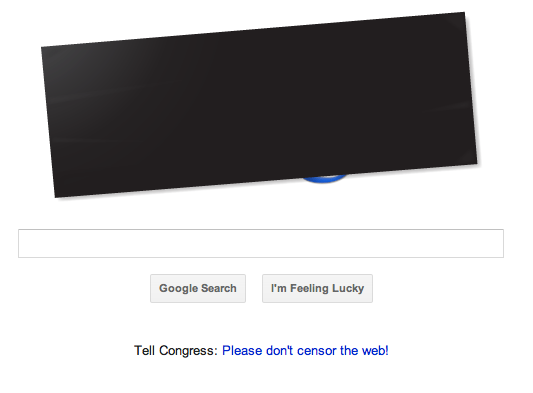
As you may have noticed by now, Wikipedia’s English-language site is (mostly) down for the day to protest SOPA and PIPA, two draconian anti-copyright infringement laws moving through Congress, and Google’s home page looks like this:

Under existing law (the DMCA), if someone posts copyrighted material in a comment on this blog, the copyright holder is supposed to send me a takedown notice, after which point I am supposed to take the material down (if it is in fact copyrighted).

SOPA and PIPA are bills in the House and Senate, respectively, that make it much easier for “copyright holders” (like the big media companies that back the bill—or, come to think of it, authors like me) to take action not only against “bad” web sites that make copyrighted material available (against the wishes of the copyright holders), but also against web sites that simply link to such “bad” web sites. For example, the copyright holder can require payment network providers (PayPal, credit card networks) to block payments to such web sites (in either category above) and can require search engines to stop providing advertising for such web sites—simply by sending them a letter. That’s SOPA § 103(b).*

Continue reading “The End of the Blog?”

What Government Aid?

By James Kwak

Earlier this year I wrote about a paper by Suzanne Mettler that included a survey showing that a large proportion of beneficiaries of government programs insist that they have never been beneficiaries of any “government social programs”—60 percent for the mortgage interest deduction and 44 percent for Social Security retirement benefits, for example. This provides ample evidence that “keep your government hands off my Medicare” is not a fringe opinion.

Recently, I read Mettler’s book, and there’s more to the story. One of her arguments is that hiding government programs in the tax code undermines the democratic system because it obscures the role that government plays in society. There were two quantitative examples I thought were particularly revealing.

Continue reading “What Government Aid?”