Profits in Finance

By James Kwak

Noah Smith on one reason why financial sector profits have remained high as the industry has grown:

Why haven’t asset-management charges gone down amid competition? In a recent post, I suggested one answer: people might just be ignoring them. Percentage fees sound tiny — 1 percent or 2 percent a year. But because that slice is taken off every year, it adds up to truly astronomical amounts. … If many investors pay no attention to what they’re being charged, more competition can’t push down those fees.

I think that’s basically right, but there’s a smidgeon more to it. Expense ratios on actively managed mutual funds have remained stubbornly high. Even though more people switch into index funds every year, their overall market share is still low—about $2 trillion out of a total of $18 trillion in U.S. mutual funds and ETFs. Actively managed stock mutual funds still have a weighted-average expense ratio of 86 basis points.

Why do people pay 86 basis points for a product that is likely to trail the market, when they could pay 5 basis points for one that will track the market (with a $10,000 minimum investment)? It’s probably because they think the more expensive fund is better. This is a natural thing to believe. In most sectors of the economy, price does correlate with quality, albeit imperfectly. It’s also natural to believe that some people are just better than others at picking stocks, just like Stephen Curry is better than other people at playing basketball. Finance and economics professors can talk all they like about nearly-efficient markets, the difficulty of identifying the people who can generate positive alpha, and the fact that you have to pay through the nose to invest your money with those people (like James Simons), but ordinary investors just don’t buy it. And this is one area where I think marketing does have a major impact, both in the form of ordinary advertising and in the form of the propaganda you get with your 401(k) plan.

So while some people are no doubt ignoring the fees, others are probably saying, “Sure the expense ratio is 100 basis points, but look at the past performance!” (Anyone who makes decisions based on past performance—that is, most people—is taking fees into account to some extent, since published mutual fund returns are almost always net of fees.) So the persistence of high fees is partly due to the difficulty of convincing people that markets are nearly efficient and that most benchmark-beating returns are some product of (a) taking on more risk than the benchmark, (b) survivor bias, and (c) dumb luck.

The Root of All Our Problems?

By James Kwak

A friend pointed me toward an op-ed in The Guardian by George Monbiot titled “Neoliberalism—The Ideology at the Root of All Our Problems.” The basic argument is that there is an ideology that has had a pervasive influence on the shaping of the contemporary world. Its policy program includes “massive tax cuts for the rich, the crushing of trade unions, deregulation, privatisation, outsourcing and competition in public services.” Monbiot calls this cocktail “neoliberalism” (more on the name later).

There’s a lot in the article that I agree with. The political and economic takeover of the Western world by the super-wealthy was not accomplished by force, nor by rich people simply demanding a larger slice of the proverbial pie. Instead, it happened because many people—particularly in the media, the think tank intelligentsia, and the political community—internalized the idea that competitive markets provided the solution to all problems. (The idea that unfettered capital markets and financial innovation would be good for everyone, which helped produce the financial crisis, is only a special case of this larger phenomenon.)

I like Monbiot’s framing of how this works:

So pervasive has neoliberalism become that we seldom even recognise it as an ideology. We appear to accept the proposition that this utopian, millenarian faith describes a neutral force; a kind of biological law, like Darwin’s theory of evolution.

Sometimes it does seem like evolutionary biology and the simply model of supply and demand are the two most common models that people turn to when trying to explain things they don’t really understand.

Continue reading “The Root of All Our Problems?”

Hamilton Everywhere, All the Time

By James Kwak

Alexander Hamilton is a big deal these days. Apparently there’s a musical about him—something I only found about when I saw Lin-Manuel Miranda’s Rose Garden video on Twitter (which tells you something about my relationship to popular culture). In their new book (on which more later), Jacob Hacker and Paul Pierson invoke Hamilton to defend their vision of an interventionist government and a mixed economy.  And Stephen Cohen and Brad DeLong have titled their new book Concrete Economics: The Hamilton Approach to Economic Growth and Policy.

I like to think that Simon and I were on the leading edge of this mini-trend when we featured Hamilton in our 2011 Vanity Fair article and in White House Burning. But it’s no surprise that people turn to Hamilton today, when what used to be known as the Tea Party (now simply the Republican Party) dreams of recreating a libertarian founding moment that never existed. Hamilton stood for a (relatively) strong central government, deficit spending, and what would now be called industrial policy, all with the intent of fostering economic growth.

Concrete Economics is less about Hamilton’s particularly approach to economic policy than about an overall attitude of which Hamilton cited as an exemplar: in short, a pragmatic rather than ideological approach to policymaking, one which used government resources and power to pursue specific goals. The best contrast is between the Republican Party c. 1955—which used state power to suburbanize the country, build up the military, and spin off the technologies that turbocharged productivity growth—and the Republican Party of the past 35 years, which (along with a considerable amount of Democratic abetting), which slashed government spending and deregulated the financial sector for ideological reasons (free flow of capital, free markets, blah, blah, blah).

Continue reading “Hamilton Everywhere, All the Time”

“Economics” as Push Poll

By James Kwak

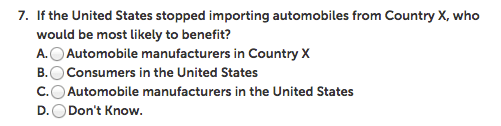
Matthew Klein of Alphaville called out the “Council of Economic Education” for a supposed “economic literacy” quiz that wrapped up free market ideology in the trappings of universal economic truth. The quiz is full of questions like this one:

Screen Shot 2016-03-29 at 2.28.07 PM

If you know a little bit of economics, and you know how to answer multiple-choice tests, it’s clear that you’re supposed to choose “C”—the point being that trade helps consumers, and limits on trade help domestic competitors. But, as Klein shows, these types of simple, first-order answers may or may not apply to the real world. For question 7, for example, you would have to know why the United States stopped importing automobiles from Country X.

What the Council of Economic Education really came up with here is a push poll: a set of questions intended to convey a certain message. The message is that complicated policy issues can be reduced to multiple choice questions which, in turn, can be answered using a handful of simple models from an Economics 101 class. But you can only answer the questions “correctly” if you assume that those models accurately depict the behavior of individuals and firms in the real world. Then everything becomes easy: trade is always good for all parties, taxes and regulations (like rent ceilings) are always bad, and competition is always good for consumers.

This idea that all questions can be answered using a few diagrams from introductory economics has been pushed by business organizations since World War II. That was the principle behind the Foundation for Economic Education, which helped sponsor Ludwig von Mises and Friedrich Hayek; behind 1950s’ economic education programs in the sponsored by the National Association of Manufacturers and large corporations (often to captive audiences of employees); and behind business-sponsored teaching kits distributed to thousands of schools. (For the full story, see Selling Free Enterprise, by Elizabeth Fones-Wolf.) In each case, the motivation was the same: teach people a streamlined, fact-free version of the competitive market model, and they will understand why free markets are always good and government intervention is always bad.

The problem, of course, is that the real world is rarely so simple. But if you can get lots of people to learn a little bit of economics, you can convince them that trade agreements are always good (comparative advantage!) and that the minimum wage is always bad (price floor!). I’m all in favor of education—I’m in the business, after all. A lot of what the Council for Economic Education does may be valuable. But multiple choice is not the right answer to real problems.

Why I’m Voting for Bernie Sanders on Tuesday

By James Kwak

I’ve written various generally supportive things about Bernie Sanders, but I hadn’t actually decided whether I preferred him or Hillary Clinton as the Democratic nominee. I’ve been concerned about the electability thing, as well as the effectiveness thing. (I haven’t given money to either candidate because of a promise I made when neither lifted a finger to help Larry Lessig get into the debates.) But I’m voting for Sanders.

Obviously, I prefer Sanders’s positions on the big issues. Government-funded health care for everyone, universal pre-K education, affordable higher education for everyone, mandatory family and medical leave, a higher minimum wage, higher taxes on people like me—what’s not to like? I have concerns about some things around the edges, like ripping up existing trade agreements (I won’t call them free trade agreements, because they are often far from it), but there has not been a serious candidate in my lifetime with such a bold and progressive vision for America.

Clinton, by contrast, stands for . . . what again? She is running as the pragmatic defender of the Clinton-Obama status quo—which is to say, slightly to the right of the Nelson Rockefeller wing of the Republican Party. Her message is basically this: I’m the only serious person in this race; it’s me, or the sack of Rome by the barbarians and one thousand years of darkness. And so, the Clinton side’s case boils down to saying, sure, we want the same things Sanders wants (lower inequality, higher wages for working people, affordable health care for everyone), but Sanders’s ideas are naïve, or impractical, or arithmetically challenged, or, worst of all, not acceptable to Paul Ryan.

So let me say a few words about that.

Continue reading “Why I’m Voting for Bernie Sanders on Tuesday”

Just Saying We’re Great Doesn’t Make It So

By James Kwak

David Brooks has competition for the title of most inane New York Times columnist. I generally never read anything by Thomas Friedman—I gave up less than one hundred pages of The World Is Flat because of his blissfully uninformed discussion of workflow software—but I made an exception today because of this brilliant tweet by Benjamin Kunkel:

I mean, I co-founded a company, and it’s not as if we had a secret laboratory churning out clones to work for us. One reason we founded the company when we did—2001, after the collapse of the technology bubble—was that we knew there were many talented people out there looking for a satisfying and challenging place to work. (One of the things I’m most proud of is that that, fourteen years later, my old company is still one of the best places to work in the economy.) In other words, skilled and motivated people (most of whom already have jobs) are a precondition for entrepreneurialism.

I assume Friedman’s point is that to have new jobs, you have to have people willing to take risks and start businesses. Of course, this isn’t completely accurate, since big companies often keep getting bigger and hiring new people. But I agree with the general point that entrepreneurial activity is a good thing. However, Friedman presents as undisputed fact this quotation from a report:

With enough hard work anyone can use entrepreneurship to pave their own way to prosperity and strengthen their communities by creating jobs and growing their local economy.

Does Thomas Friedman really think that literally anyone can become rich just by working hard and “using entrepreneurship”? Anyone?

Continue reading “Just Saying We’re Great Doesn’t Make It So”

Quick Thought on New Hampshire

By James Kwak

From the Times (order of quotations reversed):

Mr. Sanders was the choice, nearly unanimously, among voters who said it was most important to have a candidate who is “honest and trustworthy.”

[Clinton] has gone so far as to promise to rethink and adjust her campaign strategy in hopes of connecting better with Democrats.

Part of the problem is that the Clintons have spent more than twenty years trying to say what their pollsters tell them people want to hear. When people no longer believe in the political class, feel (rightly or wrongly) like the government is controlled by distant socio-economic elites, and want someone “honest and trustworthy,” another round of message calibration is not going to fill the gap. If Clinton emerges from New Hampshire as the champion of the working man, it will be about as convincing as Al Gore’s desperate rebranding as a populist in late 2000.

Why Are We Beating Up on Single Payer?

By James Kwak

Single-payer health care has emerged as the primary symbol of the differences between Bernie Sanders and Hillary Clinton. For his supporters, Sanders’s plan is the centerpiece of his vision of a European-style, social-democratic society in which health care is a right that is fully funded by largely progressive taxes. For Clinton supporters, it is the best example of Sanders’s misguided utopianism—a naive plan that has no chance of passage and that would be less effective than incremental improvements to Obamacare.

The Clinton camp has been ecstatic about a critical analysis of Sanders’s plan by Kenneth Thorpe, a health care expert who has supported single payer in the past. Thorpe argues that the plan is underfunded by more than $1 trillion and, if fully funded, would cause most people to pay more for health care than they do today. Thorpe’s analysis was publicized by Dylan Matthews and highlighted by Paul Krugman as further evidence that all the serious people support Clinton. Clinton herself likes to say, “The numbers just don’t add up.”

I have a few points to make about Thorpe’s analysis and what we should take from it. The first, simplest, and most obvious is this: Even if Sanders’s plan has problems, if the goal is single payer, then Sanders is the only choice. We know a Clinton nomination will bring us no closer to single payer. A Sanders nomination will bring it within the spectrum of future possibilities, even if it won’t be passed in the next two years. (Remember Newt Gingrich’s crazy plan to voucherize Medicare in 1995? Well, now it’s not that far from passage.) A Sanders presidency would make it possible to develop a better, more realistic plan; that’s what advocates of single payer should be hoping for.

Continue reading “Why Are We Beating Up on Single Payer?”

Donald Trump Is Running as a Conservative Republican

This guest post was written by Lawrence Glickman, Professor of History at Cornell University (and a friend from long ago when we were both graduate students at Berkeley).

As the summer of Trump turned into a phenomenon for all seasons, the Donald’s typical stump speech has grown into a bloated piece of performance art, lasting about one hour. A lot of that time is filled with bluster about how well he is doing in the polls, about how The Art of the Deal is his favorite, I mean second favorite book, after the Bible. And usually there are several more comments along the lines of, “by the way did I mention I’m doing well on the polls.”

In his speech in Des Moines on February 1, the evening of the Iowa caucus, Trump had to radically distill his campaign pitch into a two minute appeal. Presumably the pithiness forced him to highlight the most important parts of his campaign message. So what did he say? What can his candidacy be boiled down to? It turns out that for all the talk about Trump’s “populism” and his embrace of unorthodox positions, he offered talking points would have been familiar at a Rubio, Cruz, or for that matter, Jeb! rally.

Trump began by saying that “Obamacare is going to be repealed and replaced.” Then, he observed about the government that “everything that we’re doing has been wrong.” After condemning our unsustainable debt (“we owe 19 trillion dollars”) he discussed misplaced and wasteful priorities: “the budget that we just approved…funds everything that all of us in this room don’t want to see it fund.” He complained about the Iran deal and discussed the need to “build a wall” along the Mexican border.

Other than Trump’s signature claim that “Mexico is going to pay for the wall,” there was nothing outside the Republican mainstream in his litany. Compared to the other Republican candidates, who regularly spout apocalyptic rhetoric about ISIS or about dangerous trends in government overreach, his view that “we’re in trouble” seems completely in tune with the GOP chorus. Trump, being Trump, did toot his own horn, although, he assured the audience, not in a “braggadocious way” by talking about his “great, great company.” But that was only to highlight his credentials to run the country “the way it’s supposed to be run,” presumably in a business-like manner.

Continue reading “Donald Trump Is Running as a Conservative Republican”

The Future of the Democratic Party

What liberals can learn from conservatives

The future of the Democratic Party is the theme of the lead article in yesterday’s New York Times. The story more or less writes itself: you have Hillary Clinton, the face of the moderate Democratic establishment (and the spouse of the man who created it), versus Bernie Sanders, a socialist, in a battle most people thought she would have wrapped up months ago.

A lot of liberals like me spend our time wondering what the conservatives have done right—and why we can’t do it ourselves. The financial crisis and Great Recession should have debunked the ideology of deregulation, reinforced growing feelings of economic insecurity, and made people recognize the importance of the social safety net. Instead, we got the Tea Party and the most conservative Congress in living memory.

Seen in the broader sweep of history, conservatives have been relentlessly pushing the nation’s political agenda to the right on most issues (gay rights being almost the only exception), even as public opinion on most social and economic issues remains largely unchanged. Marco Rubio—just four years ago a darling of the Tea Party—is now the last hope of the Republican “moderate” establishment: what other proof is needed of the success of conservative ideology? Sure, extremism makes it hard for Republicans to win presidential elections. But although Democrats have won four and a half out of the past six contests, the result has been lower taxes on the wealthy, smaller government, no progress on climate change or gun control, and a solidly conservative federal judiciary.

So why can’t we do the same?

Continue reading “The Future of the Democratic Party”

Mark Zuckerberg’s $45 Billion Loophole

Much of the Internet is giddy over Mark Zuckerberg and Priscilla Chan’s “pledge” to give “99%” of their Facebook stock to “charity.” Bill and Melinda Gates said, “The example you’re setting today is an inspiration to us and the world.” Unfortunately, it’s not a very good example.

Since the last gilded age, the super-rich have generally given to charitable organizations or to their own charitable foundations. That’s why we have the University of Chicago, Carnegie Hall, and the Getty Center, to name a few. Today’s new class of gazillionaires has largely followed in their footsteps: Gates created the Bill and Melinda Gates Foundation, Stephen Schwarzman gave $150 million to Yale, John Paulson gave $100 million to Central Park, and so on.

Well, Mark Zuckerberg has found a different way.

Instead, he’s creating an LLC that he owns (the Chan Zuckerberg Initiative), giving his stock to the LLC, and telling us all that the LLC will do wonderful things for the world.

Quick primer: A limited liability company is just a type of business organization, like a partnership or a corporation. It has owners, who control it, either directly or through managers whom they appoint. It can do anything that any other profit-seeking business can do. It doesn’t pay taxes; instead, its profits, losses, or deductions simply get transferred to its owners’ tax returns. Its primary advantage is that it is extremely flexible: you can design an LLC more or less any way you want.

So let’s say Zuckerberg and Chan give 99% of their stock to their LLC. What does that really mean?

First off, “give” is the wrong word to use in this context. That implies that the money is irrevocably going from them to something else.

In this case, they are investing in their own company. Because it’s an LLC, they still have complete control of the money.

That means they can, among other things:

  • Write checks from the LLC to themselves as its owners, pay themselves salaries for running the LLC, borrow money from the LLC, borrow money personally using LLC shares as collateral, sell some of their shares in the LLC to other people, or take cash right back out in many other ways.
  • Use the LLC to buy houses they live in, offices that they work in, etc..
  • Invest in profit-making companies.
  • Contribute to political campaigns or super PACs, engage in direct political activity, or lobby legislators.
  • Pay for his own political campaigns, if he so chooses.
  • Give money to charitable foundations or operating 501(c)(3) nonprofit organizations.

Essentially, Zuckerberg can do everything with the LLC’s money that he can do with his own money. So on the most substantive level, he hasn’t done anything except announce some vague intentions. The “99%” claim made a lot of headlines, but there’s a lot less there than meets the eye. A lot of things that other billionaires do with their own money—like invest in other companies—Zuckerberg can now do with the LLC’s money. The only thing he seems to be saying is that he and his family will restrict their personal consumption to 1% of his fortune (about $450 million), but even that is not entirely clear. He certainly retains the ability to take money back out whenever he wants, and the LLC will almost certainly do some things that really are personal consumption (like political contributions). In addition, whenever the LLC makes a contribution to a real charity, the associated tax deduction will flow back up to Zuckerberg and Chan. So to the extent that they have to sell stock to pay for their consumption, they will never pay tax on those sales. (Put another way, their remaining $450 million, as well as any money they make in the future, is now all after-tax money.)

Is this really so bad, though? I mean, he says he will use the LLC to make the world a better place.

But compare what he’s doing to what past tycoons, up to and including Bill Gates and Warren Buffett, have done. They donated directly to charitable organizations or to charitable foundations. There are a lot of criticisms you can make of the current “charity” system that exists because of the tax deduction for contributions: a lot of recipient organizations do little good for society, some do harm (like the NRA’s 501(c)(3)), and the tax deduction directs money from productive investments to mega-rich institutions like Harvard University. But Gates and his predecessors at least agreed to play by certain rules: not to take the money back if they changed their minds, not to use it to further increase their wealth, not to use it influence the political system (although that rule has some loopholes), and so on. The idea was that if you became a multi-billionaire, you would relinquish some of your control over a large chunk of your wealth and irrevocably dedicate it to attempting to improve society, according to rules that society has agreed on. That’s what the Giving Pledge was all about.

Mark Zuckerberg doesn’t want to play by the rules. He thinks he can do a better job. Maybe he can, although I don’t have any reason to believe that’s true. This is the next step in the privatization of philanthropy. No more Giving Pledge. Instead, we’ll have the Keeping Pledge:

I pledge to keep all of my wealth and use a lot of it to make the world better place, as long as I get to define “a lot” and “better.”

Mark Zuckerberg isn’t the first person to make the Keeping Pledge. The Koch brothers already did: they’ve given away lots of money to charity, but they’re keeping even more to spend on politics, because they believe that that’s the most effective way to make the world a better place (as they see it).

Zuckerberg’s LLC’s investments may end up having as much positive impact on the world as the Gates Foundation’s (although I’m not sure how high a bar that is to begin with). Most likely we’ll never be able to evaluate it in any kind of definitive way. But it is certain to have a different impact in the short term. Other super-rich people will feel no pressure to sign onto the Giving Pledge or donate their money to the traditional charity system. Instead, they will create their own LLCs, maintain complete control over their money, and spend it on their own pet projects and political issues. That’s not a good thing.

Also posted on Medium.
Request from Two JMU Professors for Help with a Research Project

By James Kwak 

I received the following this morning and thought it was interesting.

We are writing to ask your help in bringing some empirical measurement to the long-standing question: On matters of economic policy, do liberals understand conservatives better than conservatives understand liberals, or is the reverse true?  In response to Krugman’s claim that liberals have the edge in understanding rival views (http://fivebooks.com/interviews/paul-krugman-on-inspiration-liberal-economist), Caplan disagreed and suggested a type of ideological Turing test to measure the ability of individuals to “state opposing views as clearly and persuasively as their proponents” (http://econlog.econlib.org/archives/2011/06/the_ideological.html).  Specifically, could it be determined whether one is conservative or liberal through an online question-and-answer exchange?

Although we are unable to conduct the ideal test, we have developed a multiple-choice version of this Turing-like economic policy test. At http://econturingtest.com, we have posted a ten-question economic policy test. Respondents will take the test and then anonymously report some information about themselves. With the statistical results, we hope we can shed some light on this research question.

We have received approval from our Institutional Review Board (approval No. 16-016) to offer this online survey. Now all we need is traffic to the website, and that’s why we’re appealing to you now. We are asking the top 30 economics blogs in 2012 and 2013 according to the Onalytica rankings to post a note for us. When our study is complete, we will be providing results to all who ask and seeking appropriate publication outlets.

Thanks in advance for any help you may be able to offer. If you have questions, please let us know.

Sincerely,
William Wood and Angela Smith
James Madison University-Economics

My thoughts after taking it are after the break …

Continue reading “Request from Two JMU Professors for Help with a Research Project”

Talking About Inequality …

By James Kwak

How about this?

In Georgia, you can get a life sentence for a second or succeeding drug offense.

Right now, there are 375 people serving those life sentences. 369 of them—more than 98%—are African-American.

There’s no population base rate that can explain that discrepancy. One justice on the Georgia Supreme Court found that an African-American with two or more drug priors is 28 times as likely to get a life sentence than a white person with the same record.

Or this?

Continue reading “Talking About Inequality …”

60% of Ted Cruz‘s Tax Cut Goes to the Top 1%

By James Kwak

I haven’t been commenting on Republican tax plans this season because, well, it takes a lot to impress me when it comes to absurd tax cut proposals. Ted Cruz has done it.

The major components of Cruz’s plan amount to this:

  • A flat 10% tax on individual income (labor and investments)—down from top rates today of 43.4% on labor and 23.8% on capital gains and dividends
  • No payroll taxes (15.3% for most people today), corporate income tax (average rate about 13% today), or estate tax
  • A 19% value-added tax (16% of gross business receipts, including the tax)

There are two big things that are crazy about this plan.

The first is that it eliminates an enormous amount of tax revenue: $3.6 trillion over ten years, according to the right-wing Tax Foundation’s “static” analysis—that is, before the growth fairy waves her magic wand. To put that in context, that’s more than we plan to spend on the military over the next ten years.

The second is the astonishingly naked handout to the very rich:

60% of the tax cut goes to the top 1%.

That leaves only 40% for everyone else.

Continue reading “60% of Ted Cruz‘s Tax Cut Goes to the Top 1%”

Hillary Clinton’s Lame Wall Street “Reform” “Plan”

By James Kwak

Hillary Clinton is competing for the nomination of a party whose progressive base thinks, with considerable justification, that her husband is to blame for letting Wall Street run amok—and that Barack Obama, under whom she served, did too little to rein in the bankers who torpedoed the global economy. On top of that, she faces a competitor who says what the people actually think: that the system is rigged, that big banks should be restrained, and that people should go to jail.

So she has no choice but to try to appear tough on Wall Street—but she has to do that without simply jettisoning twenty-five years of “New Democrat” friendliness to business and without alienating the financial industry donors she is counting on. So the “plan” she announced yesterday has two messages. On the one hand, she wants to show that she has the right approach to taming Wall Street. Unfortunately, it’s just more of the same: another two dozen or so regulatory tweaks, mainly of the arcane variety, that will produce more of the massive, loophole-ridden rules that Dodd-Frank gave us.

Or, that could be the point. Her second message is a promise to the financial industry that, instead of real structural reforms, she will continue the technocratic incrementalism of the Geithner era—which has left the megabanks more or less the way they were on the eve of the financial crisis. Maybe, for her base, that’s a feature, not a bug.

For more, see my latest column for The Atlantic.