The Price of Apple

By James Kwak

Last week, This American Life ran a story about the Chinese factories that produce Apple products (and a lot of the other electronic devices that fill our lives). It featured Mike Daisey, a writer and performer who traveled to Shenzhen, China, to visit the enormous factories (more than 400,000 people work at Foxconn’s, according to the story*) where electronic products are churned out using huge amounts of manual labor.

I’m sure that most of us already realized, on an intellectual level, that the stuff we buy is made by people overseas who, in general, have much less than we do and work harder than we do, under tougher working conditions. It’s harder to ignore, however, listening to Daisey talk about the long shifts (up to thirty-four hours, apparently), the crippling injuries due to repetitive stress or hazardous chemicals, the crammed dormitories, and the authoritarian rules. At one point an interviewee produces a document, produced by the Labor Relations Board (with the name of the Board on it): it’s a list of “troublemakers” who should be fired at once.

Continue reading “The Price of Apple”

Correlation, Causation

By James Kwak

XKCD (blacked out until tomorrow).

Economix has a table listing undergraduate majors by the percentage of graduates in each major that are in the “1 percent” (by income, which I think is less important than by wealth). The data are interesting, but I don’t think it’s correct to say that “the majors that give you the best chance of reaching the 1 percent are pre-med, economics, biochemistry, zoology and, yes, biology, in that order.”

All of the pre-med/life sciences majors (numbers 1, 3, 5, 8, and 11 on the list) do arguably increase your chances of making the 1% because they help you become a doctor, and many specialists are in the 1%. Of course, since many science majors are considered more difficult by undergraduates, you could argue that the inherent traits people bring to college are just as important as the majors they choose. Economics is #2, but that’s in part because many of the people who want to be in the 1 percent major in economics.

But the interesting cases are art history (#9), area studies (#12), history (#14), and philosophy (#17), all of which are disproportionately represented in the 1%. (History, for example, ranks right behind finance.) I don’t think anyone would argue that knowledge of art history is likely to earn you a high income; there just aren’t that many executives at Sotheby’s and Christie’s. I think what’s going on is that these are the kinds of things that people study at elite schools—in particular, if you’re not that worried about what you’re going to do after graduation. These are not the things that most people at normal schools study. In 2009, for example, art history didn’t even show up on the list of majors (it’s probably tucked into “liberal arts and sciences, general studies, and humanities,” which came in 11th), area studies was one of the least popular majors, and so was philosophy.

So there are two possible reasons why these people make the top 1 percent. One is that they are talented, hardworking people who succeed (financially) despite what they majored in—but then why are talented, hardworking people overrepresented in these majors? The other is that they are children of the elite who go to elite schools, study whatever they feel like, and succeed because of their upbringing and connections. (The reasons are not mutually exclusive.) Given the increasing evidence that America, the land of opportunity, is actually one of limited social mobility, I think we can’t overlook the latter explanation.
The End of the Blog?

By James Kwak

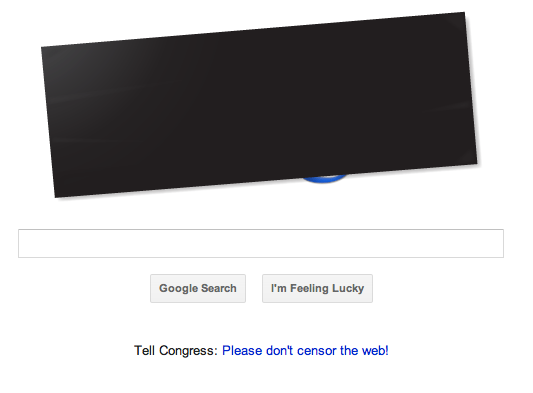
As you may have noticed by now, Wikipedia’s English-language site is (mostly) down for the day to protest SOPA and PIPA, two draconian anti-copyright infringement laws moving through Congress, and Google’s home page looks like this:

Under existing law (the DMCA), if someone posts copyrighted material in a comment on this blog, the copyright holder is supposed to send me a takedown notice, after which point I am supposed to take the material down (if it is in fact copyrighted).

SOPA and PIPA are bills in the House and Senate, respectively, that make it much easier for “copyright holders” (like the big media companies that back the bill—or, come to think of it, authors like me) to take action not only against “bad” web sites that make copyrighted material available (against the wishes of the copyright holders), but also against web sites that simply link to such “bad” web sites. For example, the copyright holder can require payment network providers (PayPal, credit card networks) to block payments to such web sites (in either category above) and can require search engines to stop providing advertising for such web sites—simply by sending them a letter. That’s SOPA § 103(b).*

Continue reading “The End of the Blog?”

Refusing To Take Yes For An Answer On Bank Reform

By Simon Johnson

The debate over megabanks and – in the aftermath of the 2008 financial crisis – how to deal with all the problems associated with “too big to fail” in the financial sector has not been easy for many politicians.  The problems and potential real solutions do not map readily into the standard left vs. right divide in American politics.

The left generally wants the state to do more, and these days most of the right usually wants the state to do much less.  But in this space regulators are “captured”, meaning that too many of them are effectively working to promote the interests of the big banks rather than to limit the dangers to the rest of us – so “more regulation” does not make much sense.  And these big banks have a strong incentive to get even bigger – it’s their size that gives them economic and political power.  If you leave these banks to their own devices, they will become even bigger and blow themselves up at greater cost to ordinary citizens (see Western Europe for details).  So “no regulation” is also not an appealing proposition.

As a matter of presidential year politics, there is a remarkable convergence between President Obama and Mitt Romney, the Republican frontrunner.  Both think that we can tweak the rules to keep the banks from becoming dangerous.  The Obama administration calls their approach “smart regulation”, while Mr. Romney has spoken of repealing the Dodd-Frank financial reform legislation (although his website is devoid of any further specifics).  But as far as anyone can see, their proposed approaches for the next four years are very similar – relying on the state to play a particular oversight role that has not gone well in recent decades.  They are both “statist” in this very particular sense. Continue reading “Refusing To Take Yes For An Answer On Bank Reform”

Ron Paul And The Banks

By Simon Johnson

We should take Ron Paul seriously. The Texas Congressman had an impressive showing in the Iowa caucuses on Tuesday and his poll numbers elsewhere are resilient – he is running a strong third nationally, but looks like to come in second in New Hampshire.  He may well become the Republican politician with populist momentum and energy in the weeks ahead.

Mr. Paul also has a clearly articulated view on the American banking system, laid out forcefully in his 2009 book, End the Fed.  This book and its bottom line recommendation that we should return to the gold standard – and abolish the Federal Reserve system – tends to be dismissed out of hand by many.  That’s a mistake, because Mr. Paul makes many sensible and well-informed points.

But there is a curious disconnect between his diagnosis and his proposed cure.  This disconnect tells us a great deal about why this version of populism from the right is unlikely to make much progress in its current form. Continue reading “Ron Paul And The Banks”

Correction to Long-Term Debt Projections

By James Kwak

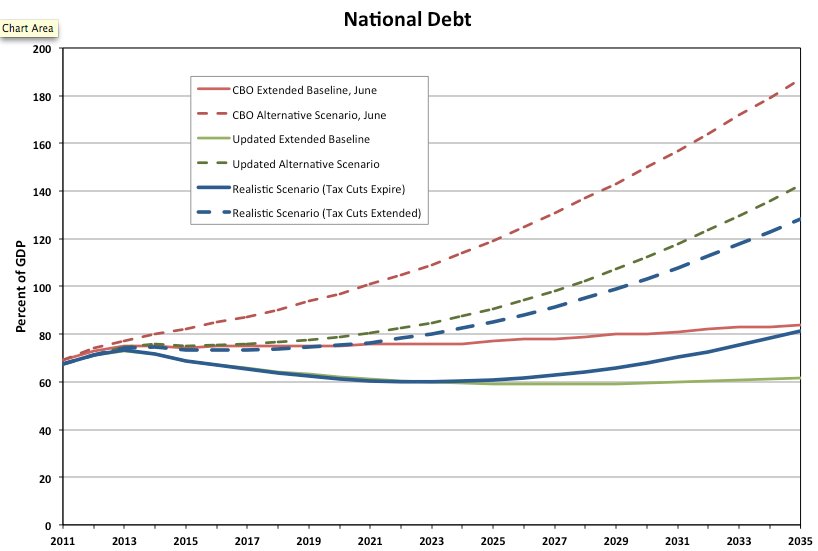
Back in October, I wrote a post laying out my long-term projections for the national debt, which were basically an adjustment to existing CBO projections. Peter Berezin recently pointed out a misleading ambiguity in that post. There, I used the same long-term growth rate of tax revenues in both my extended-baseline scenario and in my “realistic” scenarios. I got that long-term growth rate from the CBO’s extended baseline scenario in its 2011 Long-Term Budget Outlook, which assumes that current law remains unchanged.

In my realistic scenarios, I assumed that the AMT would be adjusted through 2021 but that the long-term growth rate would apply thereafter. I didn’t say anything explicitly about the AMT after 2021, but by using the long-term growth rate from the extended baseline, I was implicitly assuming that the AMT would not be indexed after 2021.

Continue reading “Correction to Long-Term Debt Projections”

State of Nature

By James Kwak

I’ve been reading a lot of books lately, some of which I’ve mentioned here: The Submerged State by Suzanne Mettler, Invisible Hands by Kim Phillips-Fein, The Wealth and Poverty of Nations (finally) by David Landes, Exorbitant Privilege by Barry Eichengreen, and a pile of books on the national debt and deficit politics. (Despite moonlighting as a blogger, I find books more satisfying than the constant stream of newspapers, magazines, and blogs.) But my favorite book I’ve read in a while is Railroaded: The Transcontinentals and the Making of Modern America, by the historian Richard White.*

For some people, most notably Rick Perry but also much of the conservative base, the late nineteenth century was the golden age: of the gold standard, no income tax, senators elected by state legislatures, and, most importantly, little to no government “regulation” of business. White shows what that world was really like.

Continue reading “State of Nature”

No One Is Above The Law

By Simon Johnson

The American ideal of “equal and impartial justice under law” has repeatedly been undermined by attempts to concentrate power.  Our political system has many advantages, but it also provides motive and opportunity for resourceful people to become so strong they can elude the legal constraints that bind others.  The most obvious example is the oil and railroad trusts at the end of the nineteenth century.  A version of the same process is happening again today but what has become concentrated is not a vital energy source or the nation’s transport arteries but rather something much more abstract: financial sector risk.

In early 2009, Treasury Secretary Timothy Geithner reportedly said to President Obama and senior members of the new administration, with regard to the financial system:

“The confidence in the system is so fragile still. The trust is gone. One poor earnings report, a disclosure of a fraud, or a loss of faith in the dealings between one large bank and another—a withdrawal of funds or refusal to clear trades—and it could result in a run, just like Lehman.” (from Ron Suskind’s Confidence Men, p.202)

Now three years later, the megabanks are even bigger, as is the risk they concentrate (see my recent testimony to the Financial Institutions subcommittee of the Senate Banking Committee for details.)  Curiously, their precariousness, as much as their power, is shielding these behemoths from the enforcement of financial fraud laws. Continue reading “No One Is Above The Law”

More on Long-Term Care Insurance

By James Kwak

After my previous post on the topic, a friend passed along a recent paper by Jeffrey Brown and Amy Finkelstein in the Journal of Economic Perspectives. I recommend reading it if you are interested in the topic because it provides a lot of good background information and explains some of why the market is the way it is.

They make some similar points to mine. For example (p. 138):

“First, the organization and delivery of long-term care is likely to change over the decades, so it is uncertain whether the policy bought today will cover what the consumer wants out of the choices available in 40 years. Second, why start paying premiums now when there is some chance that by the time long-term care is needed in several decades, the public sector may have substantially expanded its insurance coverage? A third concern is about counterparty risk. While insurance companies are good at pooling and hence insuring idiosyncratic risk, they may be less able to hedge the aggregate risks of rising long-term care utilization or long-term care costs over decades. In turn, potential buyers of such insurance may be discouraged by the risk of future premium increases and/or insurance company insolvency.”

They also show just how expensive private long-term care insurance is. By their calculations, the load on a typical policy is 32% (which means that the present value of benefits is only 68% of the present value of premium costs).  This is what you would expect in a thin market with a lot of adverse selection. (And one more note: The median cost of long-term care is a lot lower than in Massachusetts, the state I cited in my previous post. See this study to see where your state ranks.)

Continue reading “More on Long-Term Care Insurance”

Can We Afford Medicare?

By James Kwak

The conventional wisdom, repeated endlessly by the so-called serious people, is that we can’t afford traditional Medicare and hence it has to be radically overhauled (see Ryan-Wyden for the latest round). But I’ve never seen a convincing argument for why we can’t afford traditional Medicare. Yes, costs are rising as a share of GDP. But in principle, to make the case that we have to reform the program, you would have to argue that revenues can’t rise enough to keep pace—which in most cases, just shows that you don’t want revenues to rise enough.

More specifically, you have to know how big the Medicare deficit is and how fast it is rising. By my calculations, relying mainly on the 2011 Medicare Trustee’s report, the deficit was 1.7% of GDP in 2010 and will be 3.0% of GDP in 2040. So the argument that we can’t afford traditional Medicare relies on the proposition that this 1.3% of GDP is the straw that will break America’s fiscal back. Needless to say, this is nonsense, especially since other tax revenues not related to Medicare will be rising over the same time period, at least under current law. For all the details and sources, see my latest Atlantic column.

Medicare has its problems. But we have choices.

Where Is The Volcker Rule?

By Simon Johnson

Three years ago, a financial crisis threatened to bring down the United States economy – and to spread economic disaster around the world. How far have we come in preventing any kind of recurrence? And will the much-discussed Volcker Rule – attempting to limit the risks that big banks can take – play a positive role as we move forward?

Bad loans were the primary cause of the 2007-8 financial debacle. When the full extent of the problems with those loans became apparent, there was a sharp fall in the values of all securities that had been constructed based on the underlying mortgages – and a collapse in the value of related bets that had been made using derivatives.

The damage to the economy became huge because these losses were not dispersed throughout the economy or around the world. Rather, many of the so-called “toxic assets” were held by the country’s largest banks. Financial institutions that used to lend to consumers and businesses had instead become drawn into various forms of gambling on the booming mortgage market (as well as on commodities, equities and all kinds of derivatives). “Wall Street gets the upside, and society gets the downside” was the operating principle. Continue reading “Where Is The Volcker Rule?”

What Good Is the SEC?

By James Kwak

This week’s Atlantic column is my somewhat belated response to Judge Jed Rakoff’s latest SEC takedown, this time rejecting a proposed settlement with Citigroup over a CDO-squared that the bank’s structuring desk created solely so that its trading desk could short it. I think Rakoff has identified the heart of the issue (the SEC’s settlements are unlikely to change bank behavior, so what’s the point?) but he’s really pointing to a problem that someone else is going to have to fix: we need either a stronger SEC or stronger laws. I’d like to see an aggressive, powerful SEC that can deter banks from breaking the law, but we don’t have one now.

The Private Insurance Market

By James Kwak

I’m currently in the process of buying long-term care insurance—you know, so my daughter won’t have to take care of me when I’m old. I have a good agent who knows all about the market and has answered every question I’ve had. I understand personal finance, opportunity costs, discount rates, and inflation. I know my way around a spreadsheet (one benefit of my years at McKinsey). But I find it’s still hard to figure out what to do.

A bit of background: Long-term care insurance pays for your stay in a nursing home if you become unable to take care of yourself. Depending on the policy, it may also pay for care you receive at home instead of going into a facility. According to the insurer I’m considering, the median annual cost of a semi-private room in a nursing home in my state is $145,000, and the average stay is something like three years. To put that in perspective, in 2009, the median net worth of families where the head of household was of age 65–74 was $205,000 (including real estate assets).

Long term care is not covered by Medicare, except for a short period after each acute event. It is covered by Medicaid, but to be eligible for coverage you have to exhaust all of your assets. Despite that onerous requirement, Medicaid currently covers 40 percent of all spending on long-term care. (2011 Long-Term Budget Outlook, p. 39.) The Affordable Care Act of 2010 included what is known as the CLASS Act, which would have allowed anyone to buy long-term care insurance, with an average benefit of $75 per day, for a monthly premium of $123. The CLASS Act, however, has been suspended because the administration could not certify that it would be deficit-neutral over the long term. So the bottom line is: until you use up all your money, you’re on your own.

Still, shouldn’t you be able to buy protection in the private insurance market? The short answer is: not really.

Continue reading “The Private Insurance Market”