Geithner Plan vs. Paulson Plan

Dennis Snower works out the arithmetic behind the Public-Private Investment Program and shows something that we’ve suspected: if the assets are really toxic (the gap between book value and long-term expected value is big), the subsidy just isn’t big enough. He also shows that if the assets are only a little toxic, the government subsidy induces private sector bidders to overbid, making the subsidy bigger than it needs to be.

Snower’s hypothetical asset has an expected value of $50. According to his calculations:

  • If the bank has it on its books at $70, the private sector will bid it up to $85 because of the government subsidy. The government would have been better off under the original Paulson Plan (just buy it off the bank at book value, in this case $70).
  • If the bank has it on its books above $85, the private sector will not buy it at all and the plan will do nothing.

Now, his asset has different characteristics than the assets out there in the real world, whose expected values are not knowable, let alone known. That may change the analysis, but I doubt it changes the ultimate result.

Thanks to the reader who recommended this.

By James Kwak
CAFE, Part Two

In the same post I discussed yesterday, Keith Hennessey cites the same NHTSA report – the Final Rule governing CAFE standards for model years 2011-15, issued in January 2008 – to make this point: “The proposal will have a trivial effect on global climate change.” (It’s point 5 in his post, and was also picked up by Alex Tabarrok in his endorsement.) Hennessey cites the NHTSA report accurately, but the report itself is misleading.

What does the report say? Look at Table VII-12 on page 624. There are three scenarios that we are concerned with: No Action (which Hennessey calls, and I will call, “Baseline”); Optimized (“Bush Plan”); and Total Costs Equal Total Benefits (“Obama Plan”). If you want to know why Optimized is Bush and TC = TB is Obama, see my previous post. In the year 2100, the projected carbon dioxide (“CO2”) concentration in the atmosphere, in parts per million, is:

  • Baseline: 717.2
  • Bush: 716.2
  • Obama: 715.6

That’s pretty convincing – or is it?

Continue reading “CAFE, Part Two”

Real Time With Bill Maher, Tomorrow

Tomorrow evening I’m on Bill Maher’s HBO show, as part of a three person panel with Muhammad Yunus and Jon Meacham.  Bill runs a wide-ranging discussion covering pretty much anything that’s been in the news over the past week or so.  With Muhammad and Jon there, I’m sure we’ll get into issues of ethics and values – including whether we have let “the profit motive” become too central in our society.

In terms of other topics related to economics, my guess is we’ll talk about: Continue reading “Real Time With Bill Maher, Tomorrow”

The Economics of CAFE

Note: There are two somewhat significant updates at the bottom, just before the Appendix.

CAFE stands for Corporate Average Fuel Economy – the average fuel efficiency that is calculated annually for every manufacturer that sells cars or light trucks in the U.S. and compared to standards set by the National Highway Traffic Safety Administration, part of the Department of Transportation. (If you want to know more about how CAFE is measured, see the Appendix to this post.) Yesterday, President Obama proposed new, higher CAFE standards for models years up through 2016, by which point aggregate efficiency should reach 35.5 miles per gallon. 

The typical conservative response to regulations like this is that they impose costs on the economy. In this case the main argument is that mandating higher fuel efficiency standards makes cars more expensive to produce; so car companies have to charge more for them; so fewer people will buy cars, and fewer people will be employed in the auto industry. I was planning to try to pre-empt this argument, but Keith Hennessey, former head of the National Economic Council under Bush II, beat me to the punch. His post summarizes some findings from a 900-page report produced by NHTSA in January 2008, when the Bush administration released the latest version of the CAFE standards. One of his main points, taken from that report, is that the Obama standards will cost 49,000 jobs. That’s relative to some baseline that I haven’t been able to identify, but it’s 38,000 jobs more than the Bush standards. The table is on page 586 of the long report; the Bush plan is “Optimized” and the Obama plan is “TC = TB.” Hennessey’s post has been picked up by Marginal Revolution (where I found it) and by The New York Times, so I decided I should stay up late and write a response.

Continue reading “The Economics of CAFE”

Why You Should Read the Text, Not Just the Tables

Keith Hennessey, the last head of the National Economic Council before Larry Summers, has a blog post out (hat tip Alex Tabarrok) reviewing yesterday’s announcement by the Obama administration on their proposed new CAFE (Corporate Average Fuel Economy) standards. It links to a very informative report that I’m still digesting. (I was planning a post on the economics of CAFE for today, but now I need to read part of that report.)

Update: I found a mistake in the way Hennessey used a table and I posted about it here. Hennessey graciously acknowledged the mistake, fixed it on his post, and left a comment here. So I decided to delete my criticism. I really should have sent him an email first, and I feel bad about that. 

By James Kwak

Consumer Protection When All Else Fails (Written Testimony)

I took three points away from yesterday’s hearing in the House of Representatives.

  1. We need layers of protection against financial excess.  Think about the financial system as a nuclear power plant, in which you need independent, redundant back-up systems – so if one “super-regulator” fails we don’t incur another 20-40 percentage points in government debt through direct and indirect bailouts.  A consumer financial products protection agency should definitely be part of the package.  Update: The Washington Post reports that such an agency is now in the works; this is a big win for Elizabeth Warren, Brad Miller and others (add appropriate names below).
  2. Congress will work on this.  The intensity of feeling with regard to the need to re-regulate is striking, and there is much that resonates across the political spectrum.
  3. In the end, much of banking is likely to become boring again.  Special interests are convinced that they can fend off the regulatory challenge, but I find this increasingly unlikely.  Enough people have seen through what they did, how they did it, and what they keep on doing.  No doubt the outcomes will be messy and less than optimal, but at this point “less than optimal” is much preferable to “systemic meltdown”.

There is still much to argue about and, no doubt, there will be setbacks.  We’ll get a better or a worse system, depending on how the debate goes.  And if the external scrutiny slips away, so will point #3 above.  But this was still by far the most encouraging hearing I’ve so far attended.

The main points from my written testimony to the subcommittee are below.

Continue reading “Consumer Protection When All Else Fails (Written Testimony)”

First Buy High; Then Sell Low

On Monday last week, Old National Bancorp bought back the warrants it had granted Treasury as part of its participation in TARP, after buying back its preferred stock on March 31. Today, the New York Times ran a story saying that Old National only paid $1.2 million to buy back the warrants, while the warrants were almost certainly worth more.

The main authority cited by the Times was Linus Wilson, a finance professor at the University of Louisiana, Lafayette and a sometime commenter on this blog, so let’s go straight to the source.

Continue reading “First Buy High; Then Sell Low”

Economics of Sick Days

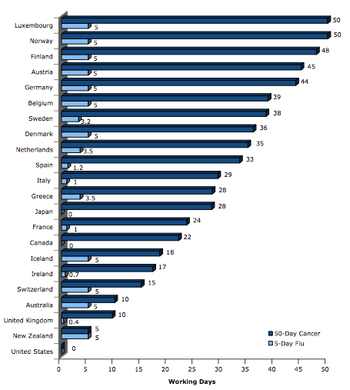
Ezra Klein is one of those bloggers, like Matt Yglesias or Andrew Sullivan, that sometimes make me want to just give up. Yesterday he started a new blog at the Washington Post, and promptly put up fifteen posts on his first day – and not the one line variety, either. Today, he brings us this chart from the Center for Economic and Policy Research:

sickdayschart-thumb-350x390

This is Klein’s explanation:

You’re seeing two things here. The light blue line measures paid sick days. This is what you use if you need to take three days off because you have a fever. The dark blue line is paid sick leave. This is what you use if you need to take three months off because you have cancer. Every other country on the list offers at least one. Most offer both. The United States is alone in guaranteeing neither.

Why does this matter? Because sick people without paid sick days go to work anyway, infecting others and increasing the virulence of epidemics. Or, when it comes to things like the common cold, they simply get more people sick, which sucks for them.

Continue reading “Economics of Sick Days”

Insolvency And Consumer Protection (House Testimony Today)

Congressman Brad Miller has some interesting ideas about how to respond to the financial crisis; not exactly on the same page as Treasury.  He’s called a hearing for this morning to talk about, in the first instance, how to assess insolvency in the banking system – and what to do about it (he chairs the Investigations and Oversight subcommittee of the House Committee on Science and Technology.)  But my guess is that the conversation will cover considerably more ground, including his idea that we establish a Financial Products Safety Commission.  (A full preview is now available at our joint venture with the Washington Post.)

The basic notion behind this commission is that consumers were taken advantage of by unscrupulous lenders.  Of course, you could also say that consumers fooled themselves, but if that is pervasive and has systemic implications then we need to take it on.  In his recent testimony before the Joint Economic Committee, Joe Stiglitz emphasized the need for more consumer protection, and this idea is also strongly advocated by Elizabeth Warren – against the odds, she continues to make some progress. Continue reading “Insolvency And Consumer Protection (House Testimony Today)”

Bankers Will Be Boys

Apparently, Anne Sibert has written an article at VoxEU describing three types of bad behavior committed by bankers that helped produce the crisis:

They committed cognitive errors involving biases towards their own prior beliefs; too many male bankers high on testosterone took too much risk, and a flawed compensation structure rewarded perceived short-term competency rather than long-run results.

I say “apparently” because I can’t get through to VoxEU despite trying three different browsers and two different computers (can’t ping it, either). But there’s a long summary over at naked capitalism

Everything she says sounds right, although the classification of three behaviors is a little frustrating, because they fall into three different categories. Confirmation bias is just part of the human condition; I’m not sure what we can do about that, short of inventing Cylons (and we know where that leads). Testosterone is part of the male branch of the human condition; so the potential solution is to have more female bankers. And flawed compensation structures are completely human creations, so we can definitely do something about them.

Continue reading “Bankers Will Be Boys”

Liquidity Crisis? Check

Remember the days of talking about the TED spread and interbank lending? So over. And apparently Sheila Bair said “the liquidity crisis is over for good.”

One way to look at the decline in interbank lending rates is that interbank lending has become safe again – because governments around the world have made it so abundantly clear that they will not let major banks default on their liabilities, no matter what happens. So what we have is interbank lending rates that are artificially suppressed by implicit government support.

In any case, I guess now we’ll find out if Tim Geithner was right that this is just a liquidity crisis, not a solvency crisis.

By James Kwak

Rating Agency Self-Defense

I’m drafting a post for The Hearing on credit rating agencies (the ones who gave AAA ratings to all those CDOs). The CEO of Fitch is giving this prepared testimony tomorrow. Here’s the question: Can anyone find anything in there that constitutes a constructive suggestion for how regulation of rating agencies could be improved? Or is it all just self-serving insistence that there is no problem? 

(My favorite part is on pages 6-7 where he says, effectively, “Don’t regulate us – regulate the issuers and underwriters instead!”

By James Kwak

New Cars, Mortgages, and Race

Like most forms of hardship in our society, the foreclosure crisis is disproportionately affecting minorities. The New York Times conducted a study of foreclosures in the New York area and found, among other things:

Defaults occur three times as often in mostly minority census tracts as in mostly white ones. Eighty-five percent of the worst-hit neighborhoods — where the default rate is at least double the regional average — have a majority of black and Latino homeowners.

Well, that might simply be a function of poverty: statistically speaking, minorities are more likely to be poor, and therefore more likely to become delinquent on their mortgages. But I don’t think it’s that simple.

Continue reading “New Cars, Mortgages, and Race”

Remember Chuck Prince!

This week the administration begins a serious behind-the-scenes charm offensive on its regulatory reform plans.  The argument seems to be: we are where we are on banks’ solvency/recapitalization, so let’s not argue about that; it’s time to strengthen financial regulation in line with our G20 commitments. 

But there is a serious dilemma lurking behind the foreshadowing, the rhetoric, and the talking points.  (Aside to Treasury: please find somone other than big financial players to endorse your next 100 days report; many taxpayers will find p.5 of your first report particularly annoying – if you don’t understand this point, you are too close to the big banks.) 

Here’s the problem.

Continue reading “Remember Chuck Prince!”