Category: Op-ed

“Paying for” Health Care Reform

This week’s Washington Post health care column is on the question of whether we can afford health care reform – meaning whether we can afford to subsidize poor and middle-class people who cannot otherwise pay for health insurance. This has a different meaning depending on you interpret “we” as the U.S. economy in general or the federal government, but in either case we think the answer is “yes.” Or at least, as far as the federal government is concerned, the answer is that we can’t afford not doing some form of health care reform, although it’s not certain that the reforms currently on the table will be sufficient to solve our government’s long-term fiscal problems.

In summary:

“If you are for fiscal discipline, you should be for health-care reform. If our government cannot produce some kind of reform, that will only reinforce the perception that our political system is incapable of resolving our largest, most difficult problem — and that is what will make investors think twice about investing in America.”

By James Kwak

A Perspective on Financial Innovation

Simon and I have a new article, “Finance: Before the Next Meltdown,” in the Fall issue of Democracy: A Journal of Ideas on one of our favorite topics, financial innovation. (It’s part of a larger Democracy symposium on innovation in general, available online and on sale on September 15.) Instead of just sniping at specific innovations gone awry, we try to lay out a systemic explanation of why financial innovation is different from other forms of innovation, and how it should be evaluated. In particular, we argue that even though some financial innovation is good, more is not necessarily better.

Financial innovation has also been on the minds of the Planet Money crew recently. Their first episode was a little over the top, basically ascribing all of the benefits of capitalism to financial innovation (I guess this is technically true, since money is a financial innovation, but they make it sound like the joint-stock corporation was a necessary ingredient for all economic progress). But last week they had a panel with prominent bloggers Felix Salmon, Tyler Cowen, and our friend Mike Konczal. Obviously I agree most with Salmon, but I thought Cowen’s position as the “defender” of financial innovation was interesting. Basically he agreed that financial innovation can cause problems, but he first argued that the innovation in question (synthetic CDOs) was a response to bad regulation, and then argued that regulation was likely to cause more problems than it solved, and therefore our best bet is to let the free market sort it out and hope for the best.

By James Kwak

Medicare and the Public Option

Simon and I have our latest weekly column up at the Washington Post. The topic is contradictions: opponents of the public option who bill themselves as defenders of Medicare, opponents of cost savings who support private health insurers, and so on. It’s also about a world without a public option:

Imagine health-care reform without a public option: Insurers have to charge the same price regardless of customers’ medical history; everyone has to buy insurance; and poor people get subsidies to help them afford it. From the insurers’ perspective, they get more than 40 million new customers, they subsidize the old and sick by overcharging the young and healthy (who have to overpay because of the mandate), and the government even pays people to buy their product. There are no new competitors (additional choices for customers), and there is no pressure to reduce costs. What could be better?

As we’ve said before, I think this is still far better than the current situation. Ezra Klein recently made the point much more forcefully. But still, reform without the public option could be a recipe for private insurers to charge whatever they feel like charging. Alex Tabarrok, not the first person you would expect to write a post called “In Defense of the Public Option,” writes:

Since escape via non-purchase will no longer be a potential response to higher prices, mandatory purchase will reduce the elasticity of demand giving firms an incentive to increase prices.  Moreover, in oligopolistic markets, a more homogeneous product can increase the ability of firms to collude.

I believe that health insurance reform will increase the market power of insurance firms and drive up prices.  In this scenario, the public option at least has a raison d’etre, although whether it actually fulfills it’s purpose is an open question.

By James Kwak

Yet More on Health Insurance

Simon and I have a kind of synthesis of our recent thoughts on health care reform, along with some more data and thoughts about the employer-based system, up at The Hearing. It seems to have 167 comments – people really like to talk about health care, don’t they?

On a related note, we will be modifying the format of our Washington Post gig. We’re moving in the direction of a weekly, substantive opinion and analysis piece, rather than trying to keep up with Congressional hearings from day to day. We’ll get you a new link when that is fully up and running.

By James Kwak

Vote For (Or Against) The IMF

The Washington Post is widely read on Capitol Hill and the reception among key people to The Hearing blog (run by us and the Post) has been generally very positive.   Members of Congress and their staff want to get you more involved in their discussions around economic policy, and we’re experimenting with ways that will help your opinions – whatever they are – get across at a time and in a manner that increases their impact.

To that end, we’re developing on-line polls in which you can register your views on questions that are currently being debated – either in general terms or as specific legislation – on the Hill (of course, longer comments are also welcome; it’s a blog, after all).  Today’s question is about whether the United States should provide an additional $100bn to the IMF, as was agreed at and immediately after the recent G20 summit; this is for a hearing held by a subcommittee of House Financial Services, which starts at 10am. Continue reading “Vote For (Or Against) The IMF”

What the IMF Would Tell the United States, If It Could

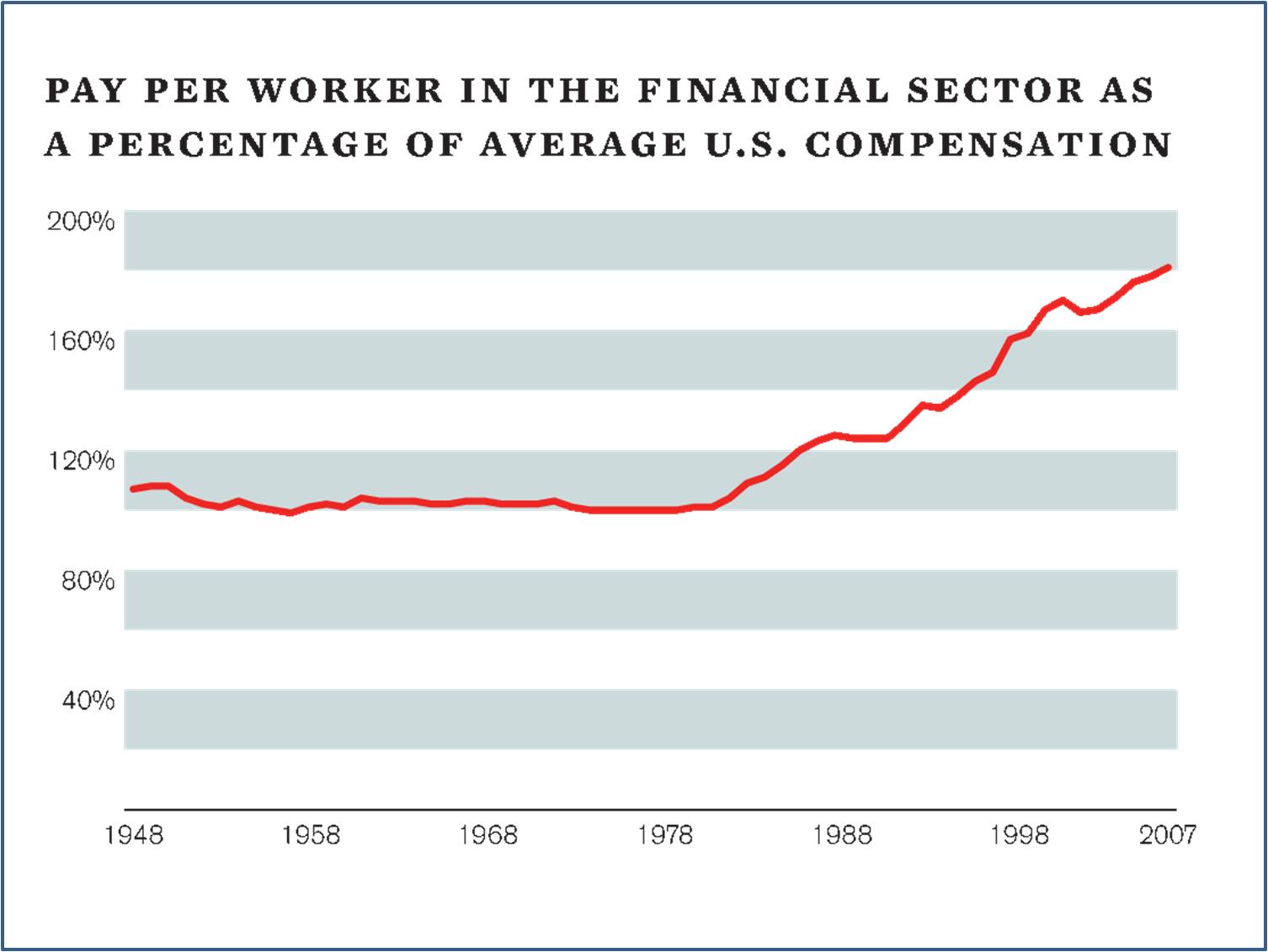
From 1945 until around 1980, the financial sector was one industry among many in the United States. Then something happened.

compensation4

People in finance started making more money,* jobs in finance became more desirable, financial institutions became more influential, and the linkages between the financial sector and the political establishment became stronger. At the same time that our financial sector became more leveraged and more risky, it also became more powerful. The result was a confluence of interests between Wall Street and Washington – one more normally found behind the scenes of emerging market crises, the kind the IMF is called on to resolve.

Simon and I tell this story – and the story of what happened next – in “The Quiet Coup,” an article in the May issue of The Atlantic. (Many thanks to The Atlantic for putting the online copy up as early as they did.) The working title of the article was, “What the IMF Would Tell the United States, If It Could.” Enjoy.

* The data in that chart are from Table 6.6 of the National Income and Product Accounts tables available from the Bureau of Economic Analysis.

Update: Henry Seggerman recently sent us an article he wrote in 2007, comparing the Korean crisis of 2007 to the then-current situation in the United States. He discusses not only the economic similarities, but also some of the political ones.

Update 2: A reader sent us an article about Mark Patterson, formerly Goldman’s chief lobbyist and now Tim Geithner’s chief of staff. Unfortunately, the article was published too late for us to use any of it in our Atlantic article.

By James Kwak

Will It Work?

Leaving aside the question of subsidies, which has gotten piles of attention on the Internet, Simon and I are skeptical that the Geithner Plan will achieve its basic objective: getting enough toxic assets off of bank balance sheets to restore the financial system to normal functioning. We discuss this in today’s Los Angeles Times op-ed, although our regular readers could probably fill in the blanks by themselves.

Update: At 2:30 PM Eastern today, I’ll be on a live chat at Seeking Alpha with Felix Salmon and possibly Brad DeLong and Mark Thoma discussing the Geithner plan. Salmon is strongly against, Delong is moderately (strongly?) for, Thoma is moderately for.

Update 2: At The New Republic, Simon discusses one plausible scenario under which the Geithner Plan is the first step in a comprehensive bank rescue strategy. But he’s skeptical that we will see the other necessary steps.

Update 3: Chat is done; replay is here.

By James Kwak

The G20 Lets Us Down

I’m continually amazed by how easy it is for government officials to hoodwink most of the news media.  All it takes is for a couple of leading finance ministers to get on roughly the same page, and we’re reading/hearing about “substantial progress” or “major steps forward.”  If someone provides an articulate background briefing to a leading newspaper on the supposed debate within a group of countries, this becomes the dominant news story.

Saturday’s G20 meeting of finance ministers and central bank governors is a leading example.  It was a disaster – we face what officials readily concede is the biggest financial and economic crisis since the 1930s, yet this conclave agreed precisely nothing that will make any difference.  If the G20 heads of government summit on April 2nd is a similar failure, we will be staring at the real possibility of a global catastrophe.  Yet the spinning storytellers of the G7 have still managed to get much of the press peering in entirely the wrong direction.

For more on what would the right direction, take a look at my piece in Britain’s Sunday Telegraph.

The FDIC Approach

We have been arguing, here and elsewhere, for a banking approach centered around scaling up FDIC-interventions. Part of the pushback is (1) Congress won’t provide any more money, (2) there is no point in even going to ask, and (3) if you did go ask, that could be destabilizing.

In that context, I’m encouraged by the moves in and around the Senate at the end of last week to increase the resources available to the FDIC (for details, see my assessment on The New Republic’s site this morning).  The Administration seems to be taking the lead and key senators are coming on board.

There are still a lot of pieces that can go wrong: the vaunted “stress test” looks weak, the signals on banks from the Fed and Treasury are mixed at best, and the banking lobby is digging in for a long struggle.  And the world economy is going to put severe pressure on any approach.

But eventually we will turn a corner and, at that point, the FDIC will likely play a central role.

But What About the Slump?

Simon’s reaction to Obama’s speech last night is up at The New Republic.

I think Simon and I agree that the speech was strong on long-term issues, but did not shed much-needed light on how we can emerge from our short-term challenges. One way to position this is to say that if we really are facing a potential “lost decade,” then talking about the long term is a bit premature. Imagine ten years of zero real GDP growth as opposed to 2.5% real GDP growth (with population continue to grow at 1-1.5% or something like that). That would take decades to make up (if it is even possible) and could outweigh any well-meaning efforts to bolster our long-term government finances.

On the other hand, I’m a bit more positive than Simon, because I wasn’t expecting the details of the banking rescue plan in a major speech to the whole country, for both practical reasons (I don’t think they are ready yet) and political ones (Obama wants to keep some measure of distance from whatever Geithner does). If I have time later today I’ll say something about the long-term issues.

Update: Now it’s later. The main thing I liked about the Obama speech is that it reflected what I believe to be the true long-term economic priorities of the country. The day after Obama was elected, I listed what I think are our top four long-term challenges (economic and non-economic): global warming, terrorism and nuclear proliferation, retirement savings (both the insufficiency of retirement savings, and the fact that retiree benefits threaten to break the federal government’s balance sheet), and health care.

Obama’s speech yesterday was mainly about four things: energy, health care, education, and fiscal sustainability. That maps pretty closely to what I think our priorities should be. He was willing to say that these are urgent, serious problems. And when it comes to the government deficit and the national debt, he has chosen to forgo the gimmicks used in the past: not only keeping the Iraq War out of the budget, but also pretending that the AMT will not be fixed every year in the future.

Admitting you have a problem, and recognizing its magnitude, is a necessary, though not sufficient, step on the way to solving it.

To Save The Banks We Must Stand Up To The Bankers

The Financial Times has just published an op ed by Peter Boone and me, arguing that aggressive bank recapitalization and toxic debt clean-up is essential in the U.S. – and that this can be done with strong protections for taxpayers and without nationalization.  The FT did a great job cutting our draft down to fit their print edition (of Tuesday, January 27th); I don’t think they took out anything crucial.  But, just in case, after the jump is the full article as submitted.

(Note: newspapers usually like to choose their own titles for op eds, and the FT is no exception.  But I like their choice and I’ve used it as the heading for this post.) Continue reading “To Save The Banks We Must Stand Up To The Bankers”

Bank Recapitalization Options and Recommendation (After Citigroup Bailout)

By Peter Boone, Simon Johnson, and James Kwak (pdf version is here)

Summary

1.       Debt and equity prices for U.S. banks at the close on Friday, November 21, indicated that the market is testing the resolve of the government to support the banking system. Allowing major banks to fail is not an option, as was made explicit in the G7 statement in mid-October. Significant recapitalization will be necessary to stem the pace of global deleveraging (the contraction of loans and sale of assets by banks around the world). However, the administration’s strategy is not clear.

2.       While full bank recapitalization is not a panacea, it is an important part of the policy mix that will get us through mid-2009, at which point a broader set of expansionary fiscal and – most important – monetary policies can begin to take effect.

3.       The response this weekend by the U.S. authorities in providing financial support to Citigroup is a partial, overly generous, and nontransparent recapitalization, including a large guarantee for distressed assets – which is very close to the asset purchases that Treasury only last week said it would not do.  This U-turn confuses the market (again), leaves the fate of other major banks unclear, and implies much larger contingent liabilities and little upside for the taxpayer.  This approach will be difficult to repeat multiple times because of likely political backlash.

4.       The most important goal now is to put in place a stable, transparent set of rules for bank recapitalization, with sufficient political support and limits on the scope for further policy changes.  Mr. Paulson’s seemingly haphazard approach has become a part of the system problem.

5.       While all recapitalization options have problems, the “least bad” is requiring firms to raise more capital and, for those that cannot, injecting capital through substantial purchases of common stock by the government. These can be managed through a special purpose agency or control board, which is designed to keep credit from becoming politicized and to sell the equity stakes when market conditions are sufficiently supportive.

6.       Another TARP-type round, on slightly tougher terms than October, may serve as an emergency stop-gap measure, but it will not solve the underlying problems and any positive effects could be short-lived.

Continue reading “Bank Recapitalization Options and Recommendation (After Citigroup Bailout)”

Banks At Serious and Immediate Risk, Again

Despite the shot of confidence provided by the recapitalization program in mid-October, equity prices and CDS spreads indicate investors are getting nervous about banks again – and some may even be betting that they will fail, or at that equity holders will be wiped out. As the recession deepens, banks’ assets (not only mortgage-backed securities, but loans in all forms) are falling in value, increasing the chance that the government will need to step in again with more capital. Peter and Simon have a guest post at Real Time Economics (WSJ) on the options – none of them pretty – that the government has.

Mortgage Restructuring Is Not Enough

Let’s be honest with ourselves.  Even if the outgoing Bush team or the incoming Obama administration can work out a scalable nationwide mortgage restructuring scheme, we will still have a housing problem in the U.S..  Specifically, we should expect a high proportion of restructured mortgages to default again within a year.  In a piece that appeared on Bloomberg this morning, Alex Stricker and I suggest that a more centralized process is needed to manage the flow of foreclosed properties onto the market, and we discuss some alternative ways to implement this idea.

There may be better ways to do this and we are completely open to suggestions – please post as comments here.  We only insist that this is one dimension of U.S housing that needs further careful consideration.

An Economic Strategy for Obama

Barack Obama has been getting a mountain of unsolicated economic advice; here’s one selection. In case he needs more to read, we posted our long-term recommendations on the WSJ Real Time Economics blog today. In short, we see a long-term challenge – and opportunity – to shift resources from the financial sector and into what is colloquially called the “real economy.” This will require, among other things, investment in education, openness to immigration, consolidated financial regulation, and assistance for workers affected by restructuring.