Category: Commentary

The Crisis Is Over, And We Wasted It

Rahm Emanuel reportedly has a doctrine: Never let a serious crisis go to waste.  His point is a good one – vested interests usually block change across a wide range of important issues in the US, and a major financial/economic crisis provides an opportunity to bypass or breakthrough those interests in order to introduce meaningful and substantial change.  Emanuel listed (from the 1:40 minute mark) five priority areas for change: health care (cost control and expansion of coverage), energy (independence and alternatives), taxes (fairness and simplicity), education (fundamental changes to effectively train the workforce), and financial regulation (transparency and accountability).

The financial crisis is abating – although the economic costs continue to mount and new problems may still appear (ask California or Ukraine).  At least among the people I talk with on Capitol Hill, there is a very real sense that business is returning to usual; certainly, the lobbyists are out in force, they want what they always want, and it’s hard to see many of them as seriously weakened.  How much progress have we made on any of Emanuel’s priority areas or, for that matter, along any other public policy dimension that was previously stuck? Continue reading “The Crisis Is Over, And We Wasted It”

What Good Is It, Anyway?

Behind the ephemeral debates over the financial crisis and the bailouts it has spawned, there is a broader debate about the financial sector as a whole: what good is it, how much of it do we need, and how do we know if it is working? 

There are many descriptions of what the financial sector does, but most of them have something to do with moving capital (money) from someone who has more than he needs to someone who could use a bit more. And I think most people would agree that is a good thing, as long as the latter person has some productive use for it. Mike at Rortybomb, in “The Financial Sector We Want,” describes a doctor saving up $1,000 more than she needs for consumption and lending it to a factory, which returns her $1,100 after a year. In real life, we need some kind of a financial sector to get the money from the doctor to the factory, even if it’s just a single local bank. Everyone is happy.

When you start asking how big the financial sector should be, and whether or not it is working properly, things get more complicated. One of the Economist’s Free Exchange bloggers took the position that financial innovation is generally good in and of itself, although it has a high risk of creating “negative spillovers” – a higher risk than for non-financial innovation: “Most financial innovations are positive, and we don’t know ex ante which will be negative, so giving ourselves the power to block certain innovations because they might have negative spillovers is risky.” At first blush, this seems like a reasonable extension from real-world innovation to financial innovation.

However, Mike (Rortybomb) has an interesting counter-argument. Financial innovation, he says, is not like real-world innovation; the former only creates value if it solves an existing market imperfection. Figuring out which factories are worth investing in – so the doctor doesn’t have to worry about it – solves a market imperfection. But his point is that it’s the factory that’s creating the value; the financial sector is helping make that possible. So, he argues, if someone figures out a way to get a higher yield out of a risk-free investment (and that was the point of the CDO boom, where you could create a “super-senior, better-than-AAA” bond that paid a higher yield than Treasuries), then you either have to show what market imperfection it is solving, or it isn’t actually risk-free. In most cases, he suspects, innovation that generates a higher return does so simply by taking on more risk.

So what are we to make of the last quarter-century, when the financial sector got bigger and bigger and the people in it got richer and richer?

An instinctive free-market reaction might be to assume that the financial sector was doing great things, and that the people getting rich deserved to. But from Mike’s perspective, you have to ask: did people suddenly discover how to fix such massive market imperfections that they deserved to make that much money for so long? Ryan Avent put it this way:

Frankly, I have no idea what most of the recent growth in finance was for. . . . To get back to Mike’s original point, when you have a few people taking home billions, that’s a sign of either very good luck or some brilliant new strategy. When you have a lot of people in finance taking home billions, then something has gone badly wrong. Either something unsustainable is building, or there are some serious inefficiencies in the market.

And Felix Salmon, I think, pinpointed the crucial issue. If the financial sector was doing such a good job innovating, then it shouldn’t have continued making so much money. 

[O]ne would hope and expect that between sell-side productivity gains and a rise in the sophistication of the buy side, any increase in America’s financing needs would be met without any rise in the percentage of the economy taken up by the financial sector. That it wasn’t is an indication, on its face, that the financial sector in aggregate signally failed to improve at doing its job over the post-war decades — a failure which was then underlined by the excesses of the current decade and the subsequent global economic meltdown.

Ordinarily, if an industry innovates, a few people make a lot of money, and then most of the benefits flow to that industry’s customers. Let’s take one of the greatest examples of recent history: Microsoft and Intel together probably created a handful of billionaires and a few thousand multi-millionaires out of their employees; but for at least the last ten years, no one going there has gotten anything more than a decent salary and a good resume credential. As computers get smaller, cheaper, and faster, the benefits flow overwhelmingly to their customers – to us. And those are near-monopolies. The general pattern in the technology industry is that a few entrepreneurs make a lot of money, and the vast majority of people make a decent salary; even the highly-educated, highly-trained, hard-working software developers, most of whom could have been “financial” engineers, are making less than a banker one year out of business school.

That’s the way innovation is supposed to work. You invent something great, you make a lot of money, then your competitors copy you, prices go down, and the long-term benefits go to the customers. And you and your competitors all get more efficient, meaning that you can do the same amount of stuff at a lower cost than before. If you want to make another killing, you have to invent something new, or at least invent a better way of doing something you already do.

By contrast, the historical pattern of the financial sector – rising revenues, rising profits, and rising average individual compensation – is what you get if there is increasing demand for your services and, instead of competing to lower costs and prices, you limit supply. Sure, prices fell on some financial products, but financial institutions encouraged substitution away from them into new, more expensive products, with the net effect of increasing profitability (and compensation). Why this happened I won’t try to get into here, but it would be worth understanding if we want to reduce the chances of living through this crisis again in our lifetimes.

By James Kwak
Design A Country Rescue Package Here (Comment Competition)

Here’s your Memorial Day assignment.  You have been called to the table for top-level policy discussions in a large monetary union.  One of the bigger countries in this union has a serious problem.  Their exports are down slightly and there are some longer-run structural issues, but the immediate issue is (1) a housing bubble just burst, resulting in a big fall in tax revenue, (2) the political system seems paralysed, i.e., cannot raise other revenues or cut spending in any sensible fashion, and (3) the market for this government’s debt appears likely to turn very sour.  Sounds like a classic fiscal crisis.

Here are your possible recommendations: Continue reading “Design A Country Rescue Package Here (Comment Competition)”

What I Didn’t Get To Say On Bill Maher Last Night

We could have talked more (or even the whole show) about the ideas of Mohammad Yunus.  His book, Creating A World Without Poverty, argues we should look beyond standard for-profit business and consider expanding the emphasis on “social business.”  This – among other things – preserves investors’ capital but doesn’t aim to make it grow, while serving pressing social needs with a business-like delivery model. 

Versions of these ideas came up repeatedly in a course I just finished running at MIT, with Anjali Sastry and other colleagues, in which more than 50 students put their business skills to work helping health care projects in Africa become more effective.  Muhammad is definitely right that more and more business people want to get involved in this kind of social space, and many social entrepreneurs welcome input/advice/any kind of serious contribution.

Ordinarily, we might dismiss a zero real rate of return as uninteresting to anyone who has other uses for their money – but Muhammad is quite eloquent on how such an investment is complementary to seeing more in your life and in finding ways to really help others. Continue reading “What I Didn’t Get To Say On Bill Maher Last Night”

Warrant Sales Could Cost Government $10 Billion

Mark Pittman at Bloomberg estimates the total potential cost to taxpayers of selling warrants back to banks at low prices: $10 billion.  These are the warrants that banks had to issue to Treasury in exchange for preferred stock investments under TARP. Pittman uses the Old National example as a benchmark: Old National paid $1.2 million to buy back warrants that he estimates at $5.8 million. (Linus Wilson, the first person I know of to do the calculations, estimated a range of values from $1.5 million to $6.9 million.) Extrapolating that “discount” to all the other warrants that Treasury currently holds, Pittman finds:

Under the Old National warrants formula, Bank of America Corp. would save $2.03 billion, followed by Wells Fargo & Co. at $1.48 billion and JPMorgan Chase & Co. at $1.46 billion. Morgan Stanley’s benefit would be $983 million, Citigroup Inc.’s would come in at $965 million and Goldman Sachs Group Inc. would have $693 million, according to the data compiled by Bloomberg.

If you are concerned about banks’ capital levels, that’s one way to help them out. The alternative, suggested by Wilson and others, would be for Treasury to auction off the warrants; if the bids were too low, it could create a trust, transfer them from Treasury to the trust, and release the banks of any TARP obligations triggered by those warrants.

It also contrasts sharply with the treatment of private (not publicly-traded) banks such as Centra, as documented by David Kestenbaum of Planet Money.

I’ll have more on option pricing later.

By James Kwak

CAFE, Part Two

In the same post I discussed yesterday, Keith Hennessey cites the same NHTSA report – the Final Rule governing CAFE standards for model years 2011-15, issued in January 2008 – to make this point: “The proposal will have a trivial effect on global climate change.” (It’s point 5 in his post, and was also picked up by Alex Tabarrok in his endorsement.) Hennessey cites the NHTSA report accurately, but the report itself is misleading.

What does the report say? Look at Table VII-12 on page 624. There are three scenarios that we are concerned with: No Action (which Hennessey calls, and I will call, “Baseline”); Optimized (“Bush Plan”); and Total Costs Equal Total Benefits (“Obama Plan”). If you want to know why Optimized is Bush and TC = TB is Obama, see my previous post. In the year 2100, the projected carbon dioxide (“CO2”) concentration in the atmosphere, in parts per million, is:

  • Baseline: 717.2
  • Bush: 716.2
  • Obama: 715.6

That’s pretty convincing – or is it?

Continue reading “CAFE, Part Two”

Real Time With Bill Maher, Tomorrow

Tomorrow evening I’m on Bill Maher’s HBO show, as part of a three person panel with Muhammad Yunus and Jon Meacham.  Bill runs a wide-ranging discussion covering pretty much anything that’s been in the news over the past week or so.  With Muhammad and Jon there, I’m sure we’ll get into issues of ethics and values – including whether we have let “the profit motive” become too central in our society.

In terms of other topics related to economics, my guess is we’ll talk about: Continue reading “Real Time With Bill Maher, Tomorrow”

The Economics of CAFE

Note: There are two somewhat significant updates at the bottom, just before the Appendix.

CAFE stands for Corporate Average Fuel Economy – the average fuel efficiency that is calculated annually for every manufacturer that sells cars or light trucks in the U.S. and compared to standards set by the National Highway Traffic Safety Administration, part of the Department of Transportation. (If you want to know more about how CAFE is measured, see the Appendix to this post.) Yesterday, President Obama proposed new, higher CAFE standards for models years up through 2016, by which point aggregate efficiency should reach 35.5 miles per gallon. 

The typical conservative response to regulations like this is that they impose costs on the economy. In this case the main argument is that mandating higher fuel efficiency standards makes cars more expensive to produce; so car companies have to charge more for them; so fewer people will buy cars, and fewer people will be employed in the auto industry. I was planning to try to pre-empt this argument, but Keith Hennessey, former head of the National Economic Council under Bush II, beat me to the punch. His post summarizes some findings from a 900-page report produced by NHTSA in January 2008, when the Bush administration released the latest version of the CAFE standards. One of his main points, taken from that report, is that the Obama standards will cost 49,000 jobs. That’s relative to some baseline that I haven’t been able to identify, but it’s 38,000 jobs more than the Bush standards. The table is on page 586 of the long report; the Bush plan is “Optimized” and the Obama plan is “TC = TB.” Hennessey’s post has been picked up by Marginal Revolution (where I found it) and by The New York Times, so I decided I should stay up late and write a response.

Continue reading “The Economics of CAFE”

Consumer Protection When All Else Fails (Written Testimony)

I took three points away from yesterday’s hearing in the House of Representatives.

  1. We need layers of protection against financial excess.  Think about the financial system as a nuclear power plant, in which you need independent, redundant back-up systems – so if one “super-regulator” fails we don’t incur another 20-40 percentage points in government debt through direct and indirect bailouts.  A consumer financial products protection agency should definitely be part of the package.  Update: The Washington Post reports that such an agency is now in the works; this is a big win for Elizabeth Warren, Brad Miller and others (add appropriate names below).
  2. Congress will work on this.  The intensity of feeling with regard to the need to re-regulate is striking, and there is much that resonates across the political spectrum.
  3. In the end, much of banking is likely to become boring again.  Special interests are convinced that they can fend off the regulatory challenge, but I find this increasingly unlikely.  Enough people have seen through what they did, how they did it, and what they keep on doing.  No doubt the outcomes will be messy and less than optimal, but at this point “less than optimal” is much preferable to “systemic meltdown”.

There is still much to argue about and, no doubt, there will be setbacks.  We’ll get a better or a worse system, depending on how the debate goes.  And if the external scrutiny slips away, so will point #3 above.  But this was still by far the most encouraging hearing I’ve so far attended.

The main points from my written testimony to the subcommittee are below.

Continue reading “Consumer Protection When All Else Fails (Written Testimony)”

Economics of Sick Days

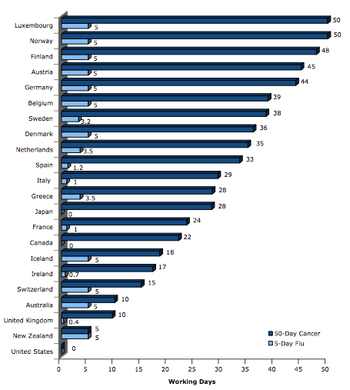
Ezra Klein is one of those bloggers, like Matt Yglesias or Andrew Sullivan, that sometimes make me want to just give up. Yesterday he started a new blog at the Washington Post, and promptly put up fifteen posts on his first day – and not the one line variety, either. Today, he brings us this chart from the Center for Economic and Policy Research:

sickdayschart-thumb-350x390

This is Klein’s explanation:

You’re seeing two things here. The light blue line measures paid sick days. This is what you use if you need to take three days off because you have a fever. The dark blue line is paid sick leave. This is what you use if you need to take three months off because you have cancer. Every other country on the list offers at least one. Most offer both. The United States is alone in guaranteeing neither.

Why does this matter? Because sick people without paid sick days go to work anyway, infecting others and increasing the virulence of epidemics. Or, when it comes to things like the common cold, they simply get more people sick, which sucks for them.

Continue reading “Economics of Sick Days”

Insolvency And Consumer Protection (House Testimony Today)

Congressman Brad Miller has some interesting ideas about how to respond to the financial crisis; not exactly on the same page as Treasury.  He’s called a hearing for this morning to talk about, in the first instance, how to assess insolvency in the banking system – and what to do about it (he chairs the Investigations and Oversight subcommittee of the House Committee on Science and Technology.)  But my guess is that the conversation will cover considerably more ground, including his idea that we establish a Financial Products Safety Commission.  (A full preview is now available at our joint venture with the Washington Post.)

The basic notion behind this commission is that consumers were taken advantage of by unscrupulous lenders.  Of course, you could also say that consumers fooled themselves, but if that is pervasive and has systemic implications then we need to take it on.  In his recent testimony before the Joint Economic Committee, Joe Stiglitz emphasized the need for more consumer protection, and this idea is also strongly advocated by Elizabeth Warren – against the odds, she continues to make some progress. Continue reading “Insolvency And Consumer Protection (House Testimony Today)”

Liquidity Crisis? Check

Remember the days of talking about the TED spread and interbank lending? So over. And apparently Sheila Bair said “the liquidity crisis is over for good.”

One way to look at the decline in interbank lending rates is that interbank lending has become safe again – because governments around the world have made it so abundantly clear that they will not let major banks default on their liabilities, no matter what happens. So what we have is interbank lending rates that are artificially suppressed by implicit government support.

In any case, I guess now we’ll find out if Tim Geithner was right that this is just a liquidity crisis, not a solvency crisis.

By James Kwak

Rating Agency Self-Defense

I’m drafting a post for The Hearing on credit rating agencies (the ones who gave AAA ratings to all those CDOs). The CEO of Fitch is giving this prepared testimony tomorrow. Here’s the question: Can anyone find anything in there that constitutes a constructive suggestion for how regulation of rating agencies could be improved? Or is it all just self-serving insistence that there is no problem? 

(My favorite part is on pages 6-7 where he says, effectively, “Don’t regulate us – regulate the issuers and underwriters instead!”

By James Kwak

New Cars, Mortgages, and Race

Like most forms of hardship in our society, the foreclosure crisis is disproportionately affecting minorities. The New York Times conducted a study of foreclosures in the New York area and found, among other things:

Defaults occur three times as often in mostly minority census tracts as in mostly white ones. Eighty-five percent of the worst-hit neighborhoods — where the default rate is at least double the regional average — have a majority of black and Latino homeowners.

Well, that might simply be a function of poverty: statistically speaking, minorities are more likely to be poor, and therefore more likely to become delinquent on their mortgages. But I don’t think it’s that simple.

Continue reading “New Cars, Mortgages, and Race”