Category: Commentary

What’s a Big Government?

By James Kwak

One thing that all parties seem to be able to agree on is that big government is bad. It was President Clinton, after all, who said, “The era of big government is over.” And the current Republican budget-slashing wave seems motivated by the idea that our government is too big.

But what is the size of government, anyway?* When a typical anti-government person thinks of government, she probably has in mind the EPA, the Consumer Financial Protection Bureau, the “jack-booted government thugs” at the the Bureau of Alcohol, Tobacco, and Firearms, OSHA, and all those government agencies that prevent businesses and individuals from getting on with their lives. The idea here is that government intervention in the free market makes the economy less efficient and therefore reduces aggregate societal welfare.
Continue reading “What’s a Big Government?”

Does The US Have A Lot Of Government Debt?

By Simon Johnson

In the nation’s latest fiscal mood swing, the mainstream consensus has swung from “we must extend the Bush tax cuts” (in December 2010) towards “we must immediately cut the budget deficit.”  The prevailing assumption, increasingly heard from both left and right, is that we already have far too much government debt – and any further significant increase will likely ruin us all.

This way of framing the debate is misleading – and very much at odds with US fiscal history.  It masks the deeper and important issues here, which are much more about distribution, in particular how much are relatively wealthy Americans willing to transfer to relatively poor Americans?

To think about the current size of our debt, start at the beginning of the American Republic.  (For a very short history of US government debt, listen to my conversation with NPR’s Guy Raz from this weekend; we cover more than 200 years in about 3 minutes; if you want more detail, look up the annual debt numbers for yourself at Treasury Direct). Continue reading “Does The US Have A Lot Of Government Debt?”

Nominate Elizabeth Warren – Provide The Pecora Hearings We Need

By Simon Johnson

Ms. Warren is helping get the new Consumer Financial Protection Bureau (CFPB) off the ground and remains the leading contender to become its formal head (subject to Senate confirmation).  She summarizes her substantive agenda this way,

We’re trying to make these markets transparent, which makes it easier for community banks to compete both with large financial institutions and with their nonbank competitors.”

She should now be nominated to the CFPB position.  There will be strong Republican opposition and some Democrats who are close to the financial sector may be lukewarm.  But a public hearing on her case represents our best opportunity to experience a modern version of the Pecora Hearings – the Senate Banking Committee hearings in the 1930s that laid bare the inner (and rotten) workings of the biggest financial firms (see Michael Perino’s book on Pecora for details).

These hearings would represent a major step forward towards forging a new consensus regarding how to really establish markets (as opposed to the crazy government subsidy schemes that predominate).  In addition, the administration would win a big victory with Ms. Warren’s confirmation. Continue reading “Nominate Elizabeth Warren – Provide The Pecora Hearings We Need”

The FDIC’s Resolution Problem

By Simon Johnson.  Links to the articles mentioned below are available here: http://economix.blogs.nytimes.com/2011/04/28/the-problem-with-the-f-d-i-c-s-powers/

Under the Dodd-Frank financial reform legislation (Title II of that Act), the Federal Deposit Insurance Corporation (FDIC) is granted expanded powers to intervene and manage the closure of any failing bank or other financial institution.  There are two strongly-held views of this legal authority: it substantially solves the problem of how to handle failing megabanks and therefore serves as an effective constraint on their future behavior; or it is largely irrelevant.

Both views are expressed by well-informed people at the top of regulatory structures on both sides of the Atlantic (at least in private conversations).  Which is right?  In terms of legal process, the resolution authority could make a difference.  But as a matter of practical politics and actual business practices, it means very little for our biggest financial institutions. Continue reading “The FDIC’s Resolution Problem”

Bond Market Blackmail

By James Kwak

Like probably most people, I have not been following the saga of Iceland and its banks’ foreign depositors, so I was grateful for Planet Money’s podcast last week on the topic. The background, as I understand it, is something like this:

  1. Iceland’s banks offered high-rate savings accounts to depositors in other countries, notably the United Kingdom and the Netherlands. These accounts did not have an explicit government guarantee.
  2. In 2008, the global financial system nearly collapsed, Iceland’s banks failed, and depositors got more or less wiped out.
  3. Iceland, unlike Ireland, did not guarantee its banks’ liabilities. It did, however, choose to bail out domestic depositors in those banks — but not foreign depositors.
  4. The U.K. and the Netherlands both chose to bail out their citizens who had deposited money in Iceland’s banks.
  5. The U.K. and the Netherlands then tried to get the Icelandic government to pay them back. They negotiated a settlement, but that was rejected by a popular referendum in Iceland. Then they negotiated another settlement (which would have cost Iceland about $6,000 per person), but that was also rejected.

Now, there is a legal question about whether or not Iceland has an obligation to bail out foreign depositors in its banks. Remember, there was no explicit government guarantee. The question is whether bailing out domestic but not foreign depositors is illegal discrimination under international law.* Apparently that’s a close question, but it’s not relevant for my purposes.

The economic question, as the podcast framed it, is whether paying off the U.K. and Dutch governments will help Iceland attract foreign investment in the future. They had a bond investor from Vanguard — ordinarily just about my favorite financial institution — saying that a vote against the settlement would make investors less likely to lend money to the Icelandic economy in the future.

Now, this may be true (although I doubt it). But think about what this is really saying.

Continue reading “Bond Market Blackmail”

Is S&P’s Deficit Warning On Target?

By Simon Johnson

On Monday Standard & Poor’s announced that its credit rating for the United States was “affirmed” at AAA (the highest level possible), but that it was revising the outlook for this rating to “negative” – in this context specifically meaning “that we could lower our long-term rating on the U.S. within two years” (p.5 of the report).  This news temporarily roiled equity markets around the world, although the bond markets largely shrugged it off.

While S&P’s statement generated considerable media attention, the economics behind their thinking is highly questionable – although, given the random nature of American politics, even this intervention may still end up having a constructive impact on the thinking of both the right and the left.

It is commendable that S&P now wants to talk about the U.S. fiscal deficit – one wonders where they were, for example, during the debate about extending the Bush-era tax cuts at the end of last year. Continue reading “Is S&P’s Deficit Warning On Target?”

“Fiscal Conservatives” Dodge $10 Trillion Debt

By Simon Johnson.  This post comprises the opening paragraphs of my column today on Bloomberg; the rest is available here: http://www.bloomberg.com/news/2011-04-19/fiscal-conservatives-dodge-10-trillion-debt-simon-johnson.html

Washington is filled with self- congratulation this week, with Republicans claiming that they have opened serious discussion of the U.S. budget deficit and President Barack Obama’s proponents arguing that his counterblast last Wednesday will win the day.

The reality is that neither side has come to grips with the most basic of our harsh fiscal realities.

Start with the facts as provided by the nonpartisan Congressional Budget Office. Compare the CBO’s budget forecast for January 2008, before the outbreak of serious financial crisis in the fall of that year, with its latest version from January 2011. The relevant line is “debt held by the public at the end of the year,” meaning net federal government debt held by the private sector, which excludes government agency holdings of government debt.

In early 2008, the CBO projected that debt as a percent of gross domestic product would fall from 36.8 percent to 22.6 percent at the end of 2018. In contrast, the latest CBO forecast has debt soaring to 75.3 percent of GDP in 2018.

What caused this stunning reversal, which in dollar terms works out to a $10 trillion swing for end-year 2018 debt, from $5.1 trillion to $15.8 trillion?

To read the rest of this post, click here.

Could Goldman Sachs Fail?

By Simon Johnson.  This link to MIT Sloan’s website provides a partial transcript and video covering the points made below.

If Goldman Sachs were to hit a hypothetical financial rock, would they be allowed to fail – to go bankrupt as did Lehman – or would they and their creditors be bailed out?

I asked this question on Sunday to four leading experts (Erik Berglof, Claudio Borio, Garry Schinasi, and Andrew Sheng) from various parts of the official sector at the Institute for New Economic Thinking (INET) Conference in Bretton Woods – and to a room full of people who are close to policy thinking both in the United States and in Europe.  In both the public interactions (for which you can review video here) and private conversations later, my interpretation of what was said and not said was unambiguous: Goldman Sachs would be bailed out (again).

This is very bad news – although admittedly not at all surprising.  Continue reading “Could Goldman Sachs Fail?”

My Medicare Deficit Solution

By James Kwak

David Brooks, perhaps realizing that it was a bad idea to swallow a politician’s PR bullet points whole, is now backpedaling. The Ryan Plan, which he originally hailed as “the most comprehensive and most courageous budget reform proposal any of us have seen in our lifetimes,” now has the principal virtue of existing: “Because he had the courage to take the initiative, Paul Ryan’s budget plan will be the starting point for future discussions.”

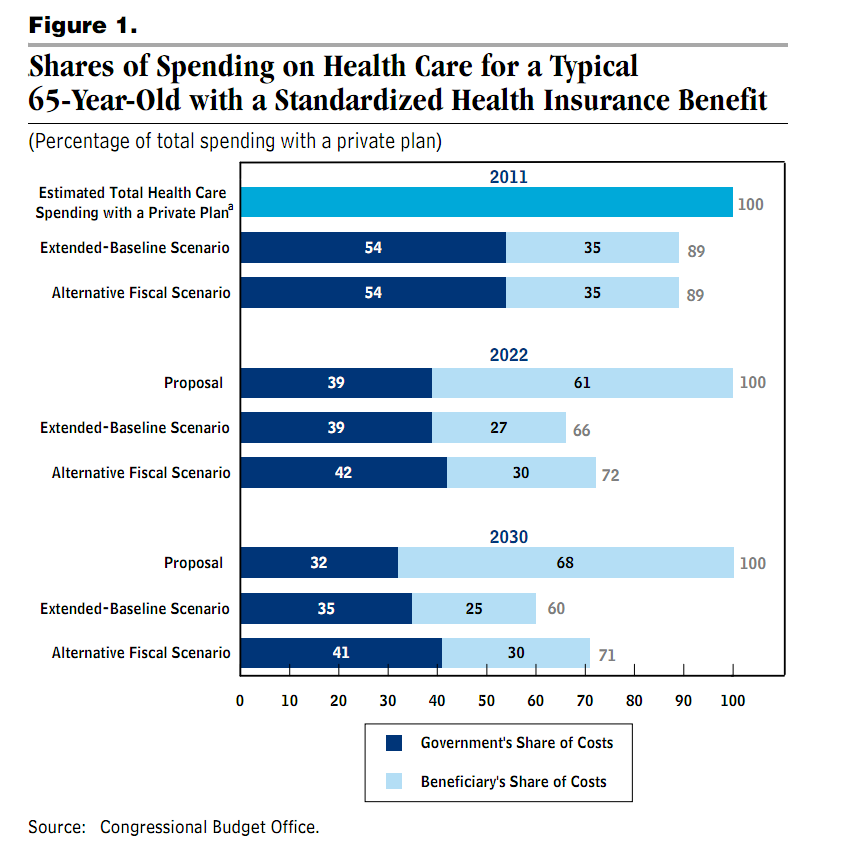
As I’ve discussed before, the Ryan Plan is just one bad idea dressed up with the false precision of lots of numbers: changing Medicare from a health insurance program to a cash redistribution program that gives up on managing health care costs. Here’s the key chart from the CBO report:

Continue reading “My Medicare Deficit Solution”

Who Wants a Voucher?

By James Kwak

In yesterday’s post, I compared two ways of solving the long-term Medicare deficit: (a) increasing payroll taxes and keeping Medicare’s current structure or (b) keeping payroll taxes where they are and converting Medicare into a voucher program. As a person who will need health insurance in retirement, I prefer (a), but others could differ.

Today I want to ask a different question. Let’s say Medicare does become a voucher program along the lines proposed by Paul Ryan. So workers pay 2.9 percent of their wages and in retirement they get a voucher. According to the CBO, if you turn 65 in 2030, that voucher will pay for 32 percent of your total health care costs, including private insurance premiums and out-of-pocket expenses (see pp. 22-23). Would you rather have that deal or nothing at all?

Continue reading “Who Wants a Voucher?”

The Vickers Commission Report On Banking

By Simon Johnson

Will the Vickers Commission report on UK banking – with a preliminary report released today – have a major positive impact?  Not likely in our assessment – see today’s Daily Telegraph.

The fight to reform the banking system in the US and more broadly is largely over – and the bankers won.  A number of sensible ideas were put forward – including on creating a resolution authority, reducing the scale and scope of big banks, and significantly increasing capital requirements.  As reviewed by Peter Boone and me in this morning’s Financial Times, all of these initiatives have essentially failed.

Big Banks Have A Powerful New Opponent

By Simon Johnson

As a lobby group, the largest U.S. banks have been dominant throughout the latest boom-bust-bailout cycle – capturing the hearts and minds of the Bush and Obama administrations, as well as the support of most elected representatives on Capitol Hill.  Their reign, however, is finally being seriously challenged by another potentially powerful group – an alliance of retailers, big and small – now running TV ads (http://youtu.be/9IUt-lY-XgM, by Americans for Job Security), web content (http://www.youtube.com/watch?v=DiKoFzS_lXs, by American Family Voices), and this very effective powerful radio spot directly attacking “too big to fail” banks: http://www.savejobs.org/audio18.html.

The immediate issue is the so-called Durbin Amendment – a requirement in the Dodd-Frank financial reform legislation that would lower the interchange fees that banks collect when anyone buys anything with a debit card.  Retailers pay the fees but these are then reflected in the prices faced by consumers.

The US has very high debit card “swipe” fees – 44 cents on average but up to 98 cents for some kinds of cards.  These fees are per transaction – representing a significant percent of many purchases but posing a particular problem for smaller merchants. This is estimated to be around $16-17 billion in annual revenue.

Other countries, such as Australia and members of the European Union, have already taken action to reduce interchange fees – because the cost of such transactions is actually quite low (think about it: the “interchange fee” for checks, which also draw directly on bank deposits, is exactly zero).  The United States severely lags behind comparable countries in terms of how consumers are treated by banks in this regard. Continue reading “Big Banks Have A Powerful New Opponent”

Moment of Blather

By James Kwak

David Brooks’s commentary on Paul Ryan’s “budget proposal” is entitled “Moment of Truth.” Brooks falls over himself gushing about his new man-crush, calling it “the most comprehensive and most courageous budget reform proposal any of us have seen in our lifetimes.” “Ryan is expected to leap into the vacuum left by the president’s passivity,” he continues.

Gag me.

Continue reading “Moment of Blather”

Institute Of International Finance Wins Two Nobel Prizes

By Simon Johnson

In a surprise announcement early this morning, the 2011 Nobel Peace Prize and the Nobel Prize for Economics (strictly speaking: “The Sveriges Riksbank Prize in Economic Sciences in Memory of Alfred Nobel”) were simultaneously awarded to the Institute of International Finance (IIF), “the world’s only global association of financial institutions”.

This is the first time the Economics Prize has been awarded to an organization – although the Peace Prize has been received by various institutions (including the Intergovernmental Panel on Climate Change, the International Atomic Energy Agency, and Lord Boyd Orr – in part for his work with the Food and Agriculture Organization).

In its citation for the economics prize, the Royal Swedish Academy of Sciences said the IIF won for its work on capital requirements for banks, which proved that requiring banks to fund themselves with positive equity – and therefore have any kind of buffer against insolvency – would limit credit, be very bad for economic growth, and generally make all consumers less happy.  Based on this single remarkable paper, the IIF earned the prize for its: Continue reading “Institute Of International Finance Wins Two Nobel Prizes”

The Myth Of The Resolution Authority

By Simon Johnson

Back when it really mattered – last spring, during the Dodd-Frank financial reform debate – Senator Ted Kaufman of Delaware emphasized repeatedly on the Senate floor that the proposed “resolution authority” was an illusion.  His point was that extending the established Federal Deposit Insurance Corporation (FDIC) powers for “resolving” (jargon for “closing down”) financial institutions to include global megabanks simply could not work. 

At the time, Senator Kaufman’s objections were dismissed by “experts” both from the official sector and from the private sector.  Now these same people (or their close colleagues) are falling over themselves to argue resolution cannot work for the country’s giant bank holding companies.  The implication, which these officials and bankers still cannot grasp, is that we need much higher capital requirements for systemically important financial institutions.

Writing in the March 29, 2011 edition of the National Journal, Michael Hirsch quotes a “senior Federal Reserve Board regulator” as saying: Continue reading “The Myth Of The Resolution Authority”