Category: Commentary

What Could the US Achieve at the G20 in Cannes?

By Simon Johnson

The April 2009 London summit of the G20 is widely regarded as having been a great success.  The world’s largest economies agreed on an immediate coordinated approach to the global financial crisis then raging and promised to work together on banking reforms that would support growth.  At the time, President Obama got high marks for his constructive engagement.

The G20 heads of government have met twice a year since London and in Cannes this week they meet again (November 3-4).  Could this summit also help stabilize the world economy?  And can President Obama again play a leading role?  The answer to both questions is likely the same: No. Continue reading “What Could the US Achieve at the G20 in Cannes?”

Are They Really That Good?

By James Kwak

The instinctive defense from Wall Street bankers is that they deserve the money they make: they’re just that good. By that logic, Jon Corzine was the best of the best: he was the head of Goldman, after all (although in his days, if I recall correctly, Goldman and Morgan Stanley were roughly tied in prestige). The failure of MF Global may have had many causes, but it does make one wonder: Are the people at Goldman really that good individually, or is it the firm (and its reputation, and its information flow) that makes them so good?

Andrew Ross Sorkin speculates that MF Global got Goldman-style risk-taking without Goldman-style compliance and risk management. I would just add: they also got it without a Goldman-style too-big-to-fail government guarantee.

What’s Wrong with Groupon?

By James Kwak

Groupon plans to go public later this week. According to the latest leaks, things are going well: the IPO valuation, scaled back from $30 billion to about $12 billion, may be raised because of a successful road show. Apparently even after the company conceded that the amount they pay to a merchant does not count as revenue, investors have decided they like what they see.

But there is still something fishy about Groupon’s business model.

Continue reading “What’s Wrong with Groupon?”

Mr. Hoenig Goes to Washington

By Simon Johnson

To fix a broken financial system – and to oversee its proper functioning in the future – you need experts.  Finance is complex and the people in charge need to know what they are doing.  One common problem, which is also manifest in the United States today, is that many of the leading experts still believe in some version of business-as-usual.

At the height of the Great Depression, Marriner S. Eccles was summoned to Washington from Utah – where he was a regional banker.  He helped remodel the Federal Reserve through the Banking Act of 1935 and then became its first independent chairman – the Fed board had previously been chaired by the Treasury Secretary.  Eccles was not a fan of big Wall Street firms and their speculative stock market operations; rather he understood and identified with smaller banks that lent to real businesses.  Eccles was the right kind of expert for the moment.  Who has the expertise to play this kind of role in our immediate future?

Tom Hoenig, formerly president of the Kansas City Fed, has long been a strong voice for financial sector reform along sensible lines.  Within the official sector, he has spoken loudest and clearest on the most important defining issue: Too Big To Fail is simply too big.  And last week he took a major step towards a more prominent role, when he was announced as the administration’s nominee to become vice-chair at the Federal Deposit Insurance Corporation (FDIC). Continue reading “Mr. Hoenig Goes to Washington”

European Debt: The Big Picture

By Simon Johnson

For everyone struggling to get their arms around the debt crisis in Europe, Bill Marsh in today’s New York Times offers literally a compelling picture, with graphic illustration for the key issues.

The picture is big, 18×21 inches. Either you need a very large computer screen or a hard copy of the paper (pp. 6-7 in the SundayReview section, “It’s All Connected: A Spectator’s Guide to the Euro Crisis).

The main debt linkages across borders for which we have data are all here – and the graphic pulls your eye appropriately to the centrality of Italy in whatever happens next.  (On why eurozone policy towards Italy now matters so much – and what are the options – see my recent paper with Peter Boone, “Europe on the Brink”.)

But you might think also about what is not in the NYT graphic because we lack reliable information.  For example, what is the exposure of US financial institutions to European debt, directly or indirectly, through derivatives transactions of any kind?

The opaqueness of derivative markets means that most investors can only guess at what could happen.  Most of the relevant regulators and supervisors with whom I have talked seem also to be largely in the dark – remember the experience of AIG in 2008.

Cross-border bank exposures through loans and other holdings are publicly disclosed – data from the Bank for International Settlements are represented by the arrows in the NYT graphic.  These data are surely not perfect, but they do convey the main points and they tell you where to focus attention.

Why do we not require publication of similar data, preferably by financial institution, for all derivative transactions – including both gross and supposedly net exposures across borders?
Jon Huntsman: Too Big To Fail Is Too Big

By Simon Johnson

The idea that big banks damage the broader economy has considerable resonance on the intellectual right.  Tom Hoenig, recently retired president of the Kansas City Fed, has been our clearest official voice on this topic.  And Gene Fama, father of the efficient markets view of finance, said on CNBC last year, that having banks that are too big to fail is “perverting activities and incentives” in financial markets – giving big financial firms, “a license to increase risk; where the taxpayers will bear the downside and firms will bear the upside.”

The mainstream political right, however, has been reluctant to take on the issue. This changed on Wednesday, with a very clear statement by Jon Huntsman in the Wall Street Journal on regulatory capture and its consequences.  Before the 2008 financial crisis: “The largest banks were pushing hard to take more risk at taxpayers’ expense.”  And now,

“More than three years after the crisis and the accompanying bailouts, the six largest American financial institutions are significantly bigger than they were before the crisis, having been encouraged to snap up Bear Stearns and other competitors at bargain prices. These banks now have assets worth over 66% of gross domestic product—at least $9.4 trillion, up from 20% of GDP in the 1990s. There is no evidence that institutions of this size add sufficient value to offset the systemic risk they pose.”

This message could work politically, for five reasons. Continue reading “Jon Huntsman: Too Big To Fail Is Too Big”

More Bathtubs

By James Kwak

Last week I criticized David Brooks for not understanding the difference between stocks and flows (that is, between your paycheck and your bank balance). (Paul Krugman instead criticized the Tax Foundation, the source for Brooks’s error—I wonder why?)

It turns out that a lot of people make this kind of mistake. Difficulty understanding stocks and flows may be a fundamental cognitive error such as anchoring or availability bias. In one experiment by Matthew Cronin, Cleotilde Gonzalez, and John Sterman, more than half of a group of students at MIT Sloan—one of the top business schools in the country—could not figure out, from a chart of entrances to and exits from a department store, when the most and fewest people were in the store. These errors turn out to be robust to different framing stories, different ways of presenting the data, and even when getting the questions wrong meant you had to stay in the room for an hour.

Continue reading “More Bathtubs”

The More You Pay, the Less You Get

By James Kwak

Schumpeter at The Economist pointed me to a paper by Richard Cazier and John McInnis on one of my favorite topics: CEO hiring. Cazier and McInnis first confirm, not surprisingly, that pay for new, externally-hired CEOs is positively related to the past performance of their previous firms. In particular, they measure EXCESS_COMP as the difference between actual first-year compensation and the compensation that you would predict just based on the characteristics of the hiring firm; EXCESS_COMP turns out to be positively associated with the CEOs’ prior firms’ stock returns. That makes sense, since you would think that people from successful companies would be able to command a higher price than people from less successful companies, and it isn’t obviously controversial, since you would think they would deserve it.

But what do the new firms get for this pay premium? It turns out that their future performance, measured in terms of return on assets and operating return on assets, is negatively associated with excess compensation based on prior performance.* In other words, people from successful companies don’t deserve the pay premium because the higher the premium they are able to command, the less well they are likely to do.

Continue reading “The More You Pay, the Less You Get”

A Dangerous Idea In The Deficit-Reduction Supercommittee

By Simon Johnson

Can tax cuts “pay for themselves” – inducing so much additional economic growth that government revenue actually increases, rather than decreases? The evidence clearly says no.

Nevertheless, a version of this idea, under the guise of “dynamic scoring,” has apparently surfaced in the supercommittee charged with deficit reduction – the joint congressional committee with 12 members. Dynamic scoring sounds technical or perhaps even scientific, but here the argument means simply that any pro-growth effect of tax cuts should be stressed when assessing potential policy changes (e.g., reforming the tax code). For anyone seriously concerned with fiscal responsibility, this is a dangerous notion. Continue reading “A Dangerous Idea In The Deficit-Reduction Supercommittee”

Bathtubs for Beginners

By James Kwak

In economics life there’s a basic conceptual distinction between a flow and a stock. A flow is a something that occurs over some period of time, like water pouring from a faucet into a bathtub. A stock is something that exists at a specific moment of time, like the water in that bathtub. You measure a flow over a period of time (e.g., gallons per minute); you measure a stock at a specific moment in time (e.g., gallons). For a business, the income statement (revenues and costs in a year) measures flows, while the balance sheet (assets and liabilities) measures a stock. That’s why the income statement is dated for a year (or a quarter) and the balance sheet is dated for a specific day. Everyone understands this. If you didn’t, you would get confused between your salary and your bank account.

But not David Brooks.

Continue reading “Bathtubs for Beginners”

Too Big To Fail Under Dodd-Frank

By Simon Johnson.  This post comprises the first three paragraphs of my latest Bloomberg column; you can read the full column there.

Here we go again. Major shocks potentially threaten the solvency of some of the world’s largest financial institutions. Concerns grow over the ability of European leaders to shore up their banks, which are reeling from a sovereign-debt crisis. In the U.S., the shares of some large banks are trading at less than book value, while creditor confidence crumbles.

Private conversations among economists, regulators and fund managers turn naturally to so-called resolution powers — the expanded ability to take over and wind down private financial companies granted to federal regulators by the Dodd-Frank financial reform law. The proponents of these powers, including Tim Geithner and Henry Paulson, the current and former U.S. Treasury secretaries, argue that the absence of such authority in the fall of 2008 contributed to the financial panic. According to this line of thought, if only the Federal Deposit Insurance Corp. had the power to manage the orderly liquidation of big banks and nonbank financial companies, the government could have decided which creditors to protect and on what basis. This would have helped restore confidence, it is argued.

Instead, the government was forced to rely on the bankruptcy process, as in the case of Lehman Brothers Holdings Inc., or complete bailouts for all creditors, as in the case of American International Group. The FDIC already has limited resolution authority, which functioned well over many years for small and medium-sized banks.

To read the rest of this column, please click on this link to Bloomberg: http://www.bloomberg.com/news/2011-10-10/too-big-to-fail-not-fixed-despite-dodd-frank-commentary-by-simon-johnson.html

Straight Out of Antiquity

By James Kwak

In their paper on the Tea Party, Vanessa Williamson, Theda Skocpol, and John Coggin (Chrystia Freeland summary here) argue that one of the central principles of the Tea Party is a division of the world into workers who deserve what they earn (including Medicare and Social Security, which they like) and undeserving “people who don’t work”—by which many mean the young, or even their own younger relatives.

We are the 99 Percent, the tumblr associated with Occupy Wall Street, is, among many other things, a kind of response to that worldview. The introduction takes it on directly:

“They say it’s because you’re lazy. They say it’s because you make poor choices. They say it’s because you’re spoiled. If you’d only apply yourself a little more, worked a little harder, planned a little better, things would go well for you. Why do you need more help? Haven’t they helped you enough? They say you have no one to blame but yourself. They say it’s all your fault.”

Continue reading “Straight Out of Antiquity”

Wall Street and Silicon Valley

By James Kwak

Whenever someone criticizes “Wall Street,” someone else tries to defend Wall Street by saying that without it we wouldn’t have Silicon Valley and all of its wonders. Most recently, A.S. at Free Exchange says this:

“What would Silicon Valley have been without venture capital and private equity? Apple’s spectacular growth was made possible by the capital it raised in financial markets (it is a public company).

“Much of Apple’s initial investment came from an angel investor (a relative or friend who provides the start-up capital). But most new companies rely on formal capital markets. In a 2009 working paper, Alicia Robb and David Robinson investigated the capital structure of start-up firms, and found that 75% primarily relied on external financing from formal capital markets, usually credit cards and bank loans in their first year. They also found that firms that used formal credit were more successful.”

As critics of Wall Street go, I probably find this more annoying than most because, well, I worked in Silicon Valley. Most of these comments are obvious, but here goes anyway.

Continue reading “Wall Street and Silicon Valley”

The 4 Trillion Euro Fantasy

By Peter Boone and Simon Johnson

Some officials and former officials are taking the view that a large fund of financial support for troubled eurozone nations could be decisive in stabilizing the situation.  The headline numbers discussed are up to 2-4 trillion euros – a large amount of money, given that German GDP is only 2.5 trillion euros and the entire eurozone GDP is around 9 trillion euros.

There are some practical difficulties, including the fact that the European Financial Stability Fund (EFSF) as currently designed has only around 240 billion euros available (although this falls if more countries lose their AAA status in the euro area) and the International Monetary Fund – the only ready money at the global level – would be more than stretched to go “all in” at 300 billion euros.  Never mind, say the optimists – we’ll get some “equity” from the EFSF and then “leverage up” by borrowing from the European Central Bank.

Such a scheme, if it could get political approval, would buy time – in the sense that it would hold down interest rates on Italian government debt relative to their current trajectory.  But leaving aside the question of whether the ECB – and the Germans – would ever agree to provide this kind of leverage and ignoring legitimate concerns about the potential impact on inflationary expectations of such measures, could a, for example, 4 trillion euro package really stabilize the situation? Continue reading “The 4 Trillion Euro Fantasy”

How Big Is the Long-Term Debt Problem?

By James Kwak

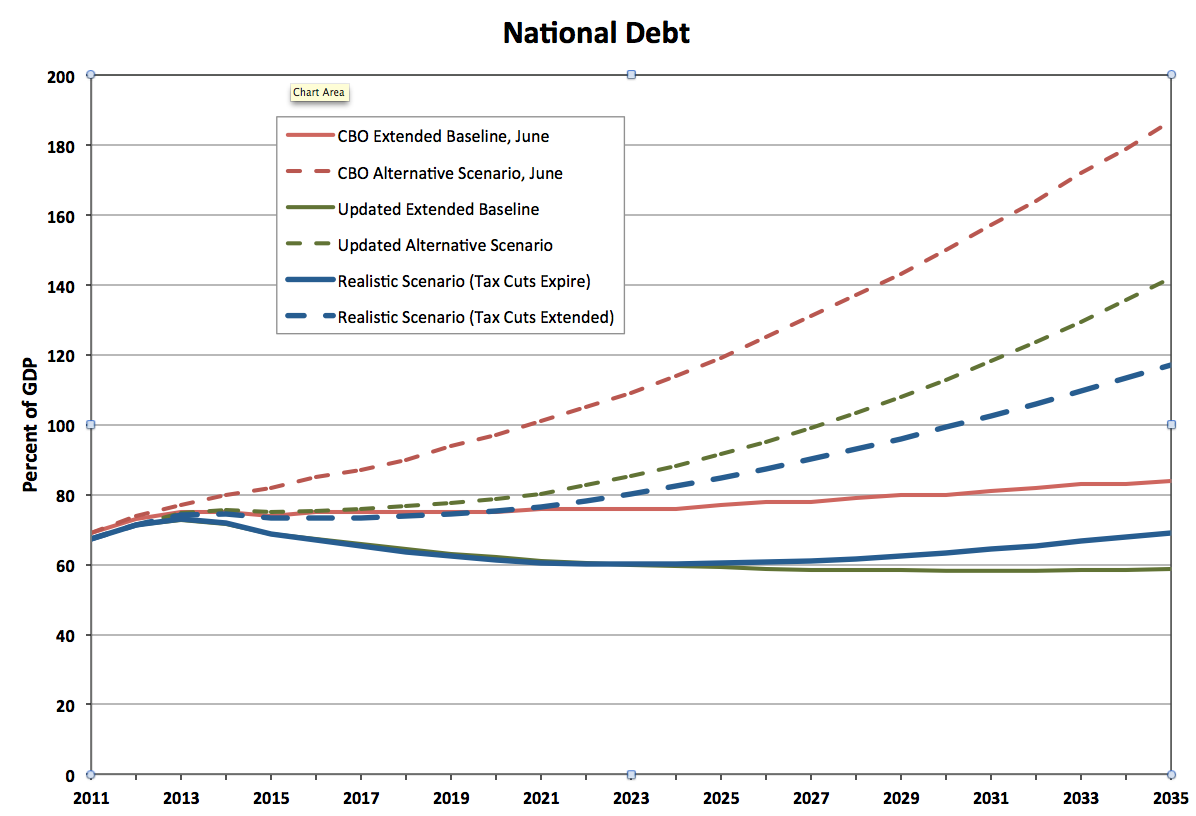
Articles about the deficits and the national debt generally talk about unsustainable long-term deficits that will drive the national debt up to a level where scary things happen. Sensible commentators usually acknowledge that our current deficits are a sideshow and the real problems happen in the 2020s and 2030s due to modestly increasing Social Security outlays and rapidly increasing health care spending. I admit that this has generally been my line as well; for example, in a previous post I said that the ten-year deficit problem is entirely a product of extending the Bush tax cuts, but that even if we let them expire things will get worse over the next two decades.

But looking at the numbers, it’s not clear that the long-term picture is really that bad. Here I’ll lay out the numbers, and then, as they say on Fox News, you can decide. The summary is the chart above; the details are below.

Continue reading “How Big Is the Long-Term Debt Problem?”