Category: Commentary

No One Is Above The Law

By Simon Johnson

The American ideal of “equal and impartial justice under law” has repeatedly been undermined by attempts to concentrate power.  Our political system has many advantages, but it also provides motive and opportunity for resourceful people to become so strong they can elude the legal constraints that bind others.  The most obvious example is the oil and railroad trusts at the end of the nineteenth century.  A version of the same process is happening again today but what has become concentrated is not a vital energy source or the nation’s transport arteries but rather something much more abstract: financial sector risk.

In early 2009, Treasury Secretary Timothy Geithner reportedly said to President Obama and senior members of the new administration, with regard to the financial system:

“The confidence in the system is so fragile still. The trust is gone. One poor earnings report, a disclosure of a fraud, or a loss of faith in the dealings between one large bank and another—a withdrawal of funds or refusal to clear trades—and it could result in a run, just like Lehman.” (from Ron Suskind’s Confidence Men, p.202)

Now three years later, the megabanks are even bigger, as is the risk they concentrate (see my recent testimony to the Financial Institutions subcommittee of the Senate Banking Committee for details.)  Curiously, their precariousness, as much as their power, is shielding these behemoths from the enforcement of financial fraud laws. Continue reading “No One Is Above The Law”
More on Long-Term Care Insurance

By James Kwak

After my previous post on the topic, a friend passed along a recent paper by Jeffrey Brown and Amy Finkelstein in the Journal of Economic Perspectives. I recommend reading it if you are interested in the topic because it provides a lot of good background information and explains some of why the market is the way it is.

They make some similar points to mine. For example (p. 138):

“First, the organization and delivery of long-term care is likely to change over the decades, so it is uncertain whether the policy bought today will cover what the consumer wants out of the choices available in 40 years. Second, why start paying premiums now when there is some chance that by the time long-term care is needed in several decades, the public sector may have substantially expanded its insurance coverage? A third concern is about counterparty risk. While insurance companies are good at pooling and hence insuring idiosyncratic risk, they may be less able to hedge the aggregate risks of rising long-term care utilization or long-term care costs over decades. In turn, potential buyers of such insurance may be discouraged by the risk of future premium increases and/or insurance company insolvency.”

They also show just how expensive private long-term care insurance is. By their calculations, the load on a typical policy is 32% (which means that the present value of benefits is only 68% of the present value of premium costs).  This is what you would expect in a thin market with a lot of adverse selection. (And one more note: The median cost of long-term care is a lot lower than in Massachusetts, the state I cited in my previous post. See this study to see where your state ranks.)

Continue reading “More on Long-Term Care Insurance”

Where Is The Volcker Rule?

By Simon Johnson

Three years ago, a financial crisis threatened to bring down the United States economy – and to spread economic disaster around the world. How far have we come in preventing any kind of recurrence? And will the much-discussed Volcker Rule – attempting to limit the risks that big banks can take – play a positive role as we move forward?

Bad loans were the primary cause of the 2007-8 financial debacle. When the full extent of the problems with those loans became apparent, there was a sharp fall in the values of all securities that had been constructed based on the underlying mortgages – and a collapse in the value of related bets that had been made using derivatives.

The damage to the economy became huge because these losses were not dispersed throughout the economy or around the world. Rather, many of the so-called “toxic assets” were held by the country’s largest banks. Financial institutions that used to lend to consumers and businesses had instead become drawn into various forms of gambling on the booming mortgage market (as well as on commodities, equities and all kinds of derivatives). “Wall Street gets the upside, and society gets the downside” was the operating principle. Continue reading “Where Is The Volcker Rule?”

The Private Insurance Market

By James Kwak

I’m currently in the process of buying long-term care insurance—you know, so my daughter won’t have to take care of me when I’m old. I have a good agent who knows all about the market and has answered every question I’ve had. I understand personal finance, opportunity costs, discount rates, and inflation. I know my way around a spreadsheet (one benefit of my years at McKinsey). But I find it’s still hard to figure out what to do.

A bit of background: Long-term care insurance pays for your stay in a nursing home if you become unable to take care of yourself. Depending on the policy, it may also pay for care you receive at home instead of going into a facility. According to the insurer I’m considering, the median annual cost of a semi-private room in a nursing home in my state is $145,000, and the average stay is something like three years. To put that in perspective, in 2009, the median net worth of families where the head of household was of age 65–74 was $205,000 (including real estate assets).

Long term care is not covered by Medicare, except for a short period after each acute event. It is covered by Medicaid, but to be eligible for coverage you have to exhaust all of your assets. Despite that onerous requirement, Medicaid currently covers 40 percent of all spending on long-term care. (2011 Long-Term Budget Outlook, p. 39.) The Affordable Care Act of 2010 included what is known as the CLASS Act, which would have allowed anyone to buy long-term care insurance, with an average benefit of $75 per day, for a monthly premium of $123. The CLASS Act, however, has been suspended because the administration could not certify that it would be deficit-neutral over the long term. So the bottom line is: until you use up all your money, you’re on your own.

Still, shouldn’t you be able to buy protection in the private insurance market? The short answer is: not really.

Continue reading “The Private Insurance Market”

Karl Rove’s Latest Attack On Elizabeth Warren

By Simon Johnson

Karl Rove’s Crossroads GPS has another ad out attacking Elizabeth Warren (video here).   This is beyond ludicrous – the ad attempts to blame Ms. Warren for the Troubled Asset Relief Program (TARP) and for bank bailouts.  The principle here seems to be that when the truth cannot be slanted in a way you want, just ignore the facts and go all out for disinformation.

I count at least five misrepresentations in the ad, and I suggest the following corrections: Continue reading “Karl Rove’s Latest Attack On Elizabeth Warren”

Thoughts on Law School

By James Kwak

A number of friends have asked me what I thought about David Segal’s article in the Times a couple weeks ago on law schools, so I thought I would share my thoughts here. The short answer is that I thought it was pretty silly.

I admit that law schools aren’t perfect. The simple fact that many (no one really knows how many) law school graduates can’t find jobs as lawyers is a problem. Now, it’s not obvious that that’s the fault of law schools as a group: when you pile a severe recession on top of an ongoing shift among law firms away from first-year associates and toward contract lawyers, the number of entry-level jobs is going to go down, and no matter how good a job the law schools do, that isn’t going to increase the number of jobs. Furthermore, you could make exactly the same criticism about all of higher education: it leaves people with large debts, and many don’t get jobs; imagine the article you could write about humanities Ph.D. programs! Still, Segal’s earlier article pointed out some of the ways in which rankings pressure has pushed some law schools to be less than candid about their graduates’ job prospects, which can’t be good. (And people like making fun of anything that has to do with lawyers. It comes with the territory.)

Continue reading “Thoughts on Law School”

The Huntsman Alternative

By Simon Johnson

The eurozone financial situation continues to worsen.  The latest idea from the eurogroup of finance ministers is apparently to have the European Central Bank make a massive loan to the International Monetary Fund, which would then turn around and lend to countries like Italy.  This is a bizarre notion.  If the IMF takes the credit risk of a mega-loan to Italy – e.g., an amount around the $600 billion mark, greater than the fund’s current lending capacity – this would represent an unprecedented and unacceptable risk to the IMF’s shareholders, including U.S. taxpayers.  If the IMF does not take this credit risk, what’s the point?  The ECB should provide financial support directly to Italy, if that is the goal.

But that goal increasingly seems both to be the only idea of officials and the last failed notion of a fading era.  More bailouts and the reinforcement of moral hazard – protecting bankers and other creditors against the downside of their mistakes – is the last thing that the world’s financial system needs.   Yet this is also the main idea of the Obama administration.  Treasury Secretary Tim Geithner told the Fiscal Times this week that European leaders “are going to have to move more quickly to put in place a strong firewall to help protect countries that are undertaking reforms,” meaning more bailouts.  And this week we learned more about the underhand and undemocratic ways in which the Federal Reserve saved big banks last time around.  (You should read Ron Suskind’s book, Confidence Men: Wall Street, Washington, and the Education of a President, to understand Mr. Geithner’s philosophy of unconditional bailouts; remember that he was president of the New York Fed before become treasury secretary.)

Is there really no alternative to pouring good money after bad?

In a policy statement released this week, Governor Jon Huntsman articulates a coherent alternative approach to the financial sector, which begins with a diagnosis of our current problem: Too Big To Fail banks, Continue reading “The Huntsman Alternative”

The End Of The Euro

By Peter Boone and Simon Johnson – this post is the first two paragraphs of a column that appears this morning on Bloomberg.com

Investors sent Europe’s politicians a painful message last week when Germany had a seriously disappointing government bond auction. It was unable to sell more than a third of the benchmark 10-year bonds it had sought to auction off on Nov. 23, and interest rates on 30-year German debt rose from 2.61 percent to 2.83 percent. The message? Germany is no longer a safe haven.

Since the global financial crisis of 2008, investors have focused on credit risk and rewarded Germany with low interest rates for its perceived frugality. But now markets will focus on currency risk. Inflation will accelerate and the euro may break up in a way that calls into question all euro-denominated obligations. This is the beginning of the end for the euro zone.

To read the rest of this column, please use this link: http://www.bloomberg.com/news/2011-11-28/the-euro-area-is-coming-to-an-end-peter-boone-and-simon-johnson.html

1994 vs. 2011

By James Kwak

I’m sorry that I’ve been too busy for the past two weeks to blog much, but I did manage to write a column for The Atlantic yesterday. It looks at how far the conservative revolution has come in less than a generation and wonders why they can’t just declare victory and go home.

Why Not Break-Up Citigroup?

By Simon Johnson

Earlier this week, Richard Fisher – President of the Dallas Federal Reserve Bank – captured the growing political mood with regard to very large banks:  “I believe that too-big-to-fail banks are too-dangerous-to-permit.” Market-forces don’t work with the biggest banks at their current sizes; they have great political power and receive almost unlimited implicit subsidies in the form of protection against downside risks – particularly in situations like now, with the European financial situation looking precarious.

“Downsizing the behemoths over time into institutions that can be prudently managed and regulated across borders is the appropriate policy response. Then, creative destruction can work its wonders in the financial sector, just as it does elsewhere in our economy.”

Mr. Fisher is an experienced public official – and also someone with a great deal of experience in financial markets, including running his own funds-management firm.  I increasingly meet leading figures in the financial sector who share Mr. Fisher’s views, at least in private.

What then is the case in favor of keeping mega-banks at their current scale?  Vague claims are sometimes made, but there is very little hard evidence and often a lack of candor on that side of the argument.  So it is refreshing to see Vikram Pandit, CEO of Citigroup, go on the record with The Banker magazine to at least explain how his bank will generate shareholder value.  (The interview is behind a paywall, unfortunately). Continue reading “Why Not Break-Up Citigroup?”

Wall Street v. Elizabeth Warren

By Simon Johnson

Karl Rove’s Crossroads GPS group has launched the first attack ad against Elizabeth Warren, presumably because she is now running hard for the Senate in Massachusetts.  This ad is not a big surprise, but the line that Mr. Rove takes could well backfire.

The ad states, “we need jobs, not radical theories and protests,” so we can break the argument down into three separate parts.

First, who destroyed more than 8 million jobs in the United States – and plunged us into the deepest and longest lasting recession since the 1930s?  Surely this was not Ms. Warren, who was just a law school professor, in the run-up to 2008.

Mr. Rove is opening the blame game and this is going to go badly for his presumed supporters – the largest banks on Wall Street that took excessive risks, paid their top people well, and then blew themselves up at great cost to the American taxpayer.  By all means, let us have a conversation about jobs and the history of job losses in the United States; “too big to fail” banks do not look good in this context. Continue reading “Wall Street v. Elizabeth Warren”

Is Europe On The Verge Of Another Great Depression – Or A Great Inflation?

By Simon Johnson

The news from Europe, particularly from within the eurozone, seems all bad.  Interest rates on Italian government debt continue to rise.  Attempts to put together a “rescue package” at the pan-European level repeatedly fall behind events.  And the lack of leadership from Germany and France is palpable – where is the vision or the clarity of thought we would have had from Charles de Gaulle or Konrad Adenauer?

In addition, the pessimists argue, because the troubled countries are locked into the euro, there are no good options.  Gentle or even dramatic depreciation of the exchange rate for Greece or Portugal or Italy is not in the cards.  As a result, it is hard to lower real wages so as to restore competitiveness and boost trade.  This means that the debt burdens for these countries are likely to seem insurmountable for a long time.  Hence there will likely be default and resulting global financial chaos.

According to the September 2011 edition of the IMF’s Fiscal Monitor, 44.4 percent of Italian general government debt is held by nonresidents, i.e., presumably foreigners (Statistical Table 9).  The equivalent number for Greece is 57.4 percent, while for Portugal it is 60.5 percent.  And if you want to get really negative and think the problems could spread from Italy to France, keep in mind that 62.5 percent of French government debt is held by nonresidents.  If Europe has a serious meltdown of sovereign debt values, there is no way that the problems will be confined just to that continent.

All of this is a serious possibility – and the lack of understanding at top European levels is a serious concern.  No one has listened to the warnings of the past three years.  Almost all the time since the collapse of Lehman Brothers has been wasted, in the sense that nothing was done to put government finances on a more sustainable footing.

But perhaps the pendulum of sentiment has swung too far, for one simple and perhaps not very comfortable reason. Continue reading “Is Europe On The Verge Of Another Great Depression – Or A Great Inflation?”

Our Health Care System, Compared

By James Kwak

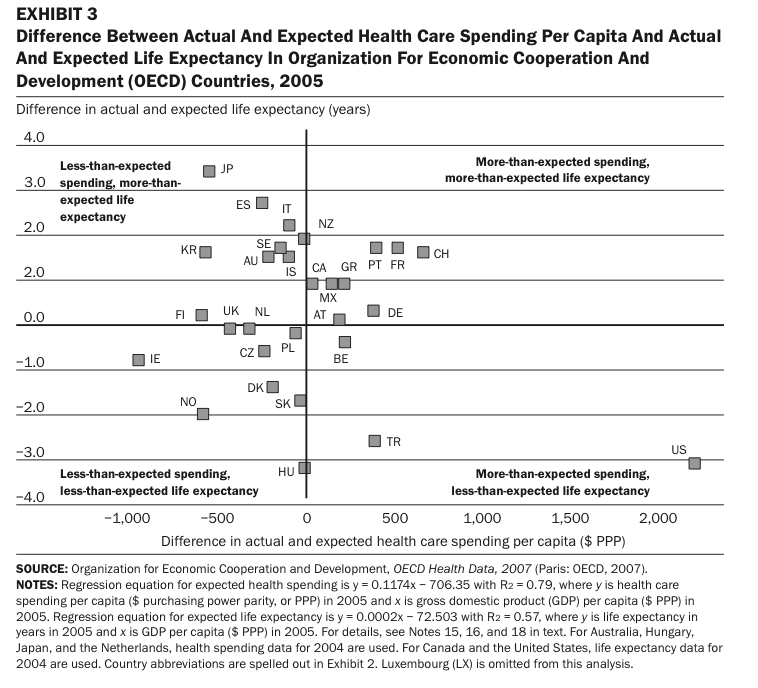
I was looking at OECD health care data for something else I’ve been working on and wanted to share some of it. It’s well known that the United States spends a lot more per person on health care than comparable countries and that our actual health outcomes are anywhere from average to bad. See, for example, this chart from a 2008 paper by Gerard Anderson and Bianca Frogner.

That chart shows how each country’s spending and life expectancy differ from what you would expect based solely on how rich they are (per capita GDP). As you can see, we spend a lot more and live a lot less. (That paper also considers a number of other outcome measures; we do well on some, poorly on others.)

Besides where we are today, though, the other thing we should be interested in is where we are going. Our health care system is the product of a number of historical factors that we can’t make go away with a snap of our fingers. So even if we have a bad, expensive health care system, maybe it is getting relatively better and relatively less expensive.

Nope.

Continue reading “Our Health Care System, Compared”