Author: James Kwak

Time for a Weekend

We don’t try to be a news site – it’s too much work to keep up with everything that happens on an hour-to-hour basis – and generally we try to provide analysis and commentary instead. But right now I just want to note the major turn events have taken in the last few days.

After a few weeks of relative calm – the economy was doing badly, but we knew that already, and there were no major controversies or scandals since the auto bailout and Bernie Madoff – the pace has picked up again. To summarize, in case you were on vacation this week:

  • Bank of America started falling into the abyss, but got a lifeline, just like Citigroup 2.
  • Speaking of which, Citigroup announced that its strategy for the last ten years has been a failure and that it is splitting itself into two banks, a “good bank” and a “bad bank” – but unfortunately it still owns both of them. It also announced $6.0 billion in increased loan loss reserves, $7.8 billion in writedowns on securities, and a $5.3 billion writedown on derivatives (I wonder how much of that affects the $300 billion in assets guaranteed by the government), but nevertheless made an Orwellian assertion of “Continued Capital and Structural Liquidity Strength.”
  • The Bank of America bailout undoubtedly made Congressmen even more mad about TARP, but at the same time all these shaky banks (and personal lobbying by Barack Obama) convinced the Senate to release the second $350 billion (both houses would have had to block it). The vote was 52-42, with 46 Democrats and 6 Republicans voting in favor. From one perspective this is not surprising: the Democrats are supposedly the party of activist government, and it was mainly Democrats who passed the bill in the first place. But seen from a long-term perspective . . . the Democrats are the party in favor of saving big banks? and the Republicans are willing to let them fail? How things have changed.
  • In a story that hasn’t gotten the attention it deserves (no doubt due to general bailout fatigue), Treasury is lending $5 billion in TARP money to Chrysler Financial. Now, is Chrysler Financial a healthy financial institution that just needs a little more capital to resume lending, or is it a systemically significant financial institution whose failure must be prevented? Right, I don’t know the answer either. But I guess after the GMAC bailout it was a foregone conclusion. Chrysler, of course, announced that it was relaxing credit standards and offering zero-percent financing on pickup trucks and minivans. (Full disclosure: I own a minivan.)
  • The CPI declined 0.7% in December (excluding food and energy, unchanged), meaning that in Q4 the CPI fell by about 3.4% (excluding food and energy, it fell 0.1%)., further stoking deflation fears. But again, most of the fall in prices is just the reversal of the run-up in energy prices in 2007-08. Now that oil prices seem to have flattened out (gasoline and heating oil are up slightly), we should be able to see what is going on. I am still in the camp that the Fed will be able to prevent deflation. It’s basically a question of how hard they want to try, and they are afraid if they try to hard they will overshoot and create too much inflation.
  • And Ben Bernanke gave a speech in which he floated the idea of creating a government-sponsored “bad bank” that would buy troubled assets from troubled banks: “Yet another approach would be to set up and capitalize so-called bad banks, which would purchase assets from financial institutions in exchange for cash and equity in the bad bank.” This idea got further support from Henry Paulson and Sheila Bair, and could be the big story of the next week (except for something else happening in Washington on Tuesday). Isn’t this original TARP all over again? Yes, it’s similar, but there are good ways and bad ways to do it. The biggest problem I had with original TARP was that it necessarily involved overpaying for assets; Simon and Peter have outlined one way of avoiding that problem.

Overall, this pace of news, primarily from the financial sector, has not been a good sign over the past several months. It’s usually a sign that things are going to get worse, although there is always some chance that this time we will solve these problems once and for all. And there is a new crew moving into town on Tuesday.
Betting on a “Depression”

A friend of mine who bets on Intrade (he made money correctly betting that Rod Blagojevich would survive into this year) alerted me to the fact that Intrade now has a market for whether the U.S. will go into “depression” in 2009 (warning: that link will resize your browser window). Their definition of “depression” is “a cumulative decline in GDP of more than 10.0% over four consecutive quarters,” but they don’t really mean that. What triggers the payout is if the sum of the quarterly annualized GDP growth rates for four consecutive quarters is less (more negative) than -10.0%. (To see the difference: GDP in Q3 2008 was 0.13% smaller than in Q2 2008, but this was reported as an annualized rate of -0.5%.) This would mean that the total economic contraction over those four quarters would be more than (about) 2.5%. This would make the current recession the worst since at least 1981-82 (which had a total peak-to-trough decline of 2.6%), but not necessarily anything that anyone would call a depression.

On to the interesting bit: the last price for this market was 56.3, meaning that the market assigns a 56% probability to the occurrence of a “depression” as defined by Intrade. The average forecast collected by the Wall Street Journal shows a “cumulative decline” of 7.8% (from Q3 2008 to Q2 2009 the forecasts are for contractions at annual rates of 0.5%, 4.3%, 2.5%, and 0.5%), or a peak-to-trough contraction of about 1.9%. Of the 54 individual forecasts collected by the Journal (you can download the data to a spreadsheet), 22, or 41%, are predicting a depression by Intrade’s definition.

So Intrade is more pessimistic than the experts. There has been a lot of talk about the accuracy of prediction markets like Intrade, but a lot depends on the liquidity of the individual market, and this one doesn’t have much (you can see all the outstanding bids and asks). We’ll just have to wait and see who wins this contest.

Here We Go Again . . .

The Wall Street Journal (subscription required; shorter Bloomberg article here) is reporting that Bank of America will receive billions of dollars more in government aid, probably in a deal that looks something like the second Citigroup bailout, ostensibly to help absorb losses incurred by Merrill Lynch since the acquisition was negotiated in September but more generally to shore up B of A’s increasingly shaky balance sheet. At least someone involved knows how this looks: the reports say the deal will be announced on January 20 – yes, the day of Barack Obama’s inauguration – thereby keeping it from being the main story of the day.

It looks bad for all sorts of reasons:

  • Wasn’t B of A supposed to be a healthy bank? Isn’t Ken Lewis (CEO) the person who told Henry Paulson he didn’t need the first round of TARP money, but he would take it to show solidarity and for the public good?
  • The money is going to finance an acquisition? Isn’t that the thing that (according to most people) banks aren’t supposed to be doing with their bailout money?
  • The B of A-Merrill deal closed on January 1. So it looks like – as the WSJ is reporting – the deal only closed because Treasury gave B of A a verbal commitment to supply the needed bailout money later.
  • Isn’t this more policy by deal?

That said, I think some sort of deal has to be done. Even Yves Smith at naked capitalism (one of the most consistent and sharp critics of the way TARP has been implemented), who says this deal “stinks to high heaven,” says that “Merrill is a systemically important player” and “letting the deal with BofA ‘fail’ is a non-starter.” But I predict that when the terms are announced I will think they are too generous – especially since B of A now has all the negotiating power, since they closed the acquisition based on a promise from Treasury.

To recap – because I have this pathological fear of not being understood – I think that TARP’s primary purpose is to protect the financial system against the collapse of any systemically critical financial institutions (I leave it to others to define what those are, but Bank of America definitely is one, GMAC I’m skeptical about), and it has suffered from three main problems:

  1. The initial round was too small, with banks only getting 3% of assets or $25 billion, whichever was smaller – which is why Citi and now B of A have had to come back.
  2. The terms were too generous; I can make an exception for the first round, but I don’t understand why Citigroup 2 and GMAC were so favorable to shareholders.
  3. Except for the very generous initial round, it’s just a pile of money to be used in ad hoc deals, not a comprehensive program with a coherent strategy, so no one is quite sure how or if it will be able to protect the financial system.

The B of A bailout will only sour public and Congressional opinion further against TARP, making it less likely that the second $350 billion will ever be released, and more likely that if it is released it will be packaged with all sorts of conditions (not necessarily bad) or allocated to community banks (beside the point).

It is true that one price we are paying in these bailouts is the creation of a new tier of mega-banks that, because they are Too Big To Fail, have the competitive advantage of being essentially government-guaranteed. What we really need as a condition on TARP money is a new regulatory structure to make sure that these mega-banks do not abuse the oligopolistic position we have just handed them, and perhaps a commitment to break them up when economic circumstances allow. That would be considerably more valuable than a cap on executive salaries and corporate jets. But it will also be a lot more difficult to define and to agree on.

Why Fiscal Stimulus Is Not Enough

Ben Bernanke gave a speech today that will be discussed for, well, at least a few days, outlining the Federal Reserve’s response to the financial crisis. We will probably devote a couple of posts to it (Simon already mentioned it below.)

Although the Obama team and Congress have been focusing on the politically popular fiscal stimulus plan, replete with hundreds of billions of dollars in tax cuts, Bernanke emphasized that stimulus will not be enough (something that Larry Summers seems to agree with, as Simon noted). Here’s the relevant passage:

with the worsening of the economy’s growth prospects, continued credit losses and asset markdowns may maintain for a time the pressure on the capital and balance sheet capacities of financial institutions.  Consequently, more capital injections and guarantees may become necessary to ensure stability and the normalization of credit markets.  A continuing barrier to private investment in financial institutions is the large quantity of troubled, hard-to-value assets that remain on institutions’ balance sheets.  The presence of these assets significantly increases uncertainty about the underlying value of these institutions and may inhibit both new private investment and new lending. . . . In addition, efforts to reduce preventable foreclosures, among other benefits, could strengthen the housing market and reduce mortgage losses, thereby increasing financial stability.

In a nutshell: as the economy gets worse, more and more loans default, eating into banks’ capital cushions; investors are still nervous about all those toxic assets; and the continuing collapse of the housing market hurts all of those mortgages and mortgage-backed securities banks are holding. And as banks teeter toward insolvency, people stop lending them money, and they stop lending people money.

On the plus side, the famous TED spread dipped below 1 today, a sign that credit markets are doing much better than back in September. (The Calculated Risk article behind that link shows improvements in other parts of the credit markets, not just interbank lending.)

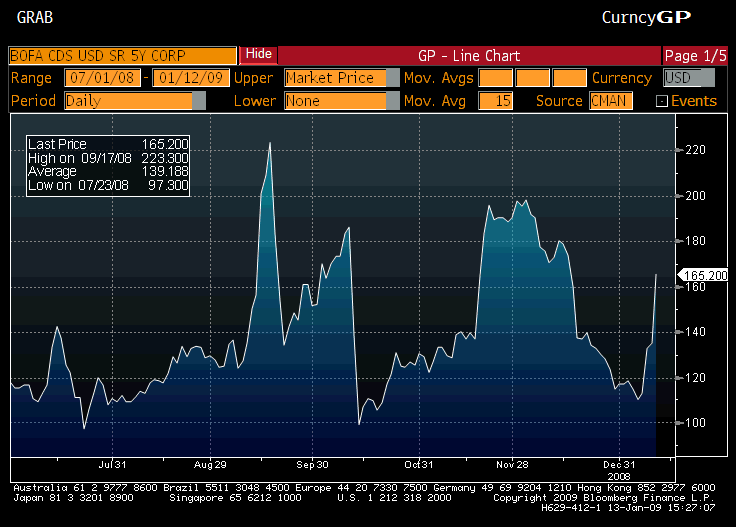
On the minus side, CDS spreads have shot up on Citigroup and Bank of America in the last week – here’s Bank of America:

Bank of America

The main peaks you see are the Lehman bankruptcy, the buildup to the bank recapitalization announcement, and the Citigroup crisis. So while there seems to be general improvement in the credit markets, the underlying problems have not been solved.

Not Quite the Marketing You Want

Robert Siegel gave GM a priceless gift today: a feature segment on All Things Considered, with a bunch of softball questions and a paean to the Chevy Malibu (which was, to give credit where credit is due, the 2008 North American Car of the Year, which includes foreign imports). Then Bob Lutz, GM’s vice chairman, fumbled the gift and dropped it on the floor, where it smashed into a thousand pieces. When asked what it was like to operate using money borrowed from the federal government, he said:

I’ve never quite been in this situation before of getting a massive pay cut, no bonus, no longer allowed to stay in decent hotels, no corporate airplane. I have to stand in line at the Northwest counter. I’ve never quite experienced this before. I’ll let you know a year from now what it’s like.

At my old company, it was a point of pride to search on price-comparison sites for the cheapest hotels you could find. (I know the argument that it saves money for expensive execs to fly corporate jets rather than flying commercial, because at their hourly rates it’s not worth the time spent waiting in line. I think those arguments are bunk, because they assume that the ten minutes you spend waiting in line are ten minutes of work you will not do that day, while my experience is that in high-level positions the amount of work you do is a function of the amount of work you have to do, not the amount of time you have.)

It may be true, as Bob Lutz claims, that GM makes good cars again. (I happen to own and drive a GM car that I am very satisfied with, but it’s a Chevy Prizm, which may not count.) But GM’s brand reputation today is that it is out of touch, and stories like this don’t help.

More TARP Programs, More Policy by Deal

Back on January 2, the Treasury Department announced something called the Targeted Investment Program. I missed this at the time, along with (according to a quick search – thank you Google Reader!) all of the economics blogs that I read. The press release admitted that this was a program announced after the fact to cover the second Citigroup bailout (the first was under the Capital Purchase Program, the main bank recapitalization plan). In essence, the program says that if Treasury thinks a financial institution is at risk of a loss of confidence, Treasury can invest in it under any terms they want. This is very similar to the Systemically Significant Failing Institutions Program, also announced after the fact (in November) to cover the second AIG bailout, which reads almost identically, except instead of talking about a “loss of confidence” it takes about the “disorderly failure” of a systemically important institution.

This isn’t a power grab by Treasury – they already had this power under the EESA (the main bailout bill passed in October, commonly known as TARP). And I happen to agree that if a systemically significant institution – the kind that whose failure would have a major impact on countless other institutions – is going to fail, it should be bailed out. However, I think these programs have two major failings.

Continue reading “More TARP Programs, More Policy by Deal”

Accountability Time

With Congress back in session, accountability is the theme of the week. Barney Frank announced the “TARP Reform and Accountability Act of 2009,” which I hope to get to in a day or two. But for now I want to talk about Elizabeth Warren and the Congressional Oversight Panel for TARP, which issued their second report on Friday. Of course, beating the accountability drum at Henry Paulson’s expense is politically easy, and a lot less controversial than, say, designing a stimulus package or a foreclosure reduction plan. But that doesn’t mean it isn’t important.

Back in September, Simon and I wrote an op-ed in the Washington Post that focused on the incentive problems in the initial TARP proposal and cynically predicted:

It is most likely that “governance” over the fund will be provided by periodic hearings of the relevant Senate and House committees during which the Treasury secretary and the fund managers will be asked why they overpaid for banks’ securities and will answer that there was no choice if the financial system was to be saved.

(Recall that the proposal at that point was for Treasury to buy toxic assets from financial institutions, most likely overpaying the process.) However, the governance measures were strengthened in the eventual legislation, and it does seem that Elizabeth Warren and most of her committee (Jeb Hensarling, R-Texas, did not endorse the report) are committed to keeping Treasury under tight scrutiny, which is all good.

Continue reading “Accountability Time”

A Sliver of Optimism

One of the scary things about this fall’s descent into economic chaos was the failure of economic forecasters to keep pace. Every week economists would predict what they said were terrible things, and then the data would come in much worse, reinforcing the overall impression that no one knew what was going on.

Buried in all the negative reports about the December jobs data was one fact that was a tiny bit encouraging: the December job losses were almost exactly what forecasters expected, on average. This indicates that it’s possible that the macroeconomic community has come to grips with the magnitude of the downturn; if you’re feeling particularly giddy, you might even infer that this means that their GDP forecasts are in the right ballpark, which means (according to the WSJ) that the economy should start growing in Q3.

I wouldn’t go that far, though, and I think that Q3 forecast is too optimistic. It takes time to plan and execute a layoff (I’ve been there), so December layoffs are based on revenue projections based on data from October and maybe November. Because sales continued to fall faster than expected in November, companies will find they have to lay off more people than they initially expected, and that will drag into the new year. Furthermore, no one really knows how much the American household will shift from consumption to saving, and my sneaking suspicion is that it will be more than most people expect.

So all I can offer is a tiny sliver of optimism, that the people in the forecasting business are at least on the same planet as the rest of us. But still no one is sure what planet we’re on.

The Cost of Reputation

Or, more accurately, the cost of caring about your reputation.

My recent article on Risk Management for Beginners closed with some unrigorous speculation about the peculiar incentives of fund managers, who are consistently well compensated in decent and good years and, in bad years, lose their clients’ money and move on to start a new fund. Steven Malliaris and Hongjun Yan have a paper on this topic entitled “Nickels Versus Black Swans:” “nickels” being the typical hedge fund strategy of making a small but consistent return with a small risk of a huge loss, and “black swans” being Taleb’s preferred strategy that makes a small but consistent loss with a small risk of a huge gain.

Simplifying the model, the problem with a black swan strategy is that by the time the huge gain rolls around, you the manager have already been fired (your clients have withdrawn their money) because of your consistent losses. The result is overinvestment in nickel strategies and underinvestment in black swan strategies – even when the latter have a higher expected return. This result holds even when you assume that the investors are sophisticated, because the key factor is the reputational concerns of the fund managers themselves.

Malliaris and Yan also show that the system can reach multiple equilibrium points: the system can be in one equilibrium where most hedge funds are pursuing suboptimal strategies, and then suddenly shift to another quickly, meaning that the hedge fund industry does not allocate capital as efficiently as one might imagine. This might help explain why (a) everyone is saying that AAA-rated mortgage-backed securities are underpriced yet (b) no one is buying them.

This paper might be seen as simply translating common sense into mathematics. Seen another way, though, it helps explain why individually rational behavior (by fund managers) does not produce the efficient outcomes you learn in first-year economics.

Paulson v. Buffett

Bloomberg has a new story out comparing the investment terms achieved by TARP with those achieved by Warren Buffett when he invested $5 billion in Goldman back in September. The results aren’t pretty for the U.S. taxpayer: the government received warrants worth $13.8 billion in connection with its 25 largest equity injections; under the terms Buffett got from Goldman, those warrants would be worth $130.8 billion. (The calculations were done using the Black-Scholes option pricing formula, which has its critics, but which I think is still a good way of estimating the relative difference between similar options.) That’s on top of the fact that TARP is getting a lower interest rate (5%) on its preferred stock investments than is Buffett (10%), which costs taxpayers $48 billion in aggregate over 5 years, according to Bloomberg. The difference in the value of the warrants themselves is due to two factors: (1) Treasury got warrants for a much smaller percentage of the initial investment amount; and (2) those warrants are at a higher strike price – the average price over the 20 days prior to investment, while Buffett got a discount to market price on the date of investment.

The comparison isn’t a new one – we recommended that TARP emulate Buffett back in October – but Bloomberg’s analysis has put the performance gap in striking perspective. Simon has a quote in the article, using the word “egregious,” but the really harsh words came from Nobel prize-winner economist Joseph Stiglitz, who said, “Paulson said he had to make it attractive to banks, which is code for ‘I’m going to give money away,'” and “If Paulson was still an employee of Goldman Sachs and he’d done this deal, he would have been fired.”

Continue reading “Paulson v. Buffett”

China and the U.S. Debt

I’m warming up for a longish Beginners-style article on government debt, which will come out next week or so. In the meantime, the New York Times has an article today about China’s diminishing demand for U.S. dollar-denominated debt. Theoretically this could make it harder for the U.S. to borrow money and thereby push up the interest rates on our debt (now at extremely low levels).

China’s voracious demand for American bonds has helped keep interest rates low for borrowers ranging from the federal government to home buyers. Reduced Chinese enthusiasm for buying American bonds will reduce this dampening effect.

However, the article doesn’t mention one compensating factor. The fall in China’s buildup of its foreign currency reserves is linked to the rise in the U.S. savings rate, which is projected to rise to as much as 6-10% (it was over 10% in the 1980s). Some of that new savings will go to pay down debt, but a lot will go into savings accounts, CDs, money market funds, and mutual funds – which means that depresses interest rates across the board. On the back of the envelope, 6% of personal income is about $600 billion a year in new domestic savings to compensate for reduced overseas investment. Whether this will be enough to compensate entirely I don’t know. But if we were all one global economy in the boom, we’re still one global economy in the bust.

Obama Doubles Down

Barack Obama did not actually predict trillion-dollar deficits indefinitely; more precisely, he said, “unless we take decisive action, even after our economy pulls out of its slide, trillion-dollar deficits will be a reality for years to come” (emphasis added). At the same time, the highly competent Congressional Budget Office projected a $1.2 trillion deficit for fiscal 2009 (year ending 9/30/09).

I was initially surprised by Obama’s forthrightness on the deficit question, but on reflection there are three good reasons for him to do it:

  1. He wants to lower expectations by making the case that we have a serious deficit problem before taking office.
  2. He wants to signal that he is aware of the deficit issue, to try to defuse the attacks he is going to get from fiscal conservatives regarding his stimulus plan.
  3. He wants to use the current crisis – and the political opportunity it gives him, as a new and generally popular president with significant majorities in both houses – to tackle the long-term retirement savings problem.

If you parse the sentence, in saying “even after our economy pulls out of our slide,” Obama is saying that the long-term deficit problem would exist with or without the current crisis – and he is right. A $1.2 trillion deficit, caused by a steep fall in tax revenues, partially by the costs of various bailouts, and a little bit by two ongoing wars, is small compared to the Social Security and Medicare funding gaps ahead. In signaling that he will announce some kind of approach to entitlement spending by next month, Obama is implying that he wants to take on not just the short-term recession, but also the long-term deficit problem.

This is good for two reasons. First, someone has to face the problem. President Bush “tried” (not very hard) to do something about Social Security in 2005, although the general direction of his proposal, in shifting from a defined-benefit to a defined-contribution model, would have shifted risk from the government onto individuals.

Second, there are economic reasons why long-term sustainability should be addressed at the same time as short-term stimulus. Virtually everyone (even Martin Feldstein) favors a large, debt-financed government stimulus package. However, the more the government borrows, the more risk there is that lenders will worry about our ability to pay off the debt. While few people expect the U.S. to default, the more widespread fear is that we will print money (in a more sophisticated form, of course) to inflate away the debt. Because of those fears, large amounts of borrowing will drive up interest rates, especially as the economy recovers, both for the government (increasing our interest payments) and for the economy as a whole (undermining growth). The solution, if there is one, is to put forward a credible plan for dealing with the long-term retirement problem.

The risk, of course, is that Social Security and Medicare can be politically lethal, which is one reason President Bush backed off so fast. But I still think this is the right bet for Obama to make. Insofar as any solution is going to involve some pain (lower benefits, increased benefit age, higher taxes, increased control over health care), it is going to be easier to pass in a time of perceived collective crisis. And being willing to tackle the problem could also help gain support from fiscal conservatives for the stimulus that we need now.

Risk Management for Beginners

For a complete list of Beginners articles, see the Financial Crisis for Beginners page.

Joe Nocera has an article in today’s New York Times Magazine about Value at Risk (VaR), a risk management technique used by financial institutions to measure the risk of individual trading desks or aggregate portfolios. Like many Magazine articles, it is long on personalities (in this case Nassim Nicholas Taleb, one of the foremost critics of VaR) and history, and somewhat light on substance, so I thought it would be worth a lay explanation in my hopefully by-now-familiar Beginners style.

VaR is a way of measuring the likelihood that a portfolio will suffer a large loss in some period of time, or the maximum amount that you are likely to lose with some probability (say, 99%). It does this by: (1) looking at historical data about asset price changes and correlations; (2) using that data to estimate the probability distributions of those asset prices and correlations; and (3) using those estimated distributions to calculate the maximum amount you will lose 99% of the time. At a high level, Nocera’s conclusion is that VaR is a useful tool even though it doesn’t tell you what happens the other 1% of the time.

naked capitalism already has one withering critique of the article out. There, Yves Smith focuses on the assumption, mentioned but not explored by Nocera, that the events in question (changes in asset prices) are normally distributed. To summarize, for decades people have known that financial events are not normally distributed – they are characterized by both skew and kurtosis (see her post for charts). Kurtosis, or “fat tails,” means that extreme events are more likely than would be predicted by a normal distribution. Yet, Smith continues, VaR modelers continue to assume normal distributions (presumably because they have certain mathematical properties that make them easier to work with), which leads to results that are simply incorrect. It’s a good article, and you’ll probably learn something.

While Smith focuses on the problem of using the wrong mathematical tools, and Nocera mentions the problem of not using enough historical data – “All the triple-A-rated mortgage-backed securities churned out by Wall Street firms and that turned out to be little more than junk? VaR didn’t see the risk because it generally relied on a two-year data history” – I want to focus on another weakness of VaR: the fact that the real world changes.

Continue reading “Risk Management for Beginners”

The Importance of Accounting

Or, as I thought of titling this post, SEC does something useful!

Accounting can seem a dreadfully boring subject to some, but it gets its moment in the sun whenever there is a financial crisis . . . remember Enron? This time around is no exception. During the panic of September, some people were calling for a suspension of mark-to-market accounting, and while they did not get what they wanted, they succeeded in inserting a provision in the first big bailout bill to study the relationship between mark-to-market accounting and the financial crisis.

A brief, high-level explanation of the dispute: Under mark-to-market accounting, assets on your balance sheet have to be valued at their current market values. So if you have $10 million worth of stock in Microsoft, but that stock falls to $5 million, you have to write it down on your balance sheet and take a $5 million loss on your income statement. The criticism was that mark-to-market was forcing financial institutions to take severe writedowns on assets whose market values had fallen precipitously, not because of their inherent value, but because nobody was buying these assets – think CDOs – and that banks were becoming insolvent because of an accounting technicality. Under this view, banks should be able to keep these assets at their “true” long-term values, instead of having to take writedowns due to short-term market fluctuations.

I am instinctively skeptical of this view, and in favor of mark-to-market accounting, because I believe that while market valuations may not be perfect, they are generally better than the alternative, which is allowing companies to estimate the values themselves, subject only to their auditors and regulators. But the issue is considerably  more complicated than either the simple criticism or my simple defense would imply.

Earlier this week, the SEC released its study of mark-to-market accounting as required by the bailout bill. Their conclusions are simple:

fair value [mark-to-market, as will be explained] accounting did not appear to play a meaningful role in bank failures occurring during 2008. Rather, bank failures in the U.S. appeared to be the result of growing probable credit losses, concerns about asset quality, and, in certain cases, eroding lender and investor confidence.

Continue reading “The Importance of Accounting”

Reliving the Fun Times

With the holidays coming to an end, my little burst of reading books (as opposed to newspapers and blogs) is coming to an end with the recent collection Panic, edited by Michael Lewis, which I got for Christmas. (I also got Snowball, the new biography of Warren Buffett, but that’s 900 pages long, so it may be a while.) The book contains several as-it-happened articles on each of four recent financial panics: the 1987 stock market crash, the 1997-98 emerging markets crisis, the collapse of the Internet bubble, and the thing we’re going through now. It’s long on entertainment – both the entertainment of hearing people say things like, “The more time that goes by, the less concerned I am about a housing bubble,” and the entertainment of reading legitimately good writing, some of it by Lewis himself. But given the format, it’s necessarily short on analysis, and its main point, if any, seems to be that all panics are alike: people underestimate risk, they think they are different, they do silly things, Wall Street people make a killing, and then bad things happen.

I believe the book was released in November, but it seems like the final touches were put on sometime in late spring or early summer – Bear Stearns had fallen, but Freddie and Fannie were still independent, and Lehman was just another investment bank. So the book provides this past summer’s perspective on the crisis: a collapsing housing bubble taking down isolated hedge funds that had invested in mortgage-backed CDOs, and one investment bank (Bear Stearns) for no clearly explained reason: Lewis’s own essay on the topic focuses on the inherent complexity of Wall Street firms and how even their CEOs don’t understand them. Reading the articles from 2007 and early 2008 reminds you how few people if any foresaw the impact the collapsing bubble would have on the financial sector as a whole.

Continue reading “Reliving the Fun Times”