Author: James Kwak

Payback Time

Once upon a time there was a president named George. He liked to do things his own way, which annoyed some of his “friends” in Europe. But then a new president named Barack was elected, who not only promised to be nicer to his friends, but was actually very popular in most parts of the world. And the people of the world thought we would see a new era of international cooperation, at least between the U.S. and Europe.

Not so much.

On this side of the Atlantic, the Obama administration and the Fed have been working night and day in an attempt to turn around the economy: Fed funds rate reduced to zero, $800 billion stimulus package, new plan to aid struggling homeowners, new plan for buying toxic assets, new budget, decision by the Fed to buy long-term Treasury bonds, new domestic regulatory framework outlined this week, etc. We’ve been plenty critical of various aspects of the U.S. response, but at least they’re trying.

(Continental) Europe, by contrast, has decided they’ve done enough and it’s time to sit back and watch.

Continue reading “Payback Time”

What the IMF Would Tell the United States, If It Could

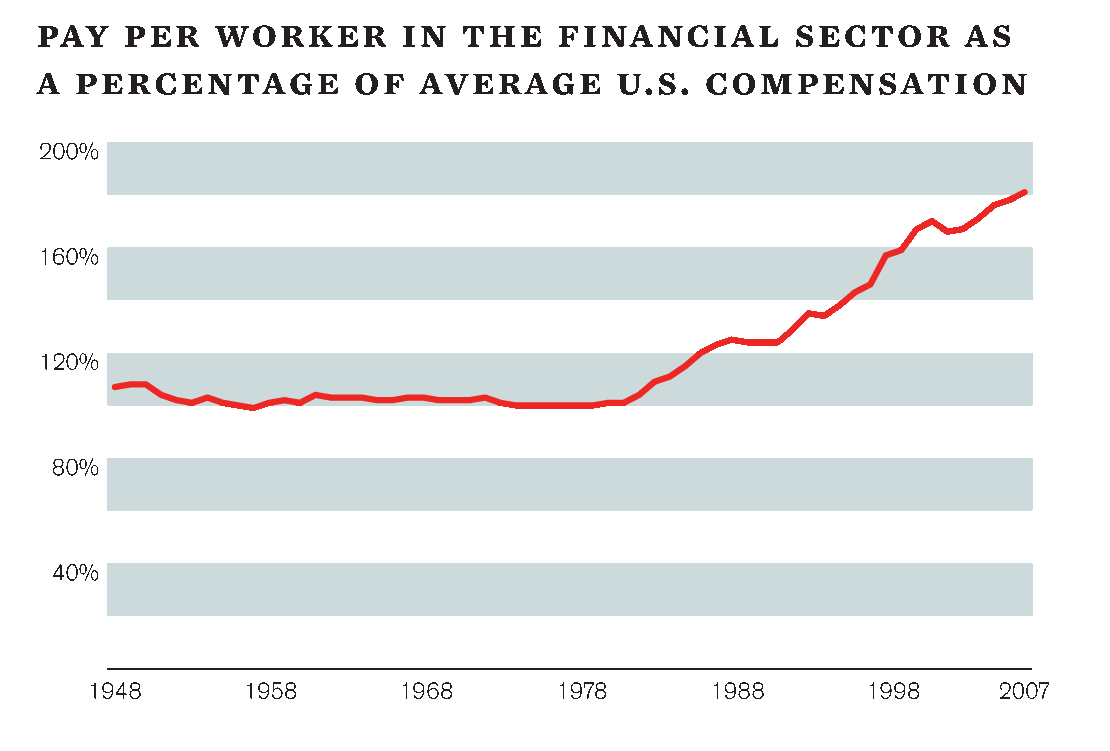
From 1945 until around 1980, the financial sector was one industry among many in the United States. Then something happened.

compensation4

People in finance started making more money,* jobs in finance became more desirable, financial institutions became more influential, and the linkages between the financial sector and the political establishment became stronger. At the same time that our financial sector became more leveraged and more risky, it also became more powerful. The result was a confluence of interests between Wall Street and Washington – one more normally found behind the scenes of emerging market crises, the kind the IMF is called on to resolve.

Simon and I tell this story – and the story of what happened next – in “The Quiet Coup,” an article in the May issue of The Atlantic. (Many thanks to The Atlantic for putting the online copy up as early as they did.) The working title of the article was, “What the IMF Would Tell the United States, If It Could.” Enjoy.

* The data in that chart are from Table 6.6 of the National Income and Product Accounts tables available from the Bureau of Economic Analysis.

Update: Henry Seggerman recently sent us an article he wrote in 2007, comparing the Korean crisis of 2007 to the then-current situation in the United States. He discusses not only the economic similarities, but also some of the political ones.

Update 2: A reader sent us an article about Mark Patterson, formerly Goldman’s chief lobbyist and now Tim Geithner’s chief of staff. Unfortunately, the article was published too late for us to use any of it in our Atlantic article.

By James Kwak

Frog, Toad, Cookies, and Financial Regulation

My two-year-old daughter loves Frog and Toad.

There is a Frog and Toad story called “Cookies.” It is the only Frog and Toad story I remember from my childhood. Toad bakes some cookies and takes them to Frog’s house. They are very good. Frog and Toad eat many cookies, one after another. They try very hard to stop eating cookies, but as long as the cookies are in front of them, they cannot help themselves.

So Frog puts the cookies in a box. Toad points out that they can open the box. Frog ties some string around the box. Toad points out that they can cut the string. Frog gets a ladder and puts the box on a high shelf. Toad points out .  . .

Finally Frog takes down the box, cuts the string, opens the box, and gives all the cookies to the birds.

“Read more, Daddy,” my daughter says.

“One moment, I have to tell all the nice people the moral to the story.”

Continue reading “Frog, Toad, Cookies, and Financial Regulation”

What’s Plan B?

One of the determinants of how you feel about the Geithner Plan is what you think will happen if it fails. By “fails,” I mean that the buyers’ bids are lower than the sellers’ reserve prices, so the toxic assets don’t actually get sold.

Brad Delong, for example, is moderately in favor of the plan, even though he thinks it is insufficient. In his words, “I think Obama has to demonstrate that he has exhausted all other options before he has a prayer of getting Voinovich to vote to close debate on a bank nationalization bill. Paul [Krugman] thinks that the longer Obama delays proposing bank nationalization the lower it’s chances become.” (“Voinovich” is DeLong’s hypothetical 60th senator, whose vote would be needed in the Senate.) In other words, DeLong thinks that if this plan fails, the administration will be more likely and able to go forward with nationalization.

Paul Krugman, by contrast, is strongly against the plan, first because he thinks it has no chance of succeeding, and second because he thinks there is no Plan B. “I’m afraid that this will be the administration’s only shot — that if the first bank plan is an abject failure, it won’t have the political capital for a second.”

Continue reading “What’s Plan B?”

What Is a Non-Bank?

I’ve read the NYT and WSJ articles, and the prepared testimony by Bernanke and Geithner, and I have a very basic question. Bernanke and Geithner said they needed new power over “systemically important nonbank financial firms” or “large, interconnected, non-depository financial institutions” or, most simply, “non-banks.” This is to complement the FDIC’s existing power to take depository institutions (“banks”) into conservatorship.

Are bank holding companies “non-banks,” which happen to have “banks” as subsidiaries? If so, the legislation they are asking for should make it easier to nationalize a large, complicated thing (I don’t know what to call it anymore, but you know what I mean) like Citigroup. Various people arguing against nationalization have said that while the government has the power to take over the depository institutions within Citigroup, it can’t take over the umbrella entity; this would eliminate that problem.

If so, I would call that a good thing. But I can’t find the answer.

Update: Thanks to the commenters. And to Yves Smith. So the Fed has regulatory authority over bank holding companies (that bit I already knew), but there is no defined process similar to what the FDIC does for taking over and winding down failing institutions.

Banks Find New Way to Hold Up Government

From The Wall Street Journal today:

Some bankers say they turned the conversations into complaints about the antibonus crusade consuming Capitol Hill. Some have begun “slow-walking” the information previously sought by Treasury for stress-testing financial institutions, three bankers say, and considered seeking capital from hedge funds and private-equity funds so they could return federal bailout money, thereby escaping federal restrictions.

Ummm . . . if they could get capital from hedge funds and private-equity funds, wouldn’t they have done so already? And they are now resisting the stress tests? Simon is usually more negative about banks’ recent behavior than I am, but I’m catching up.

Distressingly, the article is mainly about how the administration is trying to “fix” this situation by offering greater access to Wall Street leaders. Apparently they actually tried to freeze out the bankers early in the administration, but recently changed course.

By James Kwak

Will It Work?

Leaving aside the question of subsidies, which has gotten piles of attention on the Internet, Simon and I are skeptical that the Geithner Plan will achieve its basic objective: getting enough toxic assets off of bank balance sheets to restore the financial system to normal functioning. We discuss this in today’s Los Angeles Times op-ed, although our regular readers could probably fill in the blanks by themselves.

Update: At 2:30 PM Eastern today, I’ll be on a live chat at Seeking Alpha with Felix Salmon and possibly Brad DeLong and Mark Thoma discussing the Geithner plan. Salmon is strongly against, Delong is moderately (strongly?) for, Thoma is moderately for.

Update 2: At The New Republic, Simon discusses one plausible scenario under which the Geithner Plan is the first step in a comprehensive bank rescue strategy. But he’s skeptical that we will see the other necessary steps.

Update 3: Chat is done; replay is here.

By James Kwak

The Cultural Costs of Bailout Nation

This post was written, at my request, by Carson Gross, one of our regular readers and a multi-talented person I have worked with in the past. (We met one night when I needed help debugging a classpath error I was getting on my computer.) I don’t necessarily agree with what he says,  but I think he has something valuable to say. Everything below is by Carson.

James asked me to elaborate on a comment in which I worried about the public’s reaction to the real or perceived wealth transfers occurring during this financial crisis – in particular, how that reaction would manifest itself culturally.

“Wealth transfers” is a charged term, and a lot of smart people have spent a lot of time patiently explaining that, in fact, most of the bailout thus far involves loans and that, under some models (which, apparently, don’t include housing prices regressing to roughly 3x incomes, where they have been for most of history) we, the taxpayers, may actually end up making money on this whole thing.  I think that’s fanciful, but I’m not going to debate that here.  Rather, I want to focus on the bailout’s cultural impact.

I assert, without proof, that the proverbial man on the street sees the words “bailout” blaring on his TV and computer screen day in and day out, and doesn’t care to look too deeply into the details.  Who can blame him?  He has enough of his own problems to deal with without attempting to decipher deliberately impenetrable financial jargon.  Even if the government is getting reasonable compensation for the capital injections in some cases, the man on the street just sees more of his tax dollars going into banks to pay out people who make orders of magnitude more money than he’ll ever see.  That’s his reality.

Continue reading “The Cultural Costs of Bailout Nation”

Economics, Politics, Outrage, and the Media

Warning: This is a post about economics and politics; it is a reader response post; but (here’s the warning), it’s also one of those annoying self-referential posts you only see on the Internet discussing a debate among the commentariat.

Last week went something like this:

  1. We learned about the $165 million in retention bonuses at AIG Financial Products.
  2. A lot of people, up to and including President Obama, got mad.
  3. Various commentators, including Ian Bremmer (on Planet Money, around the 14-minute mark) and Joe Nocera, said, in Nocera’s words, “Can we all just calm down a little?”

Their argument is basically that $165 million is small change, the government should be working on bigger issues, and the demonization of AIG is making it harder to solve the real problems.

Continue reading “Economics, Politics, Outrage, and the Media”

Let the People In

The Geithner Plan is out. I don’t have time to look at it in detail, but in the meantime, PK, one of our readers (and someone we correspond with a lot), had an idea:  If we’re going to subsidize the private sector, why not let individuals into the deal? In his words:

If Geithner’s taxpayer subsidized toxic public/private plan goes forward, I think it would be fair if the federal government allow non-institutional investors to participate via a no-fee investment vehicle.  I think if Americans had the option of investing in this program (without having to pay the egregious fees to the investment advisors/PE shops), it would be much easier to swallow since they would at least get the same deal the sharks are getting.  There is probably more money on the sideline with individual investors than all these institutional investors.   Maybe they could set up some ETF equivalent for it.  I think the willingness of the administration to do such a thing would tell us a lot about whose for whose interest they are really looking out.

Capital for the investment funds will come from private fund managers (raising new capital from their limited partners) and from Treasury. Perhaps either a fund manager or Treasury could create an ETF- or mutual fund-type structure, where the government subsidizes the usual management fees, and use that to raise some of the capital. I know that because most individuals aren’t “sophisticated investors” this would subject the fund – or at least the individual part of it – to a higher degree of regulation, but that doesn’t seem like a bad thing.

I think it’s a brilliant idea.

(As far as the plan itself, my first reaction is that the Legacy Securities Program actually doesn’t do enough to attract private sector participation, since the leverage is only 50% or maybe 100% of the capital.)

Update: Matt Yglesias and F. Blair (below) have pointed out the following language: “The program will particularly encourage the participation of individuals, mutual funds, pension plans, insurance companies, and other long-term investors.” I believe that’s from the program for loans, not securities (the latter involves up to five professional asset managers, who generally raise their money only from qualified investors). So maybe there is something there.

By James Kwak
Exploding Cars for Beginners

Mark Thoma does a nice job comparing government purchases, public-private partnerships, and nationalization, and gets the concluding paragraph exactly right. It won’t help you through the complexities of whatever Geithner will announce in the morning, but it explains the basic concepts.

Reader Questions: Nationalization

If I had infinite time, I would respond to all reader questions and suggestions. Unfortunately, I can’t. But I’m hoping to occasionally post some in-depth responses to some of the tougher questions we get.

Chris Uregian, one of our readers, sent us three questions by email. In summary, he thought that we were overlooking some of the problems with nationalization and the reasons why Treasury might be moving more slowly than we would like. I originally answered him in email but we later decided this would be good to post to everyone, and Chris gave us his permission. I am going to copy his questions here and add a response after each one.

Continue reading “Reader Questions: Nationalization”

This Time I’m Not the One Calling It a Subsidy

According to The New York Times and the The Wall Street Journal, the Treasury Department is set to announce its plan for troubled assets early next week. It will include three components. The details aren’t clear since these are anticipatory news stories, but it will be something like this (combining bits of information from the two stories):

  1. The FDIC will create a new entity to buy troubled loans, with the government contributing up to 80% of the capital and the remainder coming from the private sector. The Fed or the FDIC would then provide non-recourse loans* for up to 85% of the total funding (NYT), or guarantees against falling asset values (WSJ), which more or less amount to the same thing.
  2. Treasury will create multiple new investment funds to buy troubled securities, with Treasury contributing 50% of the capital and the rest coming from the private sector. It’s not clear from the news stories, but I think it’s highly likely that these funds will also benefit from either non-recourse loans or asset guarantees.
  3. The Term Asset-Backed Securities Loan Facility (TALF) is a program under which the Fed was already planning to buy up to $1 trillion of newly-issued, asset-backed securities** (backed by car loans, credit card receivables, mortgages, etc.). The idea was to stimulate new lending in these categories. This program will be expanded to allow the Fed to buy “legacy” assets – those issued prior to the crisis. This enables the Fed to buy toxic assets off of bank balance sheets.

Continue reading “This Time I’m Not the One Calling It a Subsidy”

Modifying Securitized Mortgages

Amidst the gallons of ink spilt, here and elsewhere, over the nationalization debate, the AIG collateral payments, and the AIG bonuses, I neglected to comment on the details of the new housing plan, which were released on March 4. When the initial plan was announced in February, I was concerned about the seeming lack of any provision that would enable servicers of securitized mortgages to modify those mortgages without being sued by the investors who bought the securities. (In brief, the problem is that the pooling and servicing agreements (PSAs) that govern those securitizations may not allow loan modifications, or may require the servicer to gain the consent of all of the investors, which is practically impossible.) People who know housing better than I said there was something in there.

If it is, I still can’t find it in the March 4 documents (fact sheet, guidelines, modification guidelines). In any case, an important question is whether the plan will do enough to encourage servicers to modify securitized mortgages, as opposed to mortgages they own. “A New Proposal for Loan Modifications,” a short (13-page) paper by Christopher Mayer, Edward Morrison, and Tomasz Piskorski that will appear in the next issue of the Yale Journal on Regulation, describes the problem clearly and makes three proposals to solve it. (A longer version with appendices is available here.)

Continue reading “Modifying Securitized Mortgages”

The Bubble in Artwork by 8-Year-Olds

I got this from some friends who have an 8-year-old daughter whom I’ll call Franny:

Friend (looking at Franny’s artwork, which is labeled “$10,000”): How much do I have to pay you for that picture?

Franny: $10,000.

Friend: Is that in real money or pretend money?

Franny: You can pay me $5,000 in real money and $5,000 in pretend money. And if you only want to pay me the pretend money, then you get to borrow the picture for the weekend.

I’ve been struggling for weeks trying to think of the perfect real-world analogy – maybe something to do with assets being held on the books at $10,000 that everyone knows are only worth $5,000. Maybe one of our readers can come up with right answer (like in The New Yorker’s cartoon caption contest).

By James Kwak