Author: James Kwak

More Convergence of Views

Yesterday I highlighted an op-ed written by Desmond Lachman, a veteran of the IMF and Salomon Smith Barney (and currently at the American Enterprise Institute), comparing the United States and the current crisis to an emerging market crisis.

Saturday evening, Nicholas Brady, Secretary of the Treasury from the end of the Reagan administration through the entire Bush I administration, gave a speech at the Institute of International Finance – comparing the current crisis in the United States to an emerging market crisis, only in that case the banks were in the U.S. and the bad assets were in the emerging markets.

There are uncanny parallels between the situation we find ourselves in today and the one the Bush administration confronted a generation ago. . . . First of all there was a serious LDC [Least Developed Country] debt crisis. It’s easy to forget that in 1988 our banking system was in dire straits because the commercial banks held billions of dollars of loans in countries whose economic prospects had ground to a halt.

The solution, according to Brady, was identifying the fundamental problems and forcing all parties to recognize them.

Among the indisputable points we laid out were that new money commitments had dried up in the past 12 months and that many banks were negotiating private sales of LDC paper at steep discounts while maintaining their claim on the countries that the loans were still worth 100 cents on the dollar. There were more, and they were equally sobering. We used these irrefutable facts as a starting point in all subsequent meetings. Our rule was that no suggestions were permitted to be discussed if they didn’t accept the Truth Serum. They were off the table. Goodbye. Don’t waste time. . . . [W]e persuaded the international commercial banks—at first with great difficulty—to write down the stated value of the loans on their books to something close to market value in exchange for that lesser amount of host-country bonds backed by U.S. zero-coupon Treasuries.
Continue reading “More Convergence of Views”

Why Pay Tuition?

One of our goals here at The Baseline Scenario is to explain basic economics, finance, and business concepts and how they apply to the things you read about in the newspaper. I think I’m pretty good at this. But if you prefer video and diagrams, I may have found something much better (thanks to a reader suggestion).

Salman Khan has created dozens of YouTube videos covering the basics of banking, finance, and the credit crisis. (There is also a series on the Geithner Plan that doesn’t seem to be on the main index page yet.) I’ve only watched a few, but they are very clear and from what I can see everything looks accurate.

But what’s really exciting is that he also has many, many more videos on math – from pre-algebra through linear algebra and differential equations – and physics. My wife and I watched the one on the chain rule and implicit differentiation and she gave it two thumbs up. (My wife is an economics and statistics professor.) So the next time you – or your child – needs to derive the quadratic formula, just head on over to his web site. Hours and hours of fun.

By James Kwak

IMF Emerging Markets Veteran on the U.S.

One of the central themes of our Atlantic article was that the current crisis in the U.S. is very similar to the crises typically seen in emerging markets, and that resolving the crisis will require (some of) the measures often prescribed for emerging markets. This, Simon said, would be the assessment of IMF veterans who had worked on emerging markets crises.

At the exact same time that we were writing that article, Desmond Lachman – who worked at the IMF for 24 years, and then worked on emerging markets for Salomon Smith Barney for another seven years – was writing an article for the Washington Post saying many of the same things.* Here are the first three paragraphs:

Back in the spring of 1998, when Boris Yeltsin was still at Russia’s helm, I led a group of global investors to Moscow to find out firsthand where the Russian economy was headed. My long career with the International Monetary Fund and on Wall Street had taken me to “emerging markets” throughout Asia, Eastern Europe and Latin America, and I thought I’d seen it all. Yet I still recall the shock I felt at a meeting in Russia’s dingy Ministry of Finance, where I finally realized how a handful of young oligarchs were bringing Russia’s economy to ruin in the pursuit of their own selfish interests, despite the supposed brilliance of Anatoly Chubais, Russia’s economic czar at the time.

Continue reading “IMF Emerging Markets Veteran on the U.S.”

The Missed Opportunity

For a snapshot of what’s wrong with our banking policy, look at the front page of the business section of today’s New York Times. On the left side: “U.S. in Standoff with Banks over Chrysler.” On the right side: “Banks Show Clout on Legislation to Help Consumers.”

On the left side, a consortium of banks holding Chrysler debt is refusing to agree to the current restructuring plan, which involves bondholders holding $6.9 billion in secured debt getting about 15 cents on the dollar – roughly where the bonds are currently trading, according to the Times.* The banks are playing the ongoing game of chicken with the government, betting that the government will cave and give them a better deal rather than take a risk on a bankruptcy.

On the right side, the banks are using their lobbying clout to block the administration’s proposals to help consumers and households, including the mortgage cram-down provision (which would allow bankruptcy courts to modify mortgages on first homes) and added consumer protections for credit card customers. They currently have all 41 Republican votes in the Senate tied up, which means nothing can pass.

The banks leading the charge over Chrysler: JPMorgan Chase and Citigroup. The banks opposed to cram-downs: Bank of America, JPMorgan Chase and Wells Fargo. The banks blocking credit card protections: American Express, Bank of America, Capital One Financial, Citigroup, Discover Financial Services, and JPMorgan Chase. All or almost all are bailout beneficiaries. But don’t blame them: they’re just doing what they can to maximize their profits at the expense of the taxpayer, which is perfectly legal (and even ethical, depending on your conception of shareholder rights). Instead, you should be wondering why they are in a position to be maximizing profits at the taxpayer’s expense.

Continue reading “The Missed Opportunity”

A View from the Inside

If you haven’t picked up on one of the dozens of recommendations from other blogs, I recommend reading Phillip Swagel’s long and detailed account of the view of the financial crisis from his seat as assistant secretary for economic policy at the Treasury Department. It’s particularly useful for people like me who make a habit of criticizing government officials.

The writing is dry, but much of the subject matter is fascinating. It often explains or defends Treasury’s actions during the crisis, but Swagel certainly owns up to plenty of mistakes or shortcomings. For example, discussing the emergency guarantee program for money market funds, he writes, “Nearly every Treasury action there was some side effect or consequence that we had not expected or foreseen only imperfectly.”

Continue reading “A View from the Inside”

70% Off Sale!

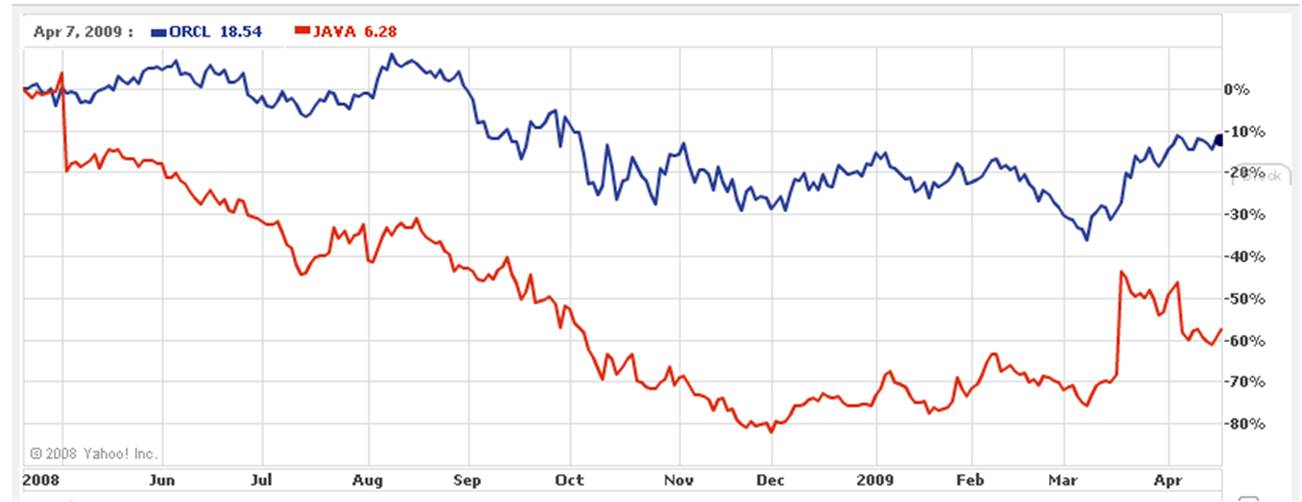
There has been a fair amount of hand-wringing along Sand Hill Road in Menlo Park over the lack of “exits” – IPOs and acquisitions – for venture-backed technology companies. Given the way the stock market has behaved recently, it’s pretty near impossible for a young technology company to go public. And the large technology companies that do most of the acquiring have been unusually quiet, presumably because they are watching their cash and avoiding risks given the global economic downturn.

However, there’s one major reason why large technology companies should be buying:

orcl-java

Blue is the share price of Oracle; red is the price of Sun (the spike in March is Sun’s merger negotiations with IBM). At some point, prices fall to the point where people start buying again. While the recession has hurt almost every company, it disproportionately hurts companies that do not have fat profit margins, hordes of repeat customers, and deep cash reserves that they can rely on in hard times. The result is huge changes in the relative values of companies, creating some once-in-a-generation bargains.

I don’t think the Oracle-Sun acquisition is a sign of a bottom or anything dramatic like that. But it shows that at least some companies are doing what they should be doing.

By James Kwak

More Accounting Games

The New York Times is reporting that the administration is thinking of stretching its TARP funds further by converting its preferred shareholdings to common stock.

The change to common stock would not require the government to contribute any additional cash, but it could increase the capital of big banks by more than $100 billion.

I hope this is one of those trial balloons they float and later think better of. Most importantly, it makes no sense. That is, there’s nothing fundamentally wrong with converting preferred for common, but it doesn’t create anything of value out of thin air. I wrote a long article about preferred and common stock a while back, but here are some of the highlights.

  • If you don’t give a bank any more money, it doesn’t have any more money. By converting preferred into common, you haven’t changed the chances of the bank going bankrupt, because its assets haven’t changed, and its liabilities haven’t changed. If it had enough money to cover its liabilities, but it couldn’t buy back its preferred shares from Treasury, it’s not like the government would have forced it into bankruptcy anyway.
  • If you accept the idea that converting preferred into common creates new capital, then you are implying that those preferred shares weren’t capital in the first place. From a capital perspective, then, the initial TARP “recapitalizations” did nothing, and nothing happens until the conversion. You can’t say that JPMorgan got $25 billion of capital last fall and it’s going to get another $25 billion now just by virtue of the conversion.
  • Tangible common equity and Tier 1 capital are just two ways of measuring the health of a bank. Taking money that wasn’t TCE and calling it TCE doesn’t serve any economic purpose. There is a minor benefit to the bank because now it doesn’t have to pay dividends on the preferred. But otherwise you’ve just shuffled together the claims of the last two groups of claimants – the preferred and the common shareholders. You’ve made things look better from the perspective of the common shareholders as a group, because they no longer have preferred shareholders standing in front of them, but the total amount available to all shareholders hasn’t changed.

Is there another way to explain this even more simply?

Update: I made a mistake in interpretation last night. They aren’t floating a possible strategy here; this is already what is going to happen. I forgot that the Capital Assistance Program already announced by Treasury – the mechanism for giving more capital to banks that need it after the stress tests – specifies the use of convertible preferred shares. So imagine you are a bank with $5 billion in TARP capital already. You issue $5 billion of convertible preferred under the CAP, use the proceeds to redeem the initial TARP, and then – if and when you choose – convert the convertible preferred into common. So the mechanism to do it is there already. I guess they are floating the spin to see if anyone believes this would actually make healthier banks.

Update 2: In case it wasn’t clear from the above, I don’t have any problem with converting preferred for common. I am probably mildly in favor of it, even, for roughly the same reasons as Matt Yglesias: as a taxpayer, I’d rather have the upside and control that come with common shares.

By James Kwak

Our Fate Is in Their Hands?

Last month, Representative John Shimkus spoke out against regulating carbon dioxide emissions on the grounds that carbon dioxide is plant food. “So if we decrease the use of carbon dioxide, are we not taking away plant food from the atmosphere?” Shimkus is on the House Subcommittee on Energy and Environment, which means he has a vote on these issues.

In the wake of a financial and economic crisis of at least generational magnitude, our government will be rewriting the rules of the financial industry. And “our government” includes not just the pedigreed scholars in the executive branch (Larry Summers, Christina Romer, Austan Goolsbee, etc.), but Congressional representatives like John Shimkus – “like” in the sense that they were selected for their jobs, and for their committee seats, in exactly the same way that Shimkus ended up discussing the crucial role of fossil fuels in sustaining plant life on this planet. And when it comes to legislation, Summers, Romer, and Goolsbee have exactly zero votes between them; Shimkus has one.

Continue reading “Our Fate Is in Their Hands?”

New Day, New Bank, Worse Story

It’s a beautiful day today, and after Goldman and JPMorgan, I don’t feel like diving deep into Citigroup’s earnings release. But judging from the Bloomberg article, it’s a similar story, just not as good.

1. All the good news was in fixed income trading: $4.7 billion in fixed income trading revenues; falling revenues in credit cards, consumer banking, and private client.

2. Assets continue to deteriorate: $5.6 billion in new writedowns in trading accounts; $3.1 billion in charge-offs and reserves for bad credit card debt.

3. Accounting fictions save the day (the new bit): $0.6 billion in losses that don’t have to be classified as other-than-temporary (and therefore affect the income statement) thanks to FASB; $2.5 billion in “profits” because of the fall in the value of Citigroup’s own debt. The theory behind the latter is that Citi could go into the market and buy back all of its distressed debt, which would be cheaper than paying it off at 100 cents on the dollar. Also: $0.4 billion in litigation expenses avoided (previously reserved) and tax benefits from an IRS audit.

Point 3 adds up to $3.5 billion, which dwarfs Citi’s $1.6 billion  profit. Why is everyone so optimistic about banks these days?

By James Kwak

Financial Innovation for Beginners

(For a complete list of Beginners articles, see Financial Crisis for Beginners.)

Kevin Drum pointed me to Ryan Avent’s insightful review of Ben Bernanke’s recent speech on financial innovation. (How’s that for the Internets in action?) Bernanke’s brief was simple: to defend financial innovation in general while acknowledging that at the margin it can be counterproductive and may need to be more closely regulated. “I don’t think anyone wants to go back to the 1970s,” he said in a line that was clearly supposed to make his point. Unfortunately for Bernanke, Avent was listening closely. His rejoinder:

neither could Bernanke point to a truly helpful piece of financial innovation developed after that decade. His examples of successful financial products? Credit cards, for one, which date from the 1950s. Policies facilitating the flow of credit to lower income borrowers was another, for which he credited the Community Reinvestment Act of 1977. And, of course, securitization and the secondary mortgage markets developed by Fannie Mae and Freddie Mac in…the 1970s.

With one exception:

Tasked with defending deregulation as a source of financial innovation, Bernanke reached for subprime lending.

This helped at least partially crystallize some thoughts I have had floating around about financial innovation for a while.

Continue reading “Financial Innovation for Beginners”

New Day, New Bank, Same Story

JPMorgan Chase reported its quarterly earnings today. The headline was $2.1 billion in net income, beating analysts’ estimates. Behind the headlines, it was similar to the story that Goldman told earlier this week: a huge jump in fixed-income trading, status quo everywhere else, and continuing writedowns. For example, if you look at the breakdown of revenue by type of activity (not line of business) on page 4 of the supplement, you’ll see that revenue was flat or down in every category except one: principal transactions, where it jumped from a loss of $7.9 billion to a gain of $2.0 billion. That $9.9 billion improvement more than explains the entire increase in pretax profit from negative $1.3 billion to positive $3.1 billion.

As with Goldman, it was clearly a good quarter for JPMorgan; making money beats losing money any day. But the question to ask is whether it is sustainable, either for JPMorgan or for the banking industry as a whole. To answer that question, here are some pictures.

Continue reading “New Day, New Bank, Same Story”

Is Goldman Really That Good?

Goldman Sachs released its quarterly earnings yesterday, and the headline was  net income of $1.8 billion, doubling analysts’ estimates. I would say this is definitely good news for Goldman; whether it’s good news for the banking sector as a whole is more uncertain.

First, as Bruce Wayne, one of our readers, pointed out, the quarter-over-quarter comparisons left out December. Because Goldman just changed its fiscal year end, its previous quarter ended in November and its latest quarter ended in March. December was reported separately and – surprise, surprise – Goldman took a net loss of $0.8 billion. So if they had mashed December into Q1, they would have had a four-month “quarter” with $1.0 billion in profits.

Second, the positive results probably reflect a better mix of businesses than other banks enjoy. Although Goldman has made big one-sided bets, its trading operation traditionally hedged many of its positions and made a lot of its money on volume. Its positive Q1 results were largely due to strong performance in fixed income, currencies, and commodities (FICC) trading, which reflects the fact that Q1 was a busy quarter – in part because of the massive unwind at AIG – and, as Goldman’s CFO politely said, “Many of our traditional competitors have retreated from the marketplace.” With fewer players in town, the oligopoly profits go up – another reason why the big banks are even more powerful than they were before the crisis.

When it comes to the value of its own investments, Goldman seems to have done less well. Its net revenues for principal investments, mainly “Other corporate and real estate gains and losses,” were negative $1.4 billion in Q1 and negative $0.8 billion in December. While Goldman was able to more than offset this with trading gains, I wonder what the implication is for commercial banks that are not dominant players in trading.

(The FT also raised an eyebrow at the fact that per-employee compensation in Q1 was much higher than in the year-earlier period. That actually doesn’t worry me, because I’m guessing those compensation expenses are bonus accruals – the better the quarter you have, the more money you have to set aside for year-end bonuses.)

By James Kwak

Unions and Business

One of the themes of the GM debate goes like this. On the one hand, the UAW is the problem, because it’s the high cost of union labor (and in particular, union retiree health benefits) that is crippling U.S. automakers. On the other hand, the UAW negotiated for those benefits fair and square, giving up higher current wages as part of the bargain, so it’s the fault of management for making promises they couldn’t keep. On the third hand, the UAW should have realized that when you negotiate for retirement benefits from a private corporation, one of the risks you take is that that corporation might go bankrupt. (For one example of these arguments, see Room for Debate at the NYT.)

Instead of touching that question any more than I already have, I wanted to raise the larger issue of whether unions are bad for business – which is what you would assume, given the lengths many companies go to in order to prevent unions from gaining collective bargaining rights. In general, this is a hard question to answer empirically. While you can observe differences between companies with unions and companies without unions, there is a huge problem of selection bias: since companies with unions are unlike companies without unions in many ways, you can’t say whether any differences in outcomes are due to the effect of the unions themselves, or due to the effect of other factors that would be there regardless of the unions.

John DiNardo and David Lee have an elegant way of getting around this problem in a 2004 paper, “Economic Impacts of New Unionization on Private Sector Employers: 1984-2001.” (The real economists out there probably know this paper already.) Instead of comparing all companies with unions to all companies without unions, they focus on companies where the union certification vote either barely won or barely lost, since these two companies are very similar to each other except for the treatment effect (having collective bargaining rights). This isolates the effect of unionization from other characteristics of the companies in question. They find that unions that barely win an election are successful in obtaining a collective bargaining agreement. Otherwise, however, the effect of successful unionization is insignificant on the company: differences in wages, employment, productivity, and output are all insignificant.

The UAW, historically, is a special case which people can debate for as long as they want. But the evidence is that in recent decades unions are not dangerous to firm survival.

Update: I forgot to add a link to a shorter summary of the work.

By James Kwak

$3.5 Million or $5 Million?

In the midst of a severe economic crisis that is, among other things, depressing federal tax revenues and adding to the national debt, the debate over the estate tax has flared up again. The basic question is whether the exemption will be raised from $1 million – where it was in 2002-03 and where it is scheduled to return after the Bush tax cuts expire – to $3.5 million (Obama) or $5 million (Lincoln-Kyl) per person; there is also disagreement over whether the marginal rate should be 35% or 45%. (Note that even with Obama’s proposed 45% tax rate, the average effective tax rate on estate would be 19%, because of the $3.5 million exemption.)

There is plenty of debate over this already, so I will confine myself to three points.

Continue reading “$3.5 Million or $5 Million?”