Author: James Kwak

Candidates Who Matter

By James Kwak

Nine months ago I endorsed Larry Lessig for president because, as I wrote at the time, “If we want real change in the long term, we have to fix the system. That means real equality of political participation, not just the formal equality of one person one vote.” There is no more fundamental issue we face than a political system that is distorted by money from top to bottom. (If you think Donald Trump somehow disproves this idea, consider that fact that, right now, the campaign topic getting the most attention is the Trump campaign’s financial situation, and the strongest evidence that Clinton is likely to win is her financial superiority.)

Larry Lessig’s campaign, unfortunately, never got off the ground, in part because the Democratic establishment bent its own rules to keep him out of the debates. That’s one reason why I’m not giving money to Hillary Clinton or the DSCC or the DCCC—that and, frankly, none of them have prioritized political reform. Sure, I want Clinton to win, but I can’t afford to donate to everyone I’d like to see win. In the long run, what we need are candidates who will put political reform first—not second, or third, or fifteenth.

So here are a two. One is Zephyr Teachout, a law professor better known for embarrassing Andrew Cuomo by winning a third of the vote in the 2014 New York gubernatorial primary despite being outspent by seventy gazillion to one. She’s also an expert on corruption in the political system, having written a serious history of corruption in America. Teachout is running for Congress in New York’s 19th district (which has a primary on Tuesday). She’s already famous, so enough said. (There’s also a documentary about her run against Cuomo that’s raising money on Kickstarter, and could use donations.)

The other is Sean Barney, a classmate of mine at the Yale Law School who is running to be Delaware’s congressional representative. Sean has made political reform his top priority, and he supports a six-for-one public match for small contributions, a new Voting Rights Act, and non-partisan redistricting commissions to end gerrymandering of congressional districts. He’s also been endorsed by Larry Lessig. (And he’s a marine who was almost killed by a sniper in Fallujah before going to law school.)

Running for Congress is hard. Running on a platform of undermining the current system . But if we have a Congress that is wholly dependent on big money, we’re never going to roll back the influence of big money. At the end of the day, whether your big issue is climate change, or workers’ rights, or financial reform, that’s the only thing that matters.

I’m sure there are other candidates out there who are also dedicated to political reform. If you care about the political system, with the June 30 reporting deadline coming up—ironic as it may sound—these are the kinds of people you should consider donating to. So that one day, whether or not you can afford the donation will no longer matter.

Yes, I’ll Vote for HRC. No, I’m Not Happy About It.

By James Kwak

Now that Hillary Clinton has wrapped up the nomination, I have no problem with Clinton supporters saying that Sanders supporters should back her in the general election. I’m certainly voting for Clinton (not that my vote matters, since I live in Massachusetts), and every liberal Democrat I know who likes Sanders is going to do the same. (Yes, there are probably some Sanders voters who will vote for Trump or stay home, but they are largely anti-establishment independents who were always unlikely to vote for Clinton.)

Apparently that’s not enough for many in the Clinton camp, however, who insist that I should be happy that Hillary Clinton is the Democratic nominee, and that this is actually a good thing for progressives—defined loosely as people who want higher taxes on the rich, less inequality, stronger social insurance programs (including true universal health care), and better protections for workers. The argument is basically that Clinton is (a) more pragmatic, (b) more skilled at getting things done, and (c) more likely to be able to work with Republicans to achieve incremental good things, while Sanders would have simply flamed out in futility.

To which my first answer, which I’m sure I share with many other liberals is: Yes, I know how the Constitution works already. I know we have three branches of government, and that the Republicans control Congress.

Continue reading “Yes, I’ll Vote for HRC. No, I’m Not Happy About It.”

The Value of the Humanities

By James Kwak

In the Washington Post, Harvard Medical School professor David Silbersweig argues for the continuing value of a liberal arts education in today’s world. The “liberal arts”—usually meaning anything other than math, science, engineering, and maybe business—do seem to be under attack from all quarters, and not only from know-nothings like Marco Rubio. Just this week, the president of Queen’s University in Belfast said this (explaining why students will no longer be able to concentrate in sociology or anthropology):

Society doesn’t need a 21-year-old who is a sixth century historian. It needs a 21-year-old who really understands how to analyse things, understands the tenets of leadership and contributing to society, who is a thinker and someone who has the potential to help society drive forward.

That’s the new conventional wisdom: we need “leaders” who can “help society drive forward,” whatever that means.

Silbersweig himself majored in philosophy before becoming a doctor and a medical researcher. He makes a number of points, but this is the one you usually see in articles like this:

If you can get through a one-sentence paragraph of Kant, holding all of its ideas and clauses in juxtaposition in your mind, you can think through most anything. If you can extract, and abstract, underlying assumptions or superordinate principles, or reason through to the implications of arguments, you can identify and address issues in a myriad of fields.

Continue reading “The Value of the Humanities”

Why Justice Is So Rare

By James Kwak

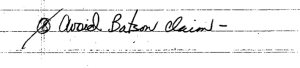
Today was a victory for justice. In Foster v. Chatman—a case brought by the Southern Center for Human Rights and argued by death penalty super-lawyer Stephen Bright—the Supreme Court overturned the death sentence imposed on Timothy Foster by an all-white jury in 1987. In that case, the prosecution made sure it had an all-white jury by eliminating  (striking) all black candidates from the jury pool. In Batson v. Kentucky (1986), the Supreme Court ruled that it is unconstitutional to strike potential jurors on the basis of race, but the prosecutors’ own notes made clear that they knew what they were doing. Here are just a few examples, from the appendix. They pretty much speak for themselves.

Screen Shot 2016-05-23 at 3.17.59 PM

Screen Shot 2016-05-23 at 3.24.27 PM

It’s hard to read, but next to the green blotch in the picture above are the words “represents Blacks.”

Screen Shot 2016-05-23 at 3.28.50 PM

Continue reading “Why Justice Is So Rare”

Moral Worldviews and Empirical Beliefs

By James Kwak

Funny thing, Twitter. My most-viewed tweet ever is the following:

That’s a retweet of this, from Neel Kashkari:

The quotation about the survey is from the WSJ article about Russ Roberts that Kashkari originally tweeted.

Most of the comments on my tweet were some version of “duh.” But then there were a bunch who said some version of “correlation doesn’t imply causality” (which is an excuse to link to my favorite XKCD cartoon).

Continue reading “Moral Worldviews and Empirical Beliefs”

Economics 101, Good or Bad?

By James Kwak

Over at the Washington Post, Michael Strain of the American Enterprise Institute is upset that people are picking on Economics 101. He singles out Paul Krugman and Noah Smith in particular for claiming that “the pages of economics 101 textbooks are filled with errors, trivia and ‘useless fables.'” Instead, Strain insists, “an economics 101 textbook is a treasure.” He continues by discussing some of the key insights that you can gain from the basic models presented in an introductory economics class.

Except, for the most part, Strain is rebutting an argument that no one is making. He is right to say that Economics 101 provides many valuable lessons—the competitive market model, opportunity cost, diminishing marginal returns, comparative advantage, the labor-leisure tradeoff, etc. But no one denies the analytical power of those abstract concepts.

Continue reading “Economics 101, Good or Bad?”

Hillary Clinton, Barack Obama, and Our Intoxicated Horse

By James Kwak

Remember just eight years ago, when we had an epic primary battle between Hillary Clinton and Barack Obama? There weren’t many significant policy differences between them; Obama was never as liberal as many people assumed he was. But there was one major difference. This is what Obama said:

Washington has allowed Wall Street to use lobbyists and campaign contributions to rig the system and get its way, no matter what it costs ordinary Americans. . . .

Unless we’re willing to challenge the broken system in Washington, and stop letting lobbyists use their clout to get their way, nothing is going to change.

The reason I’m running for President is to challenge that system.

The quotations are from the new edition of Republic, Lost by Larry Lessig (pp. 167–68). My handful of loyal readers will recall that Lessig was my choice for the Democratic presidential nomination until he was shut out of the debates by the Democratic Party. (Note to the party and its affiliated Super PACs: no, I’m not giving you money.)

I’m reading the new edition of the book, and I came across this brilliant description of Hillary Clinton’s 2008 run (p. 168):

She saw the job of the president to be to take a political system and do as much with it as you can. It may be a lame horse. It may be an intoxicated horse. It may be a horse that can only run backward. But the job is not to fix the horse. The job is to run the horse as fast as you can.

Regardless of what you think about Clinton on policy—she’s a little too far to the right for my tastes, but not terribly so—I think this is a fair summary of her approach, both in 2008 and in 2016. She has positioned herself as the pragmatic choice, the person who knows how to work within the system to make incremental gains, the candidate of modest by supposedly achievable ambitions. Last time she lost; this time she’s winning. She’s nothing if not consistent.

This means, of course, that the broken, rigged system—those are President Barack Obama’s words, everyone, not just those of some socialist from Vermont—orchestrated by lobbyists and dominated by concentrated special interests, will be around for the foreseeable future.

For someone who only tunes in during presidential election campaigns, this may raise the question: What happened? Wasn’t Obama going to fix the system? Well, as Lessig and many others have pointed out, he didn’t even try. Whether Obama gave up because he thought he could grind out legislative victories the old-fashioned way, or whether he never really believed in the cause, I guess only he knows. But Obama the candidate was right: unless we fix the system, nothing else is going to change. And except for Zephyr Teachout and a few other down-ballot candidates who are committed to electoral reform, this year is going to be another lost opportunity.

The Committee to Save the World

By James Kwak

You know that famous Time cover featuring Rubin, Greenspan, and Summers, calling them “The Committee to Save the World”? I was reading the accompanying article, which I had never read before, and it’s an absolutely precious example of the nonsense people said at the time. Like this:

Rubin, Greenspan and Summers have outgrown ideology. Their faith is in the markets and in their own ability to analyze them. … This pragmatism is a faith that recalls nothing so much as the objectivist philosophy of the novelist and social critic Ayn Rand (The Fountainhead, Atlas Shrugged), which Greenspan has studied intently. During long nights at Rand’s apartment and through her articles and letters, Greenspan found in objectivism a sense that markets are an expression of the deepest truths about human nature and that, as a result, they will ultimately be correct. … They all agree that trying to defy global market forces is in the end futile. That imposes a limit on how much they will permit ideology to intrude on their actions.

I realize this is written by a journalist, not by one of the three men themselves. But could you come up with a better example of an ideology?

The Problem with Obamacare

By James Kwak

When it comes to Obamacare, I’m firmly in the “significantly better than nothing” camp. Obamacare has increased coverage—although not as much as one might have hoped. The percentage of people uninsured has fallen from around 17% in 2013, when only a few coverage-related provisions of the ACA were in effect, to around 11% in early 2015, after the major changes kicked in in 2014. That’s six percentage points, or millions of people—but it’s still much less than half of the pre-ACA uninsured.

There has also been a lot of controversy over the impact of Obamacare on health insurance prices. According to the Kaiser Family Foundation, the weighted average pre-subsidy price of a silver plan on the exchanges only increased by 3.6% from 2015 to 2016, which certainly seems good. But one way the ACA keeps premiums reasonable is by pushing people into plans with high levels of cost sharing. The average silver plan has a combined annual deductible (including prescriptions) of more than $3,000; the deductible for an average bronze plan is close to $6,000. In other words, one reason that insurance premiums are affordable is that those premiums don’t buy you what they used to, as insurers shift more and more health care costs onto their customers.

This is exactly what we should have expected. Obamacare is an example of “managed competition,” something that Bill Clinton talked about on the campaign trail twenty-four years ago. The basic principle is that competitive markets will generally produce good outcomes—low costs, efficient allocation of resources to meet consumer needs, etc.—but need to be managed around the edges. Moderate Democrats (what we used to call moderate Republicans) have fallen in love with this idea, because they can talk about the wonders of markets while blaming anything they don’t like on “market failures.”

The classic example of correcting for a market failure, of course, is the individual mandate. By now, every liberal interested in policy has learned what adverse selection is and, more specifically, can explain why community rating will produce an adverse selection death spiral unless you have mandated universal participation. This is the image that Obamacare’s most ardent supporters want you to take away: cleverly designed regulation preventing a market failure and ensuring universal coverage, while enabling markets to reduce costs, encourage innovation, blah blah blah. What could be better?

The dirty not-so-secret of Obamacare, however, is that sometimes the things we don’t like about market outcomes aren’t market failures—they are exactly what markets are supposed to do.

The problem with adverse selection, remember, is that people know more about their health status than insurers do, so they only buy policies that are profitable for them on an expected basis (that is, sick people are more likely to buy insurance than healthy people), which means that insurers would lose money, so insurers raise premiums, but that only reduces the number of people buying insurance. But imagine if insurers had the same information as insureds, so they could calculate the actuarially fair price for every policy. No more adverse selection! But would that be a good outcome? Sick people and poor people would be unable to afford insurance at all. That’s what markets do: they distribute goods and services based on people’s willingness to pay, which is a function of their budget constraints. And that’s not something that we as a society are willing to accept.

So Obamacare says: No medical underwriting!—which means, basically, that the healthy and the sick pay the same up-front premiums. At this point, with a universal coverage mandate and no medical underwriting, you might think we should just have a single payer system. But … but … markets!

So, in order to give private insurers something to do, Obamacare allows them to offer different flavors of health plans, within the rules set up by the ACA. But what is it that insurance companies do? They try to sell policies for more (in premiums) than they cost (in benefits). We know sick people will cost more than healthy people, but now insurers aren’t allowed to price discriminate on the front end. So, instead, they offer plans with loads of cost sharing—high deductibles, high out-of-pocket maximums, and high levels of coinsurance. Cost sharing has two purposes. One is to deter people from actually using health care—this is the reality of “consumer-driven health care.” The other is to make the sick pay more than the healthy. Remember, that’s how markets are supposed to work. Insurers are supposed to identify the sick people and charge them more for insurance; Obamacare says they can’t do that, so instead they switch to policies that force sick people to pay more for care at the point of service.

None of this is at all nefarious. If you’re going to have private health insurance companies, you have to let them try to make money—otherwise, what’s the point? Indeed, if you like markets, you have to recognize that markets only do what they do because companies are trying to make money.

But you run up against this fundamental problem: Markets work by making people pay for what they get; the more health care you “consume,” the more you pay, either in insurance premiums or at the hospital. But the vast majority of Americans are not comfortable with the idea that rich people get good health care, middle-class people get passable health care (until they get seriously ill, in which case they go bankrupt), and poor people get no health care to begin with.

Obamacare is a heroic attempt to make the best out of this basic conundrum: we are trying to use markets to distribute something that, at the end of the day, we don’t want distributed according to market forces. That’s why we have not only the individual mandate and the prohibition on medical underwriting, but also the expansion of Medicaid, the subsidies, the Cadillac tax (because we don’t like the market when it produces gold-plated insurance plans) and, most telling of all, risk adjustment.

What is risk adjustment? Well, consider what a profit-seeking insurer would do if it has to charge the same price to everyone. In that case, you want to sell insurance to healthy people, not to sick people. Since you’re not allowed to turn people away, you design marketing programs so that only healthy people find out about your product. Again, nothing nefarious going on. But that’s bad for the system, because then other insurers will get stuck with the sick people, lose money, and pull out of the market.

So Obamacare’s risk adjustment provisions transfer money from plans with healthy people to plans with sick people. Insurance companies aren’t allowed to compete by trying to attract lower-risk customers. The only way they are allowed to compete is by paying less to health care providers for the same services (since Obamacare requires standard minimum benefit packages for all plans). But the thing is, we already know how to lower payments to providers. The key is to be a really, really big insurance plan, covering lots of people, so that you have bargaining power when it comes time to negotiate rates with hospitals and physician offices. There’s no “innovation” to stimulate here; it’s pure market power. No one has more of it than Medicare—and nothing can have as much market power as a single payer plan.

So at the end of the day, Obamacare is based on the idea that competition is good, but tries to prevent insurers from competing on all significant dimensions except the one that the government is better at anyway. We shouldn’t be surprised when insurance policies get worse (in terms of the benefits they actually provide) and health care costs continue to rise.

If we take as our starting premise that everyone should be able to afford decent health care—something that literally everyone agrees with—then the most obvious solution is single payer or one of its close cousins, such as we see in every other advanced economy in the world. But … markets! Not just Republicans, but also most Democrats are convinced that markets must be better, because of something they learned in Economics 101. Health care is one of the best examples of economism—the outsized influence that the competitive market model has had on public policy, even in areas where its lessons patently don’t apply.

You could say that the Obama administration made the best of the lousy hand it was dealt by decades of market propaganda and a weak majority that hinged on Democrats In Name Only. Obamacare certainly improves on what preceded it (nothing, that is, as far as the individual market is concerned). But ultimately it is a flawed attempt to force markets to produce outcomes that markets don’t want to produce.

The Long Game

By James Kwak

Charles Koch recently made headlines by saying that it is “possible another Clinton could be better than another Republican” in this year’s presidential race. Some people find this surprising: how could the Koch brothers sit by and let another Democrat be elected to the White House? But that’s a reflection less of the Kochs’ political acumen than of our collective quadrennial fixation on the presidential election.

I find it unlikely that the Kochs would actually support Hillary Clinton—it’s more likely Charles was taking the occasion to signal his displeasure with both Donald Trump and Ted Cruz—but it’s quite possible that they will simply sit out the battle for the White House. Unlike, oh, just about everyone in the Democratic Party, the Kochs have never panicked at the thought of losing any particular election. Instead, as Jacob Hacker and Paul Pierson put it:

When conservative business leaders such as Charles and David Koch invested in Cato, Heritage, the American Enterprise Institute, and all the other intellectual weapons of the right, they were playing the long game. When Republican political leaders like Newt Gingrich and Mitch McConnell developed new strategies for tearing down American government to build up GOP power, they were playing the long game.

That’s from the conclusion of their new book, American Amnesia (p. 369).

Continue reading “The Long Game”

Cultural Capture in Black and White

By James Kwak

A few years back I wrote a paper on “cultural capture” in financial regulation. The basic idea is that the industry can achieve the practical result of regulatory capture—industry-friendly policies—not just by bribing regulators (legally or illegally) and not just by providing useful “information” to agencies, but by cultivating other types of influence such as social relationships status advantages. The response was decidedly mixed. Some people said, “Yes, that’s exactly right!” while others said, “Nice idea but how can you prove that it actually happens?”

I completely concede the identification problem. Regulatory decisions are always overdetermined, and it’s hard to find data on, say, how many regulators’ kids go to school with lobbyists’ kids. But sometimes it just hits you between the eyes.

Yesterday the invaluable Jesse Eisinger published the backstory of the SEC’s ABACUS investigation (which will always have a special place in my heart, since the complaint was filed shortly after the publication of 13 Bankers, getting Simon and me a full-hour interview on Bill Moyers and boosting the book up the charts). Eisinger’s story is based on information provided by James Kidney, a veteran SEC lawyer who thought the agency should pursue Goldman senior executives on a broader theory of liability—but was opposed by other insiders and, ultimately, Enforcement Director Robert Khuzami.

Continue reading “Cultural Capture in Black and White”

Profits in Finance

By James Kwak

Noah Smith on one reason why financial sector profits have remained high as the industry has grown:

Why haven’t asset-management charges gone down amid competition? In a recent post, I suggested one answer: people might just be ignoring them. Percentage fees sound tiny — 1 percent or 2 percent a year. But because that slice is taken off every year, it adds up to truly astronomical amounts. … If many investors pay no attention to what they’re being charged, more competition can’t push down those fees.

I think that’s basically right, but there’s a smidgeon more to it. Expense ratios on actively managed mutual funds have remained stubbornly high. Even though more people switch into index funds every year, their overall market share is still low—about $2 trillion out of a total of $18 trillion in U.S. mutual funds and ETFs. Actively managed stock mutual funds still have a weighted-average expense ratio of 86 basis points.

Why do people pay 86 basis points for a product that is likely to trail the market, when they could pay 5 basis points for one that will track the market (with a $10,000 minimum investment)? It’s probably because they think the more expensive fund is better. This is a natural thing to believe. In most sectors of the economy, price does correlate with quality, albeit imperfectly. It’s also natural to believe that some people are just better than others at picking stocks, just like Stephen Curry is better than other people at playing basketball. Finance and economics professors can talk all they like about nearly-efficient markets, the difficulty of identifying the people who can generate positive alpha, and the fact that you have to pay through the nose to invest your money with those people (like James Simons), but ordinary investors just don’t buy it. And this is one area where I think marketing does have a major impact, both in the form of ordinary advertising and in the form of the propaganda you get with your 401(k) plan.

So while some people are no doubt ignoring the fees, others are probably saying, “Sure the expense ratio is 100 basis points, but look at the past performance!” (Anyone who makes decisions based on past performance—that is, most people—is taking fees into account to some extent, since published mutual fund returns are almost always net of fees.) So the persistence of high fees is partly due to the difficulty of convincing people that markets are nearly efficient and that most benchmark-beating returns are some product of (a) taking on more risk than the benchmark, (b) survivor bias, and (c) dumb luck.

The Root of All Our Problems?

By James Kwak

A friend pointed me toward an op-ed in The Guardian by George Monbiot titled “Neoliberalism—The Ideology at the Root of All Our Problems.” The basic argument is that there is an ideology that has had a pervasive influence on the shaping of the contemporary world. Its policy program includes “massive tax cuts for the rich, the crushing of trade unions, deregulation, privatisation, outsourcing and competition in public services.” Monbiot calls this cocktail “neoliberalism” (more on the name later).

There’s a lot in the article that I agree with. The political and economic takeover of the Western world by the super-wealthy was not accomplished by force, nor by rich people simply demanding a larger slice of the proverbial pie. Instead, it happened because many people—particularly in the media, the think tank intelligentsia, and the political community—internalized the idea that competitive markets provided the solution to all problems. (The idea that unfettered capital markets and financial innovation would be good for everyone, which helped produce the financial crisis, is only a special case of this larger phenomenon.)

I like Monbiot’s framing of how this works:

So pervasive has neoliberalism become that we seldom even recognise it as an ideology. We appear to accept the proposition that this utopian, millenarian faith describes a neutral force; a kind of biological law, like Darwin’s theory of evolution.

Sometimes it does seem like evolutionary biology and the simply model of supply and demand are the two most common models that people turn to when trying to explain things they don’t really understand.

Continue reading “The Root of All Our Problems?”

Hamilton Everywhere, All the Time

By James Kwak

Alexander Hamilton is a big deal these days. Apparently there’s a musical about him—something I only found about when I saw Lin-Manuel Miranda’s Rose Garden video on Twitter (which tells you something about my relationship to popular culture). In their new book (on which more later), Jacob Hacker and Paul Pierson invoke Hamilton to defend their vision of an interventionist government and a mixed economy.  And Stephen Cohen and Brad DeLong have titled their new book Concrete Economics: The Hamilton Approach to Economic Growth and Policy.

I like to think that Simon and I were on the leading edge of this mini-trend when we featured Hamilton in our 2011 Vanity Fair article and in White House Burning. But it’s no surprise that people turn to Hamilton today, when what used to be known as the Tea Party (now simply the Republican Party) dreams of recreating a libertarian founding moment that never existed. Hamilton stood for a (relatively) strong central government, deficit spending, and what would now be called industrial policy, all with the intent of fostering economic growth.

Concrete Economics is less about Hamilton’s particularly approach to economic policy than about an overall attitude of which Hamilton cited as an exemplar: in short, a pragmatic rather than ideological approach to policymaking, one which used government resources and power to pursue specific goals. The best contrast is between the Republican Party c. 1955—which used state power to suburbanize the country, build up the military, and spin off the technologies that turbocharged productivity growth—and the Republican Party of the past 35 years, which (along with a considerable amount of Democratic abetting), which slashed government spending and deregulated the financial sector for ideological reasons (free flow of capital, free markets, blah, blah, blah).

Continue reading “Hamilton Everywhere, All the Time”

“Economics” as Push Poll

By James Kwak

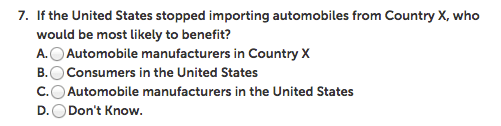
Matthew Klein of Alphaville called out the “Council of Economic Education” for a supposed “economic literacy” quiz that wrapped up free market ideology in the trappings of universal economic truth. The quiz is full of questions like this one:

Screen Shot 2016-03-29 at 2.28.07 PM

If you know a little bit of economics, and you know how to answer multiple-choice tests, it’s clear that you’re supposed to choose “C”—the point being that trade helps consumers, and limits on trade help domestic competitors. But, as Klein shows, these types of simple, first-order answers may or may not apply to the real world. For question 7, for example, you would have to know why the United States stopped importing automobiles from Country X.

What the Council of Economic Education really came up with here is a push poll: a set of questions intended to convey a certain message. The message is that complicated policy issues can be reduced to multiple choice questions which, in turn, can be answered using a handful of simple models from an Economics 101 class. But you can only answer the questions “correctly” if you assume that those models accurately depict the behavior of individuals and firms in the real world. Then everything becomes easy: trade is always good for all parties, taxes and regulations (like rent ceilings) are always bad, and competition is always good for consumers.

This idea that all questions can be answered using a few diagrams from introductory economics has been pushed by business organizations since World War II. That was the principle behind the Foundation for Economic Education, which helped sponsor Ludwig von Mises and Friedrich Hayek; behind 1950s’ economic education programs in the sponsored by the National Association of Manufacturers and large corporations (often to captive audiences of employees); and behind business-sponsored teaching kits distributed to thousands of schools. (For the full story, see Selling Free Enterprise, by Elizabeth Fones-Wolf.) In each case, the motivation was the same: teach people a streamlined, fact-free version of the competitive market model, and they will understand why free markets are always good and government intervention is always bad.

The problem, of course, is that the real world is rarely so simple. But if you can get lots of people to learn a little bit of economics, you can convince them that trade agreements are always good (comparative advantage!) and that the minimum wage is always bad (price floor!). I’m all in favor of education—I’m in the business, after all. A lot of what the Council for Economic Education does may be valuable. But multiple choice is not the right answer to real problems.