Author: James Kwak

Correlation, Causation

By James Kwak

XKCD (blacked out until tomorrow).

Economix has a table listing undergraduate majors by the percentage of graduates in each major that are in the “1 percent” (by income, which I think is less important than by wealth). The data are interesting, but I don’t think it’s correct to say that “the majors that give you the best chance of reaching the 1 percent are pre-med, economics, biochemistry, zoology and, yes, biology, in that order.”

All of the pre-med/life sciences majors (numbers 1, 3, 5, 8, and 11 on the list) do arguably increase your chances of making the 1% because they help you become a doctor, and many specialists are in the 1%. Of course, since many science majors are considered more difficult by undergraduates, you could argue that the inherent traits people bring to college are just as important as the majors they choose. Economics is #2, but that’s in part because many of the people who want to be in the 1 percent major in economics.

But the interesting cases are art history (#9), area studies (#12), history (#14), and philosophy (#17), all of which are disproportionately represented in the 1%. (History, for example, ranks right behind finance.) I don’t think anyone would argue that knowledge of art history is likely to earn you a high income; there just aren’t that many executives at Sotheby’s and Christie’s. I think what’s going on is that these are the kinds of things that people study at elite schools—in particular, if you’re not that worried about what you’re going to do after graduation. These are not the things that most people at normal schools study. In 2009, for example, art history didn’t even show up on the list of majors (it’s probably tucked into “liberal arts and sciences, general studies, and humanities,” which came in 11th), area studies was one of the least popular majors, and so was philosophy.

So there are two possible reasons why these people make the top 1 percent. One is that they are talented, hardworking people who succeed (financially) despite what they majored in—but then why are talented, hardworking people overrepresented in these majors? The other is that they are children of the elite who go to elite schools, study whatever they feel like, and succeed because of their upbringing and connections. (The reasons are not mutually exclusive.) Given the increasing evidence that America, the land of opportunity, is actually one of limited social mobility, I think we can’t overlook the latter explanation.

The End of the Blog?

By James Kwak

As you may have noticed by now, Wikipedia’s English-language site is (mostly) down for the day to protest SOPA and PIPA, two draconian anti-copyright infringement laws moving through Congress, and Google’s home page looks like this:

Under existing law (the DMCA), if someone posts copyrighted material in a comment on this blog, the copyright holder is supposed to send me a takedown notice, after which point I am supposed to take the material down (if it is in fact copyrighted).

SOPA and PIPA are bills in the House and Senate, respectively, that make it much easier for “copyright holders” (like the big media companies that back the bill—or, come to think of it, authors like me) to take action not only against “bad” web sites that make copyrighted material available (against the wishes of the copyright holders), but also against web sites that simply link to such “bad” web sites. For example, the copyright holder can require payment network providers (PayPal, credit card networks) to block payments to such web sites (in either category above) and can require search engines to stop providing advertising for such web sites—simply by sending them a letter. That’s SOPA § 103(b).*

Continue reading “The End of the Blog?”

Correction to Long-Term Debt Projections

By James Kwak

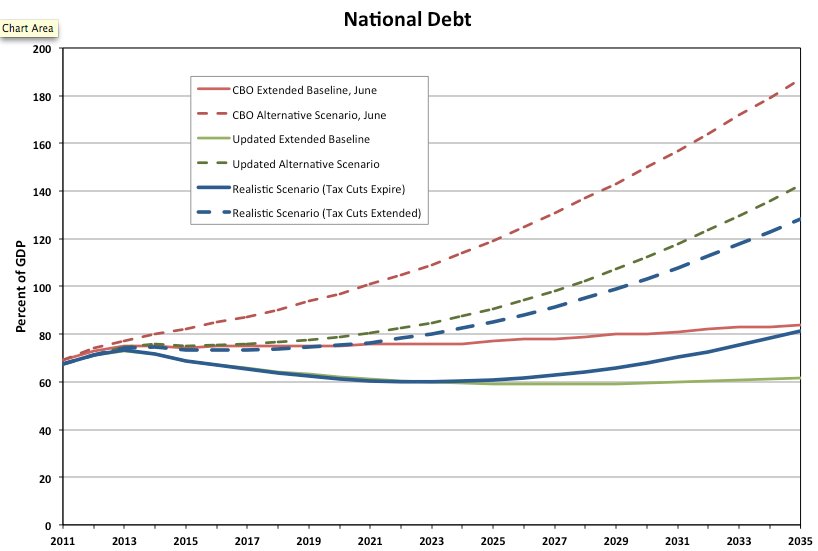
Back in October, I wrote a post laying out my long-term projections for the national debt, which were basically an adjustment to existing CBO projections. Peter Berezin recently pointed out a misleading ambiguity in that post. There, I used the same long-term growth rate of tax revenues in both my extended-baseline scenario and in my “realistic” scenarios. I got that long-term growth rate from the CBO’s extended baseline scenario in its 2011 Long-Term Budget Outlook, which assumes that current law remains unchanged.

In my realistic scenarios, I assumed that the AMT would be adjusted through 2021 but that the long-term growth rate would apply thereafter. I didn’t say anything explicitly about the AMT after 2021, but by using the long-term growth rate from the extended baseline, I was implicitly assuming that the AMT would not be indexed after 2021.

Continue reading “Correction to Long-Term Debt Projections”

State of Nature

By James Kwak

I’ve been reading a lot of books lately, some of which I’ve mentioned here: The Submerged State by Suzanne Mettler, Invisible Hands by Kim Phillips-Fein, The Wealth and Poverty of Nations (finally) by David Landes, Exorbitant Privilege by Barry Eichengreen, and a pile of books on the national debt and deficit politics. (Despite moonlighting as a blogger, I find books more satisfying than the constant stream of newspapers, magazines, and blogs.) But my favorite book I’ve read in a while is Railroaded: The Transcontinentals and the Making of Modern America, by the historian Richard White.*

For some people, most notably Rick Perry but also much of the conservative base, the late nineteenth century was the golden age: of the gold standard, no income tax, senators elected by state legislatures, and, most importantly, little to no government “regulation” of business. White shows what that world was really like.

Continue reading “State of Nature”

More on Long-Term Care Insurance

By James Kwak

After my previous post on the topic, a friend passed along a recent paper by Jeffrey Brown and Amy Finkelstein in the Journal of Economic Perspectives. I recommend reading it if you are interested in the topic because it provides a lot of good background information and explains some of why the market is the way it is.

They make some similar points to mine. For example (p. 138):

“First, the organization and delivery of long-term care is likely to change over the decades, so it is uncertain whether the policy bought today will cover what the consumer wants out of the choices available in 40 years. Second, why start paying premiums now when there is some chance that by the time long-term care is needed in several decades, the public sector may have substantially expanded its insurance coverage? A third concern is about counterparty risk. While insurance companies are good at pooling and hence insuring idiosyncratic risk, they may be less able to hedge the aggregate risks of rising long-term care utilization or long-term care costs over decades. In turn, potential buyers of such insurance may be discouraged by the risk of future premium increases and/or insurance company insolvency.”

They also show just how expensive private long-term care insurance is. By their calculations, the load on a typical policy is 32% (which means that the present value of benefits is only 68% of the present value of premium costs).  This is what you would expect in a thin market with a lot of adverse selection. (And one more note: The median cost of long-term care is a lot lower than in Massachusetts, the state I cited in my previous post. See this study to see where your state ranks.)

Continue reading “More on Long-Term Care Insurance”

Can We Afford Medicare?

By James Kwak

The conventional wisdom, repeated endlessly by the so-called serious people, is that we can’t afford traditional Medicare and hence it has to be radically overhauled (see Ryan-Wyden for the latest round). But I’ve never seen a convincing argument for why we can’t afford traditional Medicare. Yes, costs are rising as a share of GDP. But in principle, to make the case that we have to reform the program, you would have to argue that revenues can’t rise enough to keep pace—which in most cases, just shows that you don’t want revenues to rise enough.

More specifically, you have to know how big the Medicare deficit is and how fast it is rising. By my calculations, relying mainly on the 2011 Medicare Trustee’s report, the deficit was 1.7% of GDP in 2010 and will be 3.0% of GDP in 2040. So the argument that we can’t afford traditional Medicare relies on the proposition that this 1.3% of GDP is the straw that will break America’s fiscal back. Needless to say, this is nonsense, especially since other tax revenues not related to Medicare will be rising over the same time period, at least under current law. For all the details and sources, see my latest Atlantic column.

Medicare has its problems. But we have choices.

What Good Is the SEC?

By James Kwak

This week’s Atlantic column is my somewhat belated response to Judge Jed Rakoff’s latest SEC takedown, this time rejecting a proposed settlement with Citigroup over a CDO-squared that the bank’s structuring desk created solely so that its trading desk could short it. I think Rakoff has identified the heart of the issue (the SEC’s settlements are unlikely to change bank behavior, so what’s the point?) but he’s really pointing to a problem that someone else is going to have to fix: we need either a stronger SEC or stronger laws. I’d like to see an aggressive, powerful SEC that can deter banks from breaking the law, but we don’t have one now.

The Private Insurance Market

By James Kwak

I’m currently in the process of buying long-term care insurance—you know, so my daughter won’t have to take care of me when I’m old. I have a good agent who knows all about the market and has answered every question I’ve had. I understand personal finance, opportunity costs, discount rates, and inflation. I know my way around a spreadsheet (one benefit of my years at McKinsey). But I find it’s still hard to figure out what to do.

A bit of background: Long-term care insurance pays for your stay in a nursing home if you become unable to take care of yourself. Depending on the policy, it may also pay for care you receive at home instead of going into a facility. According to the insurer I’m considering, the median annual cost of a semi-private room in a nursing home in my state is $145,000, and the average stay is something like three years. To put that in perspective, in 2009, the median net worth of families where the head of household was of age 65–74 was $205,000 (including real estate assets).

Long term care is not covered by Medicare, except for a short period after each acute event. It is covered by Medicaid, but to be eligible for coverage you have to exhaust all of your assets. Despite that onerous requirement, Medicaid currently covers 40 percent of all spending on long-term care. (2011 Long-Term Budget Outlook, p. 39.) The Affordable Care Act of 2010 included what is known as the CLASS Act, which would have allowed anyone to buy long-term care insurance, with an average benefit of $75 per day, for a monthly premium of $123. The CLASS Act, however, has been suspended because the administration could not certify that it would be deficit-neutral over the long term. So the bottom line is: until you use up all your money, you’re on your own.

Still, shouldn’t you be able to buy protection in the private insurance market? The short answer is: not really.

Continue reading “The Private Insurance Market”

What Government Aid?

By James Kwak

Earlier this year I wrote about a paper by Suzanne Mettler that included a survey showing that a large proportion of beneficiaries of government programs insist that they have never been beneficiaries of any “government social programs”—60 percent for the mortgage interest deduction and 44 percent for Social Security retirement benefits, for example. This provides ample evidence that “keep your government hands off my Medicare” is not a fringe opinion.

Recently, I read Mettler’s book, and there’s more to the story. One of her arguments is that hiding government programs in the tax code undermines the democratic system because it obscures the role that government plays in society. There were two quantitative examples I thought were particularly revealing.

Continue reading “What Government Aid?”

Thoughts on Law School

By James Kwak

A number of friends have asked me what I thought about David Segal’s article in the Times a couple weeks ago on law schools, so I thought I would share my thoughts here. The short answer is that I thought it was pretty silly.

I admit that law schools aren’t perfect. The simple fact that many (no one really knows how many) law school graduates can’t find jobs as lawyers is a problem. Now, it’s not obvious that that’s the fault of law schools as a group: when you pile a severe recession on top of an ongoing shift among law firms away from first-year associates and toward contract lawyers, the number of entry-level jobs is going to go down, and no matter how good a job the law schools do, that isn’t going to increase the number of jobs. Furthermore, you could make exactly the same criticism about all of higher education: it leaves people with large debts, and many don’t get jobs; imagine the article you could write about humanities Ph.D. programs! Still, Segal’s earlier article pointed out some of the ways in which rankings pressure has pushed some law schools to be less than candid about their graduates’ job prospects, which can’t be good. (And people like making fun of anything that has to do with lawyers. It comes with the territory.)

Continue reading “Thoughts on Law School”

1994 vs. 2011

By James Kwak

I’m sorry that I’ve been too busy for the past two weeks to blog much, but I did manage to write a column for The Atlantic yesterday. It looks at how far the conservative revolution has come in less than a generation and wonders why they can’t just declare victory and go home.

Our Health Care System, Compared

By James Kwak

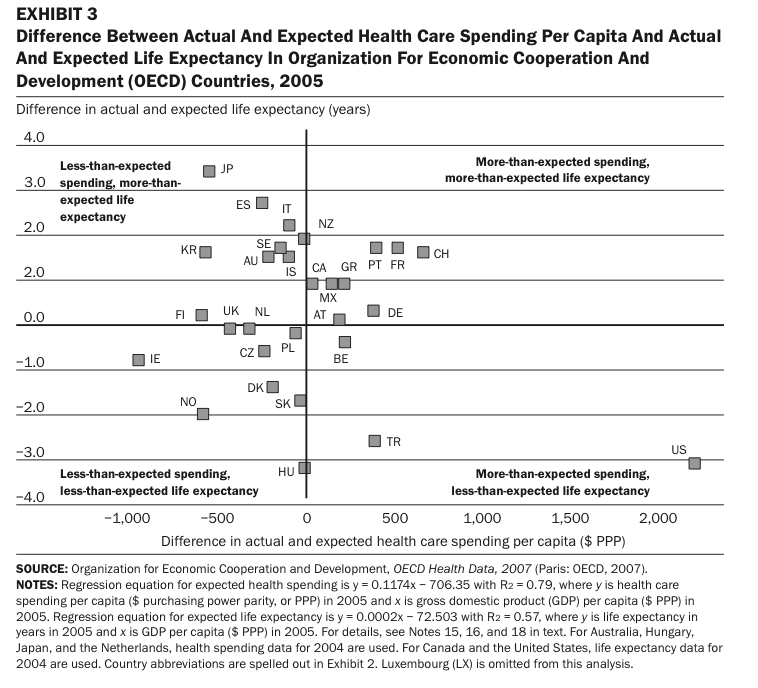
I was looking at OECD health care data for something else I’ve been working on and wanted to share some of it. It’s well known that the United States spends a lot more per person on health care than comparable countries and that our actual health outcomes are anywhere from average to bad. See, for example, this chart from a 2008 paper by Gerard Anderson and Bianca Frogner.

That chart shows how each country’s spending and life expectancy differ from what you would expect based solely on how rich they are (per capita GDP). As you can see, we spend a lot more and live a lot less. (That paper also considers a number of other outcome measures; we do well on some, poorly on others.)

Besides where we are today, though, the other thing we should be interested in is where we are going. Our health care system is the product of a number of historical factors that we can’t make go away with a snap of our fingers. So even if we have a bad, expensive health care system, maybe it is getting relatively better and relatively less expensive.

Nope.

Continue reading “Our Health Care System, Compared”