Author: James Kwak

Why Taxes Should Pay for Health Care

By James Kwak

William Baumol and some co-authors recently published a new book on what is widely known as “Baumol’s cost disease.” This is something that Simon wanted to include in White House Burning, but I couldn’t find a good way to fit it in (and it would have gone in one of the chapter’s I was writing), so I it isn’t in there. (Baumol is cited for something else.) But in retrospect, I should have put it in.

Baumol’s argument, somewhat simplified, goes like this: Over time, average productivity in the economy rises. In some industries, automation and technology make productivity rise rapidly, producing higher real wages (because a single person can make a lot more stuff). But by definition, there most be some industries where productivity rises more slowly than the average. The classic example has been live classical music: it takes exactly as many person-hours to play a Mozart quartet today as it did two hundred years ago. You might be able to make a counterargument about the impact of recorded music, but the general point still holds. One widely cited example is education, where class sizes have stayed roughly constant for decades (and many educators think they should be smaller, not larger). Another is health care, where technology has vastly increased the number of possible treatments, but there is no getting around the need for in-person doctors and nurses.

Continue reading “Why Taxes Should Pay for Health Care”

43.4 = 30.9?

By James Kwak

Adam Davidson wrote his latest New York Times Magazine column about how Barack Obama and Mitt Romney largely agree on economic questions. This is a classic example of how to mislead through deceptively selective citation.

Here’s the core assertion:

For someone who lived in the first 150 years or so of this country, it might be hard to see what’s so different about the economic policies of Barack Obama and Mitt Romney. Romney seeks a 25 percent top corporate tax rate, and Obama is proposing 28 percent. Romney wants to eliminate capital-gains taxes for the typical investor and leave the rate at 15 percent for higher earners. Obama wants to increase it to 20 percent. They differ on how to tax the highest incomes. But for most Americans, the distinctions might be mistaken for a rounding error. Both men strongly support expanding free trade and maintaining close to the same level of Social Security and welfare benefits.

As anyone who follows fiscal policy knows, the corporate tax rate is a sideshow. It’s the individual income tax and payroll taxes that bring in the big dollars, and it’s the individual income tax that has the real impact (or not) on inequality.

Continue reading “43.4 = 30.9?”

File Under Fascinating

By James Kwak

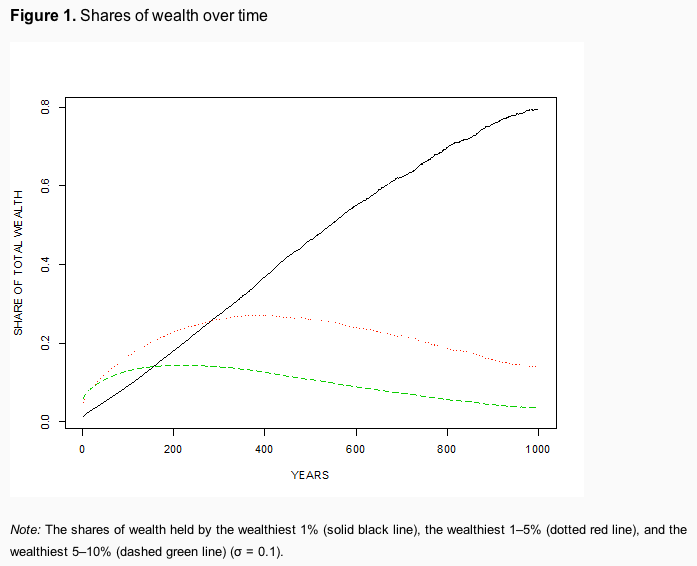
A reader pointed me to “Instability and Concentration in the Distribution of Wealth,” a paper by Ricardo and Robert Fernholz (Vox summary here). It’s a pretty mathematical paper (and I’m not just talking about the usual multivariate regression here), and I didn’t make it through all the equations. But the basic idea is to come up with a model that might explain the high degree of income and wealth inequality we see in advanced economies and particularly in the United States, where 1 percent of the population holds 33 percent of all wealth.

What’s fascinating is that the model assumes that all households are identical with respect to patience (consumption decisions) and skill (earnings ability). Household outcomes differ solely because they have idiosyncratic investment opportunities—that is, they can’t invest in the market, only in things like privately-held businesses or unique pieces of real estate. Yet when you simulate the model, you see an increasing share of wealth finding its way into fewer and fewer hands:

Continue reading “File Under Fascinating”

The Problems with Software Patents

By James Kwak

Charles Duhigg and Steve Lohr have a long article in the Times about the problems with the software patent “system.” There isn’t much that’s new, which isn’t really a fault of the article. Everyone in the industry knows about the problems—companies getting ridiculously broad patents and then using them to extort settlements or put small companies out of business—so all you have to do is talk to any random group of software engineers. And it’s not as much fun as the This American Life story on software patents, “When Patents Attack!” But it’s still good that they highlight the issues for a larger audience.

The article does have a nice example of examiner shopping: Apple filed essentially the same patent ten times until it was approved on the tenth try. So now Apple has a patent on a universal search box that searches across multiple sources. That’s something that Google and other companies have been doing for years, although perhaps not before 2004, when Apple first applied. There’s another kind of examiner shopping, where you file multiple, similar patents on the same day and hope that they go to different examiners, one of whom is likely to grant the patent.

Continue reading “The Problems with Software Patents”

Capital Gains Tax Rates and Savings

By James Kwak

Earlier this week, I  wrote my own “job creator’s” manifesto for The Atlantic, in response to Steven Pearlstein’s great parody. You can read it if you are interested in knowing what one “job creator” thinks our country needs.

There’s something I forgot to add, however. (Literally: while I was away from my computer I decided to add it, but then I forgot to do so before sending it to my editor.) As I’ve said before, the capital gains tax rate had no impact on my decision to start a company. It couldn’t have had any impact, because I didn’t know what it was.

Continue reading “Capital Gains Tax Rates and Savings”

One-Hit Wonders

By James Kwak

Meg Whitman is what is known as a superstar CEO. She became CEO of eBay in 1998 and took it public; during her reign, eBay became one of the most successful, most valuable Internet companies in existence (and Whitman became a billionaire). She used her celebrity to mount a high-profile, expensive, and ultimately unsuccessful campaign to become governor of California (losing to career politician Jerry Brown) before being named CEO of HP, the iconic Silicon Valley company.

Why did HP, one of the largest information technology companies in existence, hire Whitman, who preceded her stint at eBay (auction house for random stuff from people’s attics) with jobs at Disney, a shoe company, a flower delivery service, and a toy company? Because of the idea of the superstar CEO, with transferable general management skills, who can transform any organization.

Continue reading “One-Hit Wonders”

Thomas Hoenig Read All of Basel III . . .

By James Kwak

. . . and doesn’t like what he sees. In a post for the Harvard Law School Forum on Corporate Governance and Financial Regulation, the former president of the Kansas City Federal Reserve Bank echoes some of the issues raised by Andrew Haldane, which I discussed earlier. The core problem, for Hoenig, is that Basel III “promises precision far beyond what can be achieved for a system as complex and varied as that of U.S. banking.” Banks were able to arbitrage the risk-weighted capital requirements of Basel II? Well, we’ll close all of those loopholes, one by one. But this cannot be done, given the incentives and power imbalances at work: “Directors and managers . . . will delegate the task of compliance to technical experts, and the most brazen and connected banks with the smartest experts will game the system.”

Continue reading “Thomas Hoenig Read All of Basel III . . .”

Masters or Trend-Followers of the Universe?

By James Kwak

There is an image that underlies the theory of efficient markets. The image is of a pack of hyper-intelligent, hyper-competitive, voracious traders (working at hedge funds, at bank prop trading desks, in their basements, whatever), relentless scouring the markets for pricing inefficiencies and pouncing on them, trading them out of existence before moving on to the next one. The archetype is the quantitative trading desk at Salomon Brothers in the late 1980s, led by John Meriweather, exploiting arbitrage opportunities between on-the-run and off-the-run Treasury bonds. In finance theory, these sharks are contrasted with the “noise traders” who don’t know what they’re doing, and the question is whether the noise traders are enough to upset market efficiency.

But how good are the sharks anyway? That’s the question that came to my mind on reading the Economist‘s summary of a paper by Lauren Cohen, Christopher Malloy, and Karl Diether on stock market responses to legislation affecting specific industries. They found that you could make money by buying stocks of companies likely to be helped by new bills, and you could identify those companies from the voting records of senators and the incidence of keywords in the bill text.

“The mystery,” according to the Economist, “is why the broader market is so slow to recognise the effect of legislation.” That’s the classic way of thinking about the problem. Shouldn’t the hedges have figured this out already? But this isn’t the only case. A recent column by Lucian Bebchuk reminded me of another example: Up until the 1990s, you could have made money by buying stocks of companies with good corporate governance practices and shorting those of companies with poor practices.

These are patterns that were discovered by academics, who have limited research budgets and little financial incentive involved. (Academic prestige counts for something, but, according to theory at least, not as much as the billions of dollars in fees brought in by top hedge funds.) How come they were discovered by Bridgewater and Renaissance and all of those guys who have huge piles of money to invest in research?

One possibility is that Renaissance has discovered this and other trading strategies and has figured out a way to milk them without making the arbitrage opportunity go away entirely. The other possibility is that the sharks really aren’t so terrifying and ruthless as popularly believed, and instead they just stumble around copying each other to try to reduce their variance from the competition.

Or more likely it’s some combination of the two. A handful of firms come up with their own superior trading strategies, but most simply copy whatever they hear other people are doing. That’s why the corporate governance anomaly seems to have been traded away, and why everyone is doing high-frequency trading these days. The problem is that most investors’ money is going to the followers, which is why they are getting low returns and high costs. But it’s good for the entire industry that laypeople are in such undeserved awe of hedge fund managers as a class.
Voters: Not So Stupid?

By James Kwak

In July, a New York Times article on Priorities USA Action mentioned a focus group in which participants refused to believe that any presidential candidate could be in favor of “ending Medicare as we know it” (replacing guaranteed coverage with vouchers that will pay for an unknown percentage of guaranteed coverage) and tax cuts for the rich. At the time, I called this no less than “the problem with American politics.” 

But perhaps the problem isn’t so bad. Here are some results from recent Times/Quinnipiac polls of swing states (click on the image for a bigger version):


Continue reading “Voters: Not So Stupid?”

The Gift That Keeps on Giving

By James Kwak

By now most of you probably know about the video of Mitt Romney at a fund-raiser for rich people dissing 47 percent of Americans, including seniors, one of his core constituencies. (Many seniors don’t pay income tax because they don’t have enough income, since Social Security is not taxed except for high-income households. For more on the “47 percent,” see here.)

Continue reading “The Gift That Keeps on Giving”

Musical Pseudo-Science

By James Kwak

A friend sent me to an article in The Economist titled “The Science of Conducting” summarizing a study by a number of researchers (including apparently at least one real musician). The Economist’s conclusion:

“The findings are in harmony with what conductors knew all along: that baton-toting despots, like the late Herbert von Karajan, do add value—but only if they rein in the uppity musicians in front of them.”

This is more or less what the paper itself claims:

“We propose that the conductor will significantly change the perceived quality of a piece when s/he both increases his/her influence on musicians and, at the same time, expresses a personality able to overshadow the inter-musician communication. In simpler terms, this might be the essence of leadership.”

Continue reading “Musical Pseudo-Science”

Simple or Complex?

By James Kwak

Ever since the financial crisis, there has been an on-again, off-again debate over the right model for financial regulation. On the one hand are those who favor simpler rules—such as a simple leverage limit based on total unweighted assets—on the grounds that they are easier to monitor and tougher to game. On the other hand are those who favor complex rules—such as the Dodd-Frank Act, which has so far generated over 8,000 pages of rules—on the grounds that the world is complicated so we need complicated rules. For the most part, this has been a shouting match over broad principles.

A friend sent me Andrew Haldane’s paper from Jackson Hole a couple of weeks ago, “The Dog and the Frisbee.” (The title refers to the ability of a dog—or a child—to catch a frisbee by following a single visual heuristic, ignoring factors such as the rotational speed of the frisbee or wind currents.) Now we have evidence.

Continue reading “Simple or Complex?”

No There There

By James Kwak

On the one hand, over in Romney headquarters, they can take heart from the fact that the economy continues to sputter, as evidenced by the latest jobs report. On the other hand, as the election draws near, people will only ask more questions about what President Romney would actually do. For months now, the campaign has whispered one thing to the base (e.g., “severely conservative”) while being purposefully vague to everyone else, hoping that independents will assume he is still the moderate who introduced universal health care to Massachusetts. Now that strategy is breaking down.

Exhibit A is yesterday’s comical back-and-forth-and-forth-and-back on the Affordable Care Act. But the more important Exhibit B is the Romney “tax plan”—you know, the one that cuts rates for everyone by 20 percent, yet does not reduce revenues, does not increase taxes on the middle class, and achieves this miracle by eliminating tax expenditures, but without touching the preferences for investment income or the mortgage interest tax deduction.

Continue reading “No There There”

The Problem with Bankers’ Pay

By James Kwak

From today’s WSJ:

“At J.P. Morgan, the biggest U.S. bank by assets, directors are considering lower 2012 bonuses for Chief Executive James Dimon and other top executives in the wake of a multibillion-dollar trading disaster, said people close to the discussions. But they also are grappling with the question of how to do that without drastically reducing the executives’ take-home pay.”

Huh? Isn’t reducing their take-home pay the point?

Dominos

By James Kwak

So, as everyone knows, the ECB came out yesterday with its latest plan to stem the creeping European sovereign debt crisis. This one involves potentially unlimited ECB purchases of sovereign debt, so long as its maturity is less than three years (presumably so that the ECB can pull the plug within three years on non-complying governments) and the country in question agrees to comply with fiscal policy reforms (i.e., austerity).

I don’t have any particular ability to forecast whether this will succeed or fail. My inclination is that it will succeed for a while and then turn out to be insufficient, for the reasons that others have identified. Central bank bond-buying will enable governments to borrow money at manageable yields, so their national debt will not spiral out of control solely because of climbing interest rates. But to bring debt levels down will require actual economic growth, and more austerity—even if it isn’t quite as austere as that imposed on Greece in the past—will not generate growth. In addition, the ECB’s promise to “sterilize” its bond purchases—I believe by selling other assets to raise the cash for bond purchases, so the net effect will not be to create money—means that this is not a particularly expansionary form of monetary policy.

This is as good an occasion as any, however, to ask a question I’ve been wondering about for, oh, years now. Every discussion of the European crisis includes the following domino theory (although no one calls it that anymore, for reasons I’ll get back to): If Greece leaves the Eurozone, that proves that it is possible to leave the Eurozone—or, put another way, that the powers that be cannot keep the Eurozone intact. If people realize that it is possible, then bond markets will bet even more heavily against Spain and Italy, which will force them to leave the Eurozone, which would be terrible. Hence Greece cannot leave the Eurozone.

Continue reading “Dominos”