Month: November 2011

The End Of The Euro

By Peter Boone and Simon Johnson – this post is the first two paragraphs of a column that appears this morning on Bloomberg.com

Investors sent Europe’s politicians a painful message last week when Germany had a seriously disappointing government bond auction. It was unable to sell more than a third of the benchmark 10-year bonds it had sought to auction off on Nov. 23, and interest rates on 30-year German debt rose from 2.61 percent to 2.83 percent. The message? Germany is no longer a safe haven.

Since the global financial crisis of 2008, investors have focused on credit risk and rewarded Germany with low interest rates for its perceived frugality. But now markets will focus on currency risk. Inflation will accelerate and the euro may break up in a way that calls into question all euro-denominated obligations. This is the beginning of the end for the euro zone.

To read the rest of this column, please use this link: http://www.bloomberg.com/news/2011-11-28/the-euro-area-is-coming-to-an-end-peter-boone-and-simon-johnson.html
1994 vs. 2011

By James Kwak

I’m sorry that I’ve been too busy for the past two weeks to blog much, but I did manage to write a column for The Atlantic yesterday. It looks at how far the conservative revolution has come in less than a generation and wonders why they can’t just declare victory and go home.

Why Not Break-Up Citigroup?

By Simon Johnson

Earlier this week, Richard Fisher – President of the Dallas Federal Reserve Bank – captured the growing political mood with regard to very large banks:  “I believe that too-big-to-fail banks are too-dangerous-to-permit.” Market-forces don’t work with the biggest banks at their current sizes; they have great political power and receive almost unlimited implicit subsidies in the form of protection against downside risks – particularly in situations like now, with the European financial situation looking precarious.

“Downsizing the behemoths over time into institutions that can be prudently managed and regulated across borders is the appropriate policy response. Then, creative destruction can work its wonders in the financial sector, just as it does elsewhere in our economy.”

Mr. Fisher is an experienced public official – and also someone with a great deal of experience in financial markets, including running his own funds-management firm.  I increasingly meet leading figures in the financial sector who share Mr. Fisher’s views, at least in private.

What then is the case in favor of keeping mega-banks at their current scale?  Vague claims are sometimes made, but there is very little hard evidence and often a lack of candor on that side of the argument.  So it is refreshing to see Vikram Pandit, CEO of Citigroup, go on the record with The Banker magazine to at least explain how his bank will generate shareholder value.  (The interview is behind a paywall, unfortunately). Continue reading “Why Not Break-Up Citigroup?”

Wall Street v. Elizabeth Warren

By Simon Johnson

Karl Rove’s Crossroads GPS group has launched the first attack ad against Elizabeth Warren, presumably because she is now running hard for the Senate in Massachusetts.  This ad is not a big surprise, but the line that Mr. Rove takes could well backfire.

The ad states, “we need jobs, not radical theories and protests,” so we can break the argument down into three separate parts.

First, who destroyed more than 8 million jobs in the United States – and plunged us into the deepest and longest lasting recession since the 1930s?  Surely this was not Ms. Warren, who was just a law school professor, in the run-up to 2008.

Mr. Rove is opening the blame game and this is going to go badly for his presumed supporters – the largest banks on Wall Street that took excessive risks, paid their top people well, and then blew themselves up at great cost to the American taxpayer.  By all means, let us have a conversation about jobs and the history of job losses in the United States; “too big to fail” banks do not look good in this context. Continue reading “Wall Street v. Elizabeth Warren”

Is Europe On The Verge Of Another Great Depression – Or A Great Inflation?

By Simon Johnson

The news from Europe, particularly from within the eurozone, seems all bad.  Interest rates on Italian government debt continue to rise.  Attempts to put together a “rescue package” at the pan-European level repeatedly fall behind events.  And the lack of leadership from Germany and France is palpable – where is the vision or the clarity of thought we would have had from Charles de Gaulle or Konrad Adenauer?

In addition, the pessimists argue, because the troubled countries are locked into the euro, there are no good options.  Gentle or even dramatic depreciation of the exchange rate for Greece or Portugal or Italy is not in the cards.  As a result, it is hard to lower real wages so as to restore competitiveness and boost trade.  This means that the debt burdens for these countries are likely to seem insurmountable for a long time.  Hence there will likely be default and resulting global financial chaos.

According to the September 2011 edition of the IMF’s Fiscal Monitor, 44.4 percent of Italian general government debt is held by nonresidents, i.e., presumably foreigners (Statistical Table 9).  The equivalent number for Greece is 57.4 percent, while for Portugal it is 60.5 percent.  And if you want to get really negative and think the problems could spread from Italy to France, keep in mind that 62.5 percent of French government debt is held by nonresidents.  If Europe has a serious meltdown of sovereign debt values, there is no way that the problems will be confined just to that continent.

All of this is a serious possibility – and the lack of understanding at top European levels is a serious concern.  No one has listened to the warnings of the past three years.  Almost all the time since the collapse of Lehman Brothers has been wasted, in the sense that nothing was done to put government finances on a more sustainable footing.

But perhaps the pendulum of sentiment has swung too far, for one simple and perhaps not very comfortable reason. Continue reading “Is Europe On The Verge Of Another Great Depression – Or A Great Inflation?”

Our Health Care System, Compared

By James Kwak

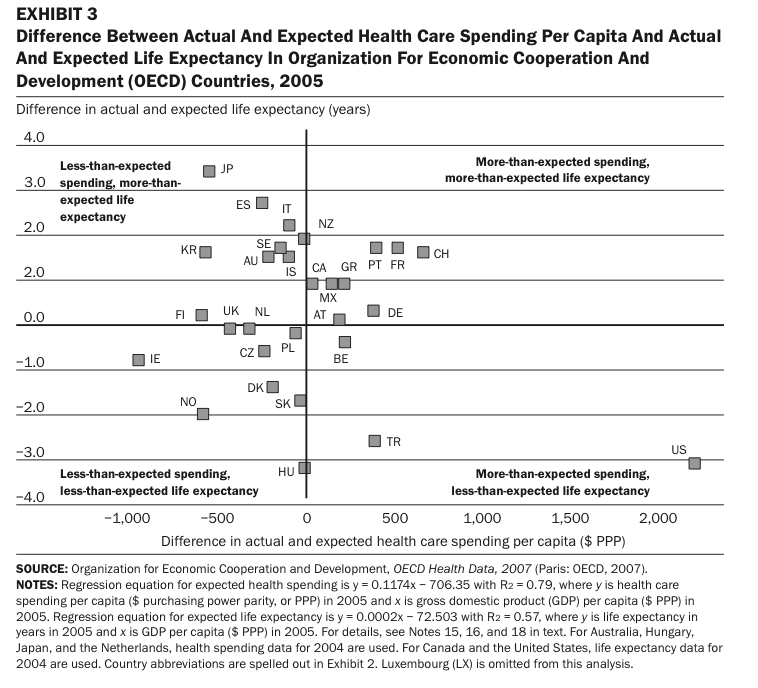
I was looking at OECD health care data for something else I’ve been working on and wanted to share some of it. It’s well known that the United States spends a lot more per person on health care than comparable countries and that our actual health outcomes are anywhere from average to bad. See, for example, this chart from a 2008 paper by Gerard Anderson and Bianca Frogner.

That chart shows how each country’s spending and life expectancy differ from what you would expect based solely on how rich they are (per capita GDP). As you can see, we spend a lot more and live a lot less. (That paper also considers a number of other outcome measures; we do well on some, poorly on others.)

Besides where we are today, though, the other thing we should be interested in is where we are going. Our health care system is the product of a number of historical factors that we can’t make go away with a snap of our fingers. So even if we have a bad, expensive health care system, maybe it is getting relatively better and relatively less expensive.

Nope.

Continue reading “Our Health Care System, Compared”

What Could the US Achieve at the G20 in Cannes?

By Simon Johnson

The April 2009 London summit of the G20 is widely regarded as having been a great success.  The world’s largest economies agreed on an immediate coordinated approach to the global financial crisis then raging and promised to work together on banking reforms that would support growth.  At the time, President Obama got high marks for his constructive engagement.

The G20 heads of government have met twice a year since London and in Cannes this week they meet again (November 3-4).  Could this summit also help stabilize the world economy?  And can President Obama again play a leading role?  The answer to both questions is likely the same: No. Continue reading “What Could the US Achieve at the G20 in Cannes?”

Who Wants Tax Cuts?

By James Kwak

Yesterday I wrote an Atlantic column about Republican presidential candidates’ fondness for tax plans that transfer massive amounts of money from the poor to the rich. The main question, to my mind, is why people like Herman Cain and Rick Perry talk about transferring massive amounts of money to the rich when polls show that even a majority of Republicans think the rich should pay more in taxes.

Many of the readers here could probably  have written that column themselves, but it does have a wonderful picture of Cain and Perry in all their well-dressed glory.

Are They Really That Good?

By James Kwak

The instinctive defense from Wall Street bankers is that they deserve the money they make: they’re just that good. By that logic, Jon Corzine was the best of the best: he was the head of Goldman, after all (although in his days, if I recall correctly, Goldman and Morgan Stanley were roughly tied in prestige). The failure of MF Global may have had many causes, but it does make one wonder: Are the people at Goldman really that good individually, or is it the firm (and its reputation, and its information flow) that makes them so good?

Andrew Ross Sorkin speculates that MF Global got Goldman-style risk-taking without Goldman-style compliance and risk management. I would just add: they also got it without a Goldman-style too-big-to-fail government guarantee.

What’s Wrong with Groupon?

By James Kwak

Groupon plans to go public later this week. According to the latest leaks, things are going well: the IPO valuation, scaled back from $30 billion to about $12 billion, may be raised because of a successful road show. Apparently even after the company conceded that the amount they pay to a merchant does not count as revenue, investors have decided they like what they see.

But there is still something fishy about Groupon’s business model.

Continue reading “What’s Wrong with Groupon?”