Month: January 2010

The Obama Financial Tax Is A Start, Not The End

The flurry of interest this week around ways to tax Big Banks is important, because officials in the US are – for the first time – recognizing that reckless risk-taking in our banking system is dangerous and undesirable.

But the possibility of a tax on bonuses or on “excess profits” that are large relative to the financial system should not distract us from the more fundamental issues. Continue reading “The Obama Financial Tax Is A Start, Not The End”

The Citi Never Weeps

On the first day of the Financial Crisis Inquiry Commission, Phil Angelides demonstrated a gift for powerful and memorable metaphor: accusing Goldman Sachs of essentially selling defective cars and then taking out insurance on the buyers.  Lloyd Blankfein and the other CEOs looked mildly uncomfortable, and this image reinforces the case for a tax on big banks – details to be provided by the president later today.

But the question is: How to keep up the pressure and move the debate forward?  If we stop with a few verbal slaps on the wrist and a relatively minor new levy, then we have achieved basically nothing.  We need people more broadly to grasp the dangerous financial “risk system” we have created and to agree that it needs to be dismantled completely.

One way to do this would be for the Commission to call key people from Citigroup to testify. Continue reading “The Citi Never Weeps”

“I Do Not Blame The Regulators”

Jamie Dimon has all the best lines.  In May 2009, he told JPMorgan Chase shareholders that 2008 was probably “our finest year ever.”  That was before he thought about profits for 2009.

And today he told to the Financial Crisis Inquiry Commission, “I want to be clear that I do not blame the regulators.  The responsibility for a company’s actions rests with the company’s management” (p. 9).

This is true enough – and something to reflect on during bonus season.  But at a deeper level, the crisis of 2008-09 and our continued dangerous financial system are very much the fault of our regulators.  Continue reading ““I Do Not Blame The Regulators””

United States Health Care Spending

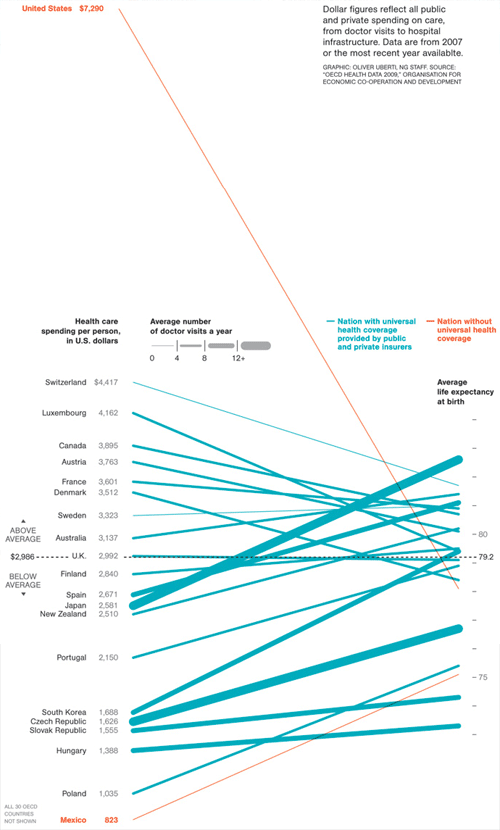
The vast discrepancy between what we spend on health care and what every other prosperous (or not-so-prosperous) country spends on health care–and the little good it does us–is so well-known that it’s not going to change any minds when it comes to health care reform. Opponents of reform have come up with their rationalizations (more spending on technology, someone has to subsidize cheap drugs for the rest of the world, etc.), some of which contain grains of truth. But even if people aren’t listening any more, that doesn’t make it any less true.

Ezra Klein brings us the latest reminders. Here’s the most amazing graph from National Geographic:

That’s a clever trick, putting the outlier above the title of the chart. I’ll have to try it sometime.

By James Kwak

“Appalled, Disgusted, Ashamed and Hugely Embarrassed”

No, that’s not someone talking about the banking industry. That’s Howard Wheeldon of BGC Partners (a brokerage firm) responding to Adair Turner’s statement last September that “Some financial activities which proliferated over the last 10 years were socially useless, and some parts of the system were swollen beyond their optimal size.” (Turner is head of the FSA, the United Kingdom’s primary bank regulator.) That’s from a recent profile of Turner on Bloomberg.

“‘How dare he?’ Wheeldon now says. ‘Markets will decide if something is too big or too small. It’s not for an individual, however powerful, to slam and damn nearly 1 million people.'”

Do we really need to point out that markets don’t always make the right decisions? Markets didn’t break up Standard Oil or AT&T–people did. And how is it wrong for public figures to be publicly stating their beliefs about what the objectives of public policy should be?

But the point of this post isn’t to single out another free-market zealot who apparently doesn’t think about the words he is saying. It’s to talk about John Paulson and Malcolm Gladwell.

Continue reading ““Appalled, Disgusted, Ashamed and Hugely Embarrassed””

Drill, Baby, Drill: Reviewing The Advice To The Financial Crisis Inquiry Commission

The NYT has a collection of potential questions for the Financial Crisis Inquiry Commission (FCIC) to ask four of the country’s leading bankers today.

Some of the proposed questions are technical or even philosophical.  These are interesting, but hardly likely to be effective.

I like where Yves Smith is going: what kind of bonuses were paid for trades on which firms ultimately lost money?  Bill Cohan and David Walker, coming from very different perspectives, are also pushing on issues related to compensation structure in general and bonuses in particular.

The real issue, of course, is the nature of the risk system itself.  But this is a big abstract question – and not suited to these kind of hearings.  The Commission needs to find concrete issues that people can relate to much more broadly, and bonuses are very much in the line of fire.  The fact that the 2009 bonuses are already in the works – and eerily, but not coincidentally, parallel to the 2007 bonuses – is going to make this hard for the bankers to spin.

Serious debate is just beginning – drill down into how bankers at Too Big To Fail firms really pay themselves, and you will be amazed at what you start to see more clearly.

By Simon Johnson
More from “The Lion”

In the short days between Christmas and New Year’s, BusinessWeek published an interview with Paul Volcker conducted by Charlie Rose headlined “The Lion Lets Loose.” Rose asked him why the U.S. economy has fallen behind in some areas, such as manufacturing. Here’s the segment:

“How did that happen?
“What happened is our best and brightest got attracted to Wall Street. You’ve read about those big bonuses. These are generalizations, but I do think that the pull of Wall Street on bright young people, ambitious young people, has been tremendous.”

Continue reading “More from “The Lion””

Feed Problems?

I’ve gotten a few messages that our feed is not working properly. And, it occurs to me that I haven’t been getting email updates for the past couple of days.

The default feed produced by WordPress (https://baselinescenario.com/feed/) is working fine, and I can read the blog fine in Google Reader. But the Feedburner version (http://feeds.feedburner.com/BaselineScenario), which generates the emails, is stuck at January 8. I’ll look into it, but if you have any diagnostic details or suggestions let me know below.

(I suspect it is related to my having changed the number of items that go into the feed from 15 to 200; I was trying to figure out a better way to convert the blog to PDF, and that was one of the steps. I reset it this morning, so that may fix it.)

Update: Forcing Feedburner to ping the default feed worked; the Feedburner feed is up to date now. I’ll watch it to see if it picks up the next post or not.

Update 2: It did. I’m guessing that email subscribers will get an email tonight. (Of course, most of you aren’t here to read this.)

By James Kwak

The Financial Crisis Inquiry Commission: Ready For A Breakthrough

The Financial Crisis Inquiry Commission (FCIC) holds its first public session on Wednesday.  When the FCIC was established in May, the prevailing wisdom was that the hearings and final report would be dry and rather inconclusive.

But the debate around Big Banks has started to shifted markedly, particularly in recent weeks.  Anger about bonuses is increasingly expressed by the most mild-mannered policy experts.  The administration itself is proposing some sort of excess profits tax on the biggest banks.  And – most important – our top bankers have their tin ears prominently on display.

In the Daily Beast, I suggest exactly how the Commission can put this moment to productive use.  The point is to find for rather dull and difficult technical material to become names, dates, and numbers that catch the popular imagination – and provide a genuine warning.  The most obvious and reasonable way to do this is by drilling down into the details of the Wall Street compensation system, then and now – the more you dig, the more you understand why we are heading for trouble.

By Simon Johnson

Bank Tax Arrives

The Obama administration tipped its hand today – they are planning a new tax of some form on the banking sector.  But the details are deliberately left vague – perhaps “not completely decided” would be a better description.

The NYT’s Room for Debate is running some reactions and suggestions.  The administration is finally getting a small part of its act together – unfortunately too late to make a difference for the current round of bonuses. 

We know there is a G20 process underway looking at ways to measure “excess bank profits” and, with American leadership, this could lead towards a more reasonable tax system for finance.  In the meantime, my point is that taxing bonuses – under today’s circumstances – is not as bad as many people argue, particularly as it lets you target the biggest banks. 

By Simon Johnson

My Last Post on Ben Bernanke

His confirmation, that is. I summarized most of my position in Foreign Policy, which asked me to lay out the anti-confirmation argument. My reasons overlap with Simon’s but are not identical–I think Simon worries about cheap money and asset bubbles more than I do. I was originally not particularly motivated by the anti-Bernanke campaign, because I didn’t think Obama would appoint anyone better, but as Russ pointed out, whether Bernanke should be confirmed and what the alternative is are two separate questions.

Whom would I pick? I certainly don’t know the candidates well enough to make a good choice. But the first thing I would say is that the Federal Reserve chair does not need to be Superman. The Federal Reserve Board of Governors is a board, and while the chair is important, he or she should really be the first among equals. You want someone who will push the Board in a certain direction, but the chair can draw on the experience and skills of the other board members and the staff, who are technically very competent. The idea that the chair must be Superman seems to be a product of the Greenspan era, and we project it back onto Volcker because of his success in fighting inflation in the early 1980s. And it’s a bad idea, just like searching for a savior CEO. In this context, I think it’s limiting to insist that the nominee have experience on the board, or have government experience, or be a prominent academic, or anything in particular.

Continue reading “My Last Post on Ben Bernanke”

Leading Indicator of Me

If I ever go to another school, you should run away from it as fast as you can. That is the practical implication of Felix Salmon’s post a few days ago rounding up arguments for why you should not get a Ph.D. in the humanities or go to law school.

Thomas Benton’s article, “Graduate School in the Humanities: Just Don’t Go,” nails the basic reasons why I went to UC Berkeley nineteen years ago: excitement in the subject, a history of high grades, the comforting structure of academia, romanticization of university life, and no practical application of academic skills. (See the six bullets halfway down the article.) When I left Berkeley in 1997, I could not get an academic job that I wanted … and the rest is history, I guess. If you do get a Ph.D. in the humanities these days, the numbers are even more heavily against you than they were then. First, American universities as a whole are shifting from tenure-track jobs to untenured adjunct positions; second, within universities, the jobs are shifting from the humanities into vocational fields like accounting and nursing. The ongoing bloodbath in state finances is only making things worse, since most of the good universities in the country are public.

Continue reading “Leading Indicator of Me”

The Case For A Supertax On Big Bank Bonuses

The big banks are pre-testing their main messages for bonus season, which starts in earnest next week.  Their payouts relative to profits will be “record lows”, their people won’t make as much as in 2007 (except for Goldman), and they will pay a higher proportion of the bonus in stock than usual.  Behind the scenes, leading executives are still arguing out the details of the optics.

As they justify their pay packages, the bankers open up a broader relevant question: How much bonus do they deserve in this situation?  After all, bonus time is when you decide who made what kind of relative contribution to your bottom line – and you are able to recognize unusually strong achievement. 

Seen in these terms, the answer is easy: people working at our largest banks – say over $100 bn in total assets – should get zero bonus for 2009. Continue reading “The Case For A Supertax On Big Bank Bonuses”

Obama and FDR

Kevin Drum found a great quotation from FDR and what he thought of bankers, monopolists, and speculators. It’s so good he deserves to have you go there and read it.

Drum’s point is that while health care may have required conciliation and moderation, “When it comes to financial regulatory reform, Obama needs to let us know whose side he’s on.” So far Obama has played the peacemaker, the reasonable man in the middle, the man who bridges divides. “My administration is the only thing between you and the pitchforks,” he said last March; note that he brought up the pitchforks, but positioned himself as the center, holding back the crazies.

Continue reading “Obama and FDR”

Bernanke, Manager

There’s a platitude repeated by most CEOs that their main job is not anything so mundane as making decisions, but “mentoring and supporting people” or something like that. Most of the CEOs who repeat this are mediocre at best at mentoring or supporting people, since the key people for any CEO are not the people who work for him or her, but the members of the board of directors. But the truism that is still true is that when you are head of a large organization, you can’t do everything yourself, and your real impact is made through the people you hire, promote, and don’t fire.

In October, Ben Bernanke named Patrick Parkinson director of the Division of Bank Supervision and Regulation. Who is Patrick Parkinson?

Continue reading “Bernanke, Manager”