Month: April 2009

Unions and Business

One of the themes of the GM debate goes like this. On the one hand, the UAW is the problem, because it’s the high cost of union labor (and in particular, union retiree health benefits) that is crippling U.S. automakers. On the other hand, the UAW negotiated for those benefits fair and square, giving up higher current wages as part of the bargain, so it’s the fault of management for making promises they couldn’t keep. On the third hand, the UAW should have realized that when you negotiate for retirement benefits from a private corporation, one of the risks you take is that that corporation might go bankrupt. (For one example of these arguments, see Room for Debate at the NYT.)

Instead of touching that question any more than I already have, I wanted to raise the larger issue of whether unions are bad for business – which is what you would assume, given the lengths many companies go to in order to prevent unions from gaining collective bargaining rights. In general, this is a hard question to answer empirically. While you can observe differences between companies with unions and companies without unions, there is a huge problem of selection bias: since companies with unions are unlike companies without unions in many ways, you can’t say whether any differences in outcomes are due to the effect of the unions themselves, or due to the effect of other factors that would be there regardless of the unions.

John DiNardo and David Lee have an elegant way of getting around this problem in a 2004 paper, “Economic Impacts of New Unionization on Private Sector Employers: 1984-2001.” (The real economists out there probably know this paper already.) Instead of comparing all companies with unions to all companies without unions, they focus on companies where the union certification vote either barely won or barely lost, since these two companies are very similar to each other except for the treatment effect (having collective bargaining rights). This isolates the effect of unionization from other characteristics of the companies in question. They find that unions that barely win an election are successful in obtaining a collective bargaining agreement. Otherwise, however, the effect of successful unionization is insignificant on the company: differences in wages, employment, productivity, and output are all insignificant.

The UAW, historically, is a special case which people can debate for as long as they want. But the evidence is that in recent decades unions are not dangerous to firm survival.

Update: I forgot to add a link to a shorter summary of the work.

By James Kwak
The Bank Run Next Time (Frankenstein’s Monster)

Think about the current and potential future pressure on our largest banks like this.  The underlying problems are deep, but the “run” comes from the credit default swap market, and presumably from experienced professional investors – many of whom used to work in the largest banks. 

The big banks helped set up these markets.  They trained many of the people who are now engaged in speculative attacks on these banks.  And the excessive bonuses of yesterday form the capital base for many hedge funds that now lead the attack.

In my Economix column at NYT.com this morning, I explore the ironies and emphasize the dangers.  The system may have a tendency to self-destruct, but don’t think that the costs to the rest of us will be anything less than huge.

Calling All Shareholders

If you cast your mind back to when executive compensation and bonus limits first reached the mainstream debate, you may recall people saying these would be ineffective and the issue is a red herring.

These points do not now seem compelling.  People who work at the big banks are quite irked by what they see as unjustified limits on their bonuses.  Some of the “talent” is jumping ship.  Big bank leadership is lobbying hard to remove the restrictions or, failing that, for the right to pay back government TARP funds in order to escape the bonus cap – leading firms, such as Goldman Sachs, seem poised to raise new capital to that end.

This is a remarkable moment.  Excessive risk taking in large firms was based on inappropriate bonus structures (take risk and get compensated now; face the consequences of that risk down the road), facilitated by a deep failure to understand/control risk inside these organizations and probably made possible by the implicit put option from being too big or too complex to fail (i.e., Wall Street insiders own the upside; taxpayer owns the downside).  We have all focused of late on the costs for taxpayers, which of course are horrible, and going forward – with the implicit option now explicit – who can believe this will lead to anything other than further massive bailouts?

But think about this arrangement from the perspective of shareholders.  Are we looking at the greatest tunneling scheme in the history of organized finance? Continue reading “Calling All Shareholders”

$3.5 Million or $5 Million?

In the midst of a severe economic crisis that is, among other things, depressing federal tax revenues and adding to the national debt, the debate over the estate tax has flared up again. The basic question is whether the exemption will be raised from $1 million – where it was in 2002-03 and where it is scheduled to return after the Bush tax cuts expire – to $3.5 million (Obama) or $5 million (Lincoln-Kyl) per person; there is also disagreement over whether the marginal rate should be 35% or 45%. (Note that even with Obama’s proposed 45% tax rate, the average effective tax rate on estate would be 19%, because of the $3.5 million exemption.)

There is plenty of debate over this already, so I will confine myself to three points.

Continue reading “$3.5 Million or $5 Million?”

Why Bail Out Life Insurers?

That’s the question I woke up with this morning. Sad, isn’t it.

The Wall Street Journal reported this week that Treasury will soon announce that it will use TARP funds to invest in life insurers, or at least those who snuck under the federal regulatory umbrella by buying a bank of some sort. The argument for the bailout is a version of the “No more Lehmans” theory: the failure of a large financial institution could have ripple effects on other financial markets and institutions that could cause systemic damage. For a bank, the ripple effect is primarily caused by two things: (a) defaulting on liabilities hurts bank creditors, and (b) defaulting on trades (primarily derivatives) hurts bank counterparties, if they aren’t sufficiently collateralized (think AIG).

My thought this morning was that life insurance policies are long-term liabilities that are already guaranteed by state guarantee funds, so we don’t have to worry about (a), and hopefully most life insurers were not doing (b) – large, one-sided bets on credit risk like AIG. So why not just let them fail and let the states take over their subsidiaries? But then I checked the facts, and it turns out that the limits on state guarantee fund payouts are pretty low. So the scenario is this: you hear bad things about your life insurer, you decide to redeem your policy (usually at a significant loss to yourself), turning it into a short-term liability, and then the insurer has to start dumping assets into a lousy market, pushing the prices of everything further down and hurting everyone holding those assets. Would this really cause a systemic crisis worse than we’ve already got? I don’t know, but no one in Washington wants to take that risk.

Continue reading “Why Bail Out Life Insurers?”

The Economy and Popular Democracy

One of the central themes of the current economic crisis has been the cozy relationship between “Wall Street” and Washington that resulted from both ideological convergence and old-fashioned campaign contributions. Another theme, as Simon discussed yesterday, has been the absence of a simple left-right axis for opinions to coalesce around. If you think that fixing the banking sector requires a government conservatorship and forcible balance sheet cleanup – rather than periodically dribbling large amounts of cash into institutions and management teams that have already failed by any free-market measure – it’s not clear who your advocates in government are.

Tomorrow, however, you can stand up and be counted. A New Way Forward is organizing demonstrations all around the country, most at 2 PM Eastern Time. The basic message is simple: “If it’s too big to fail, it’s too big to exist. Dismantle the power of the financial elite and make policies that keep a new crop from springing up. We want our economy and politics restored for the public.”

And don’t forget your pitchfork. (Just kidding.)

Does The US Still Face An Emerging Market-Type Crisis?

The US has developed some features more typically seen in an emerging market, including disproportionate power and system-threatening activities in the finance sector.  In fall 2007, the US (and the world) experienced the kind of precipitous fall in credit, output, and employment that was, in modern times, seen only in “emerging market crises”.  Our first Baseline Scenario was controversial and largely dismissed when it first appeared on September 29, 2008, but many of its arguments and policy recommendations have now been absorbed into official thinking (at least in the US).

Is the US out of the emerging market-type woods?  Can we now rule out the possibility of a great depression?  Such a severe economic outcome is not currently our baseline view (e.g., as discussed in this NBR interview), but it is still a downside scenario that needs to be taken seriously – and, at least in our interpretation – this is also the view of Bernanke’s Fed (see our piece on Sunday and the profile in yesterday’s Washington Post.)

Why is a depression scenario still on the table? Continue reading “Does The US Still Face An Emerging Market-Type Crisis?”

What Next For Banks?

The case for keeping banks in something close to their current structure begins to take shape.  It’s not about traditional claims that big banks are more efficient, or Lloyd Blankfein’s argument that this is the only way to encourage risk-taking, or even the House Financial Services Committee view that immediate resumption of credit flows is essential for preserving jobs. 

Rather, the argument is: those opposed to banks and bankers are angry populists who, if unchecked, would do great damage.  Bankers should therefore agree to some mild reforms and more socially acceptable behavior in the short-run; in return, the centrists who control economic policymaking will protect them against the building backlash.  This is a version of Jamie Dimon’s line: “if you let them vilify us too much, the economic recovery will be greatly delayed.”

There are three problems with this argument: it is wrong, it won’t work, and it doesn’t move the reform process at all in the right direction. Continue reading “What Next For Banks?”

Inflation Expectations for Beginners

For a complete list of Beginners articles, see Financial Crisis for Beginners.

Only a few years ago, the accepted remedy for a recession was for the Federal Reserve to lower interest rates – namely, the Federal funds rate. Now, however, the economy has been stuck in recession for over fifteen months and the Federal funds rate has spent the last several months at zero. (The Fed funds rate cannot ordinarily be negative, because one bank won’t lend $100 to another bank and accept less than $100 in return; it always has the option of just holding onto its $100.) As a result, the Fed has resorted to other policy tools, most notably large-scale purchases of agency and Treasury securities, funded by creating money. (Here’s James Hamilton’s analysis.)

As the Fed’s monetary policy plays a more prominent role in the response to the economic crisis, there will be more talk of inflation or, more accurately, inflation expectations. While inflation is what affects the purchasing power of the money in your wallet, inflation expectations are what affect people’s behavior in ways that have a long-term economic impact. Take the case of wage negotiations, for example: a union that believes inflation will average 5% over the life of a contract will demand higher wage increases than a union that believes inflation will average only 1%. Once those higher wages are built into the contract, the employer is forced to raise prices in order to cover those wage increases, and inflation begins to ripple through the economy.

Continue reading “Inflation Expectations for Beginners”

Is It a V?

Yesterday, at the Peterson Institute for International Economics, Mike Mussa and I discussed – and debated – the likely shape of the US and global economic recovery.  Mike has great experience and an outstanding track record as an economic forecaster.  His view is that the entire post-war experience of the US indicates there will be a sharp rebound.  Victor Zarnowitz apparently stressed to Mike, a long time ago, “deep recessions are almost always followed by steep recoveries.”

I completely accept the idea that a slow or L-shaped recovery for the US and at the global level would be something outside the realm of experience over the past 50 years.  I would also suggest that the financial crisis in fall 2008, the speed of decline in the US, and the synchronicity of the slowndown around the world over the past 6 months has also surprised everyone (including most officials) who think that we are always destined to re-run some version of the post-1945 data. Continue reading “Is It a V?”

Baseline Scenario, April 7, 2009

Baseline Scenario for 4/7/2009 (9am): Post-G20 Edition

Peter Boone, Simon Johnson, and James Kwak, copyright of the authors.

This long-overdue (and hopefully widely-awaited) version of our Baseline Scenario focuses largely on the United States, both because of the volume of activity in the U.S. in the last two months, and also because the U.S. will almost certainly have to be at the forefront of any global economic recovery, especially given the wait-and-see attitude prevalent in Europe.

Global Economic Outlook

The global economy remains weak across the board, with no significant signs of improvement since our last baseline. The one positive sign is that some forecasters are beginning to recognize that growth in 2010 is not a foregone conclusion. The OECD, for example, now forecasts contraction of 4.3% in 2009 for the OECD area as a whole – and 0.1% contraction in 2010.  This is broadly with our previous “L-shaped” recovery view.

Even that forecast, however, expects quarter-over-quarter growth rates to be positive beginning in Q1 2010. (This is not a contradiction: if growth is sharply negative in early 2009, then quarterly rates can be positive throughout 2010, without total output for 2010 reaching average 2009 levels.) While most forecasters expect positive growth in most parts of the world in 2010, those forecasts seem to reflect expected reversion to the mean rather than any identified mechanism for economic recovery. The underlying assumption is that at some point economic weakness becomes its own cure, as falling prices finally prompt consumers to consume and businesses to invest. But given the unprecedented nature of the current situation, it seems by no means certain that that assumption will hold. In particular, with demand low around the globe, the typical mechanism by which an isolated country in recession can recover – exports – cannot work for everyone.

Continue reading “Baseline Scenario, April 7, 2009”

Inflation Prospects In An Emerging Market, Like The U.S.

There are two ways to think about inflation in today’s economy.  The first, suggested by conventional macroeconomic frameworks for the US, is that, with rising unemployment and actual output sinking further below “potential” output, inflation will stay low – and we could actually experience the dangers of falling wages and prices (think what happens to mortgage defaults in that scenario).  This is the view, for example, expressed by Fed Vice Chair Don Kohn last week, and the Obama Administration seems to be on exactly the same page – talking already about a further very large fiscal stimulus.

Some people in this camp do see a danger of inflation, down the road, as the economy recovers – and resumes its potential level (or growth rate).  As a result, many of them stress that the Fed will need to start “withdrawing” its support for credit and raising interest rates as soon as the economy turns the corner.  One informed insider’s reaction to our piece on Ben Bernanke in the Washington Post on Sunday was that we were too easy on Bernanke for failing to tighten monetary conditions as the economy began to recover after the last big easing earlier this decade (specifically, our correspondent argues that Bernanke provided the intellectual underpinnings for what Greenspan wanted to do.)

In today’s post-G20 summit situation, some of my former IMF colleagues are worried that further monetary easing around the world will create inflationary pressure in middle-income emerging markets, where inflation is often harder to control than in richer “industrial countries.”  But if you think the broader political and economic dynamics of the United States have become more like those of emerging markets, e.g., the concentrated power of the financial elite and their ability to access corporate welfare, doesn’t that also have potential implications for inflation?

Continue reading “Inflation Prospects In An Emerging Market, Like The U.S.”

Kindle and Facebook

1. I submitted the blog to Amazon for publication on the Kindle. Their form says they have a backlog, so we’ll see if it ever happens. If you have any pull at Amazon, put in a word for us.

2. We now have a Facebook page called The Baseline Scenario. If that link doesn’t work for you you should be able to search for it and then become a fan. The page imports the RSS feed from the blog, so you can read the blog without leaving Facebook, if that’s your cup of tea. There is also a Wall that you can post things to as usual. In the future, we may figure out more things to do on Facebook, but that’s it for now.*

We do these things (Twitter, too) because we want to make things easier for our readers. It’s a generally correct rule in business that it is a good thing to make life easier for your customers. I believe that if you want people to read your stuff, you have to go where they are – and if that’s Twitter, or Facebook, or Kindle, then that’s where you should be.

* Incidentally, I don’t understand the Facebook model. They seem to be trying to get people to use and enjoy the Internet within the tight confines of Facebook. This reminds me of the old days of CompuServe and AOL. Ordinarily when I work I have about 10-12 tabs open on my browser, and at most one of them is Facebook. There is so much stuff on the Internet, why would you limit yourself to the stuff your friends posted? Besides, I find their user interface non-intuitive, and with each iteration they make it less powerful – and I used to work at a software company.

Two Things That Have Nothing To Do with Each Other

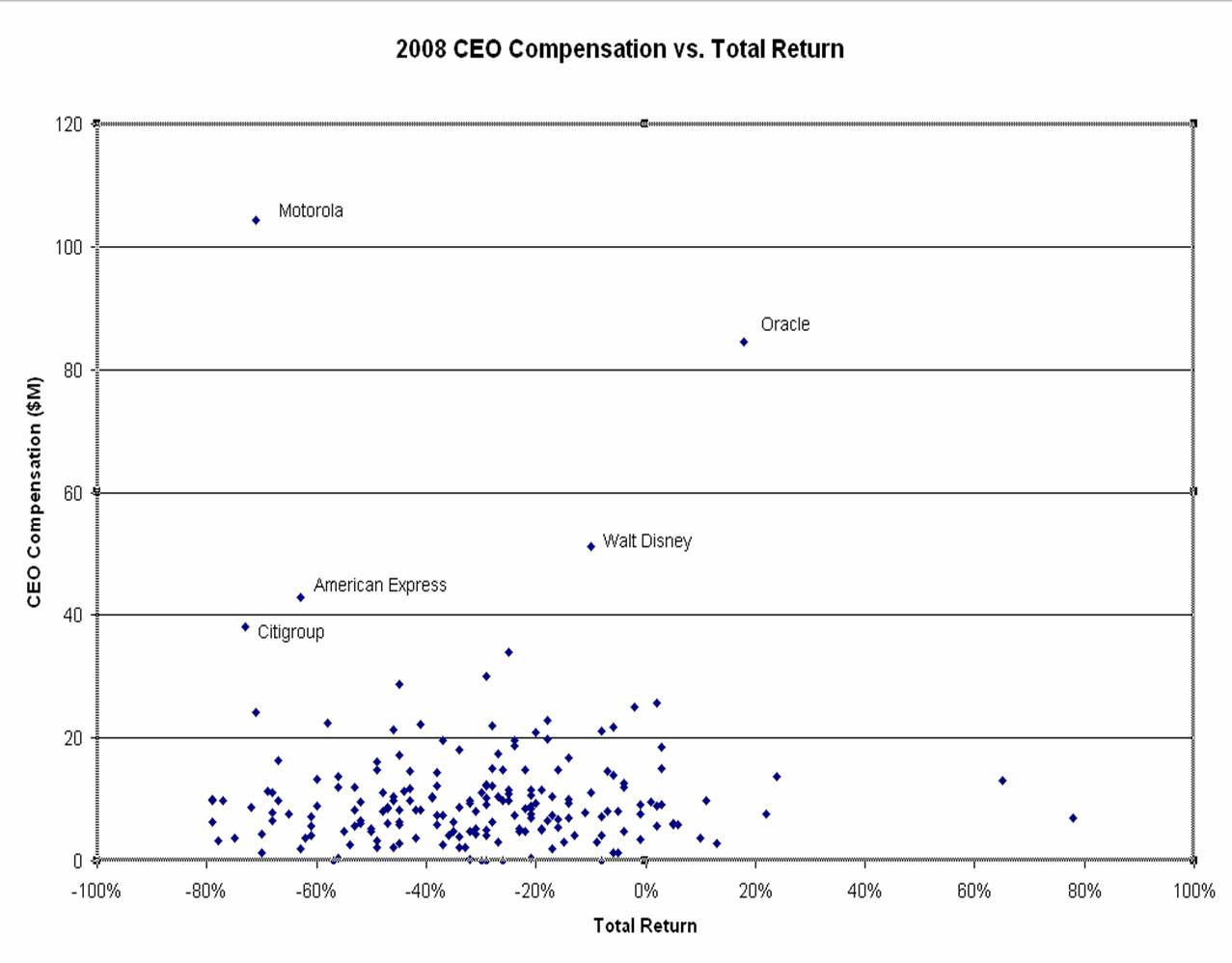
Data from Equilar (methodology), published by The New York Times:

compensation

I know this is simplistic, but I just couldn’t resist.

Some caveats:

  • Stock total return is a poor way to measure CEO performance – yet it’s the one that CEOs and boards commonly point to to justify compensation.
  • A CEO may have been granted a large stock award in 2008 as a reward for “good performance” in 2007. This could explain the combination of high compensation and poor 2008 performance. However, just think about what that means for a second.
  • Most of the large compensation awards are largely restricted stock or stock options. These were valued as of the data of the grant, so if the company’s stock price later fell, the CEO is unlikely to realize the calculated value of the award. But imagine if the stock price had gone up instead: the CEO and the board would be insisting that the award should be valued as of the grant date, not the later exercise date (when it would be worth much more).

Also, I excluded a company called Mosaic, because it’s total return was 257%, so it packed all the other companies into one side of the chart. Mosaic’s CEO earned $6 million.

Continue reading “Two Things That Have Nothing To Do with Each Other”