Month: April 2009

The Missing Witness

Yesterday’s JEC Hearing on Too Big To Fail did not include any financial industry representatives.  This surprised me – surely they want to go public with their views on the future structure of the financial system?  Obviously, they have great behind-the-doors access on Capitol Hill, but surely it is not in their interest to have right, left, and center piling on with regard to breaking up Big Finance?  Yesterday, Thomas Hoenig, Joseph Stiglitz, and I were in complete agreement on this point, and my idea of using antitrust measures against major banks seemed to gain traction during and after the hearing.

Apparently, the committee invited a number of leading people from the industry (i.e., individuals who generally articulate the case for big banks) and they were all too busy to attend (Update: this statement is incorrect; the potential witnesses who were unable to attend are academics).  This is a curious coincidence, because someone else – in an unrelated initiative – has been trying to set up a discussion involving me and people from the Financial Services Roundtable and/or the American Bankers Association, to be held at the National Press Club, but their calendars are completely full (i.e., there is literally no day that works for them, ever). Continue reading “The Missing Witness”
A View from the Inside

If you haven’t picked up on one of the dozens of recommendations from other blogs, I recommend reading Phillip Swagel’s long and detailed account of the view of the financial crisis from his seat as assistant secretary for economic policy at the Treasury Department. It’s particularly useful for people like me who make a habit of criticizing government officials.

The writing is dry, but much of the subject matter is fascinating. It often explains or defends Treasury’s actions during the crisis, but Swagel certainly owns up to plenty of mistakes or shortcomings. For example, discussing the emergency guarantee program for money market funds, he writes, “Nearly every Treasury action there was some side effect or consequence that we had not expected or foreseen only imperfectly.”

Continue reading “A View from the Inside”

Two Hearings On Banks Today

This morning, by coincidence, there are parallel hearings on Capitol Hill dealing with the nature of our banking system and attempts to stabilize it.  In the Cannon House Office Building, starting at 9:30am, the Joint Economic Committee will hear from Thomas Hoenig, Joseph Stiglitz, and me, on whether Big Finance is too big to save (see yesterday’s preview for details).

At 10am over on the Senate side (Dirksen Senate Office Building), Secretary Geithner will appear before the TARP Congressional Oversight Panel.  We preview that event this morning on The Hearing, with a discussion of the context, the latest numbers, and our forecast of the ideas that will be expressed; it’s a viewer’s guide – but one that you can talk to by sending in comments (and, most important, your questions for the Secretary). Continue reading “Two Hearings On Banks Today”

70% Off Sale!

There has been a fair amount of hand-wringing along Sand Hill Road in Menlo Park over the lack of “exits” – IPOs and acquisitions – for venture-backed technology companies. Given the way the stock market has behaved recently, it’s pretty near impossible for a young technology company to go public. And the large technology companies that do most of the acquiring have been unusually quiet, presumably because they are watching their cash and avoiding risks given the global economic downturn.

However, there’s one major reason why large technology companies should be buying:

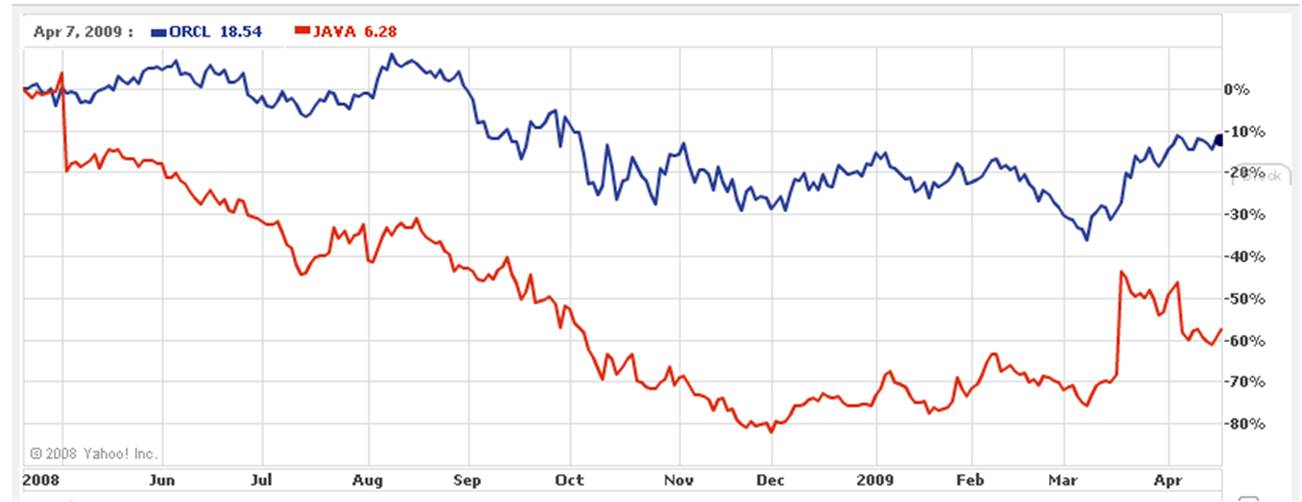
orcl-java

Blue is the share price of Oracle; red is the price of Sun (the spike in March is Sun’s merger negotiations with IBM). At some point, prices fall to the point where people start buying again. While the recession has hurt almost every company, it disproportionately hurts companies that do not have fat profit margins, hordes of repeat customers, and deep cash reserves that they can rely on in hard times. The result is huge changes in the relative values of companies, creating some once-in-a-generation bargains.

I don’t think the Oracle-Sun acquisition is a sign of a bottom or anything dramatic like that. But it shows that at least some companies are doing what they should be doing.

By James Kwak

Your Hearing: New Blog at WashingtonPost.com

Some readers have emphasized how the current economic and financial situation leaves them feeling powerless.  Others complain that it’s hard for outsiders even to understand the process through which ideas are debated and become policies – how Capitol Hill really works is a fascinating mystery at many levels.

This morning we’re extending our efforts to address these issues with the launch of The Hearing, a new blog at the Washington Post.  James and I are the moderators and we’ll focus the discussion around Congressional hearings – including the broader debates in which these are situated.

The Post has great impact in Washington and it’s our hope that The Hearing will allow you to express ideas in ways and at a time that can have real effects on policies.  For this reason, we’ll preview public events and provide ways for you to suggest questions that need to be heard.  At the very least, we can all learn more about what is happening and exactly why.

We’re open to suggestion regarding the exact format, guest contributors, and generally how to make The Hearing more effective.  We will, of course, keep BaselineScenario as our primary outlet for opinions and analysis – The Hearing is intended to be complementary, by bringing your voices into the specifics of idea flow through Congress.  We’ll tell you here when you should consider going to look there.

My first post deals with tomorrow’s JEC hearing on “Is Big Finance Too Big To Save”?  I preview what Joe Stiglitz and Thomas Hoenig are likely to say (based on their racing form), and I anticipate where the discussion will go – or at least where I will try to push it, as I’m on the panel also. 

If you have points or questions you want raised, please post them here or on the Post’s site.  There’s no guarantee your issues will be taken up, of course, but my guess is that this new forum will help sensible requests – of the kind often seen here – gain broader traction.

By Simon Johnson

More Accounting Games

The New York Times is reporting that the administration is thinking of stretching its TARP funds further by converting its preferred shareholdings to common stock.

The change to common stock would not require the government to contribute any additional cash, but it could increase the capital of big banks by more than $100 billion.

I hope this is one of those trial balloons they float and later think better of. Most importantly, it makes no sense. That is, there’s nothing fundamentally wrong with converting preferred for common, but it doesn’t create anything of value out of thin air. I wrote a long article about preferred and common stock a while back, but here are some of the highlights.

  • If you don’t give a bank any more money, it doesn’t have any more money. By converting preferred into common, you haven’t changed the chances of the bank going bankrupt, because its assets haven’t changed, and its liabilities haven’t changed. If it had enough money to cover its liabilities, but it couldn’t buy back its preferred shares from Treasury, it’s not like the government would have forced it into bankruptcy anyway.
  • If you accept the idea that converting preferred into common creates new capital, then you are implying that those preferred shares weren’t capital in the first place. From a capital perspective, then, the initial TARP “recapitalizations” did nothing, and nothing happens until the conversion. You can’t say that JPMorgan got $25 billion of capital last fall and it’s going to get another $25 billion now just by virtue of the conversion.
  • Tangible common equity and Tier 1 capital are just two ways of measuring the health of a bank. Taking money that wasn’t TCE and calling it TCE doesn’t serve any economic purpose. There is a minor benefit to the bank because now it doesn’t have to pay dividends on the preferred. But otherwise you’ve just shuffled together the claims of the last two groups of claimants – the preferred and the common shareholders. You’ve made things look better from the perspective of the common shareholders as a group, because they no longer have preferred shareholders standing in front of them, but the total amount available to all shareholders hasn’t changed.

Is there another way to explain this even more simply?

Update: I made a mistake in interpretation last night. They aren’t floating a possible strategy here; this is already what is going to happen. I forgot that the Capital Assistance Program already announced by Treasury – the mechanism for giving more capital to banks that need it after the stress tests – specifies the use of convertible preferred shares. So imagine you are a bank with $5 billion in TARP capital already. You issue $5 billion of convertible preferred under the CAP, use the proceeds to redeem the initial TARP, and then – if and when you choose – convert the convertible preferred into common. So the mechanism to do it is there already. I guess they are floating the spin to see if anyone believes this would actually make healthier banks.

Update 2: In case it wasn’t clear from the above, I don’t have any problem with converting preferred for common. I am probably mildly in favor of it, even, for roughly the same reasons as Matt Yglesias: as a taxpayer, I’d rather have the upside and control that come with common shares.

By James Kwak

Our Fate Is in Their Hands?

Last month, Representative John Shimkus spoke out against regulating carbon dioxide emissions on the grounds that carbon dioxide is plant food. “So if we decrease the use of carbon dioxide, are we not taking away plant food from the atmosphere?” Shimkus is on the House Subcommittee on Energy and Environment, which means he has a vote on these issues.

In the wake of a financial and economic crisis of at least generational magnitude, our government will be rewriting the rules of the financial industry. And “our government” includes not just the pedigreed scholars in the executive branch (Larry Summers, Christina Romer, Austan Goolsbee, etc.), but Congressional representatives like John Shimkus – “like” in the sense that they were selected for their jobs, and for their committee seats, in exactly the same way that Shimkus ended up discussing the crucial role of fossil fuels in sustaining plant life on this planet. And when it comes to legislation, Summers, Romer, and Goolsbee have exactly zero votes between them; Shimkus has one.

Continue reading “Our Fate Is in Their Hands?”

New Day, New Bank, Worse Story

It’s a beautiful day today, and after Goldman and JPMorgan, I don’t feel like diving deep into Citigroup’s earnings release. But judging from the Bloomberg article, it’s a similar story, just not as good.

1. All the good news was in fixed income trading: $4.7 billion in fixed income trading revenues; falling revenues in credit cards, consumer banking, and private client.

2. Assets continue to deteriorate: $5.6 billion in new writedowns in trading accounts; $3.1 billion in charge-offs and reserves for bad credit card debt.

3. Accounting fictions save the day (the new bit): $0.6 billion in losses that don’t have to be classified as other-than-temporary (and therefore affect the income statement) thanks to FASB; $2.5 billion in “profits” because of the fall in the value of Citigroup’s own debt. The theory behind the latter is that Citi could go into the market and buy back all of its distressed debt, which would be cheaper than paying it off at 100 cents on the dollar. Also: $0.4 billion in litigation expenses avoided (previously reserved) and tax benefits from an IRS audit.

Point 3 adds up to $3.5 billion, which dwarfs Citi’s $1.6 billion  profit. Why is everyone so optimistic about banks these days?

By James Kwak

Financial Innovation for Beginners

(For a complete list of Beginners articles, see Financial Crisis for Beginners.)

Kevin Drum pointed me to Ryan Avent’s insightful review of Ben Bernanke’s recent speech on financial innovation. (How’s that for the Internets in action?) Bernanke’s brief was simple: to defend financial innovation in general while acknowledging that at the margin it can be counterproductive and may need to be more closely regulated. “I don’t think anyone wants to go back to the 1970s,” he said in a line that was clearly supposed to make his point. Unfortunately for Bernanke, Avent was listening closely. His rejoinder:

neither could Bernanke point to a truly helpful piece of financial innovation developed after that decade. His examples of successful financial products? Credit cards, for one, which date from the 1950s. Policies facilitating the flow of credit to lower income borrowers was another, for which he credited the Community Reinvestment Act of 1977. And, of course, securitization and the secondary mortgage markets developed by Fannie Mae and Freddie Mac in…the 1970s.

With one exception:

Tasked with defending deregulation as a source of financial innovation, Bernanke reached for subprime lending.

This helped at least partially crystallize some thoughts I have had floating around about financial innovation for a while.

Continue reading “Financial Innovation for Beginners”

Who Had This Good Idea First? (A Weekend Comment Competition)

In early February, James proposed that bankers’ bonuses be paid out in “toxic assets” – after all, the industry was arguing that these would definitely rebound (“it’s just a liquidity problem”) and that their “true” value was substantially above current market value.  The idea was well received by our readers but not so much by the banking or insurance industry.

Someone quickly pointed out that – back in December – Bloomberg reported Credit Suisse would actually use a version of the same idea.  And, in the whirlwind of the fall, I now vaguely remember this same point coming up even earlier in some bigger discussion.

So in the spirit of proper attribution (also because a reader asked and I’d like to know the answer), here is our first ever weekend “comment competition”.

Who really originated this (very good) idea, either in private discourse or – easier to document – in a public comment, blog post, corporate document, or the like?  We’d also welcome updates on where any form of this idea is being used in practice.

By Simon Johnson

The Department Of Justice Is On Line Two

I don’t generally overreact to news (from the NYT this morning, on the AIG-Goldman connection that runs through Edward Liddy’s stock ownership), but this has gone far enough. 

Have we completely lost of sense of what is and is not a conflict of interest?  Have we really built a system in which greed fully overshadows responsibility?  Is it not time for a complete rethink of what constitutes acceptable executive behavior?

One of our country’s leading corporate attorneys made a telling point to me on Wednesday night, “the only way to control executive behavior is to criminalize it,” i.e., civil penalties do not change behavior – the prospect of jail time has to be on the table.  His broader point was that antitrust action can make a difference in today’s world, but only if this includes potential criminal charges. Continue reading “The Department Of Justice Is On Line Two”

New Day, New Bank, Same Story

JPMorgan Chase reported its quarterly earnings today. The headline was $2.1 billion in net income, beating analysts’ estimates. Behind the headlines, it was similar to the story that Goldman told earlier this week: a huge jump in fixed-income trading, status quo everywhere else, and continuing writedowns. For example, if you look at the breakdown of revenue by type of activity (not line of business) on page 4 of the supplement, you’ll see that revenue was flat or down in every category except one: principal transactions, where it jumped from a loss of $7.9 billion to a gain of $2.0 billion. That $9.9 billion improvement more than explains the entire increase in pretax profit from negative $1.3 billion to positive $3.1 billion.

As with Goldman, it was clearly a good quarter for JPMorgan; making money beats losing money any day. But the question to ask is whether it is sustainable, either for JPMorgan or for the banking industry as a whole. To answer that question, here are some pictures.

Continue reading “New Day, New Bank, Same Story”

Forecasting The Official Forecasts, Spring 2009 Edition

Our forecast of official growth forecasts back in the fall turned out to be fairly accurate.  My update of this assessment – for the new IMF numbers due out next week – is now online at NYT.com.

Many officials seem to have bought into some version of the “it’s a V!” take on the global recession.  To me, this looks like wishful thinking.  Whether or not you support the “V” view fully, officials should surely be spending more time preparing for worse scenarios. 

Just in case – why not prepare properly for the cross-border resolution issues that would arise from the failure of a major global bank?  Why did the G20 decline to take on this issue properly?  Even the IMF’s baseline, I expect, will suggest potentially serious problems ahead.

Bring In The Antitrust Division (On Banking)

In early February I suggested there was a showdown underway between the US Treasury and the country’s largest banks.  Treasury (with the Fed and other regulators) is responsible for the safety and soundness of the financial system, the banks are mostly looking out for their own executives, and the tension between these goals is – by now – quite evident.

As we’ve been arguing since the beginning of the year, saving the banking system – at reasonable cost to the taxpayer – implies standing up to the bankers.  You can do this in various ways, through recapitalization if you are willing to commit more taxpayer money or pre-packaged bankruptcy if you want to try it with less, but any sensible way forward involves Treasury being tough on the biggest banks.

The Administration seems to prefer “forbearance”, meaning you just ignore the problem, hope the economy recovers anyway, and wait for time or global economic events to wash away banking insolvency concerns.  But this strategy is increasingly being undermined by the banks themselves – their actions threaten financial system stability, will likely force even greater costs on the taxpayer, and demonstrate fundamentally anticompetitive practices that inflict massive financial damage on ordinary citizens. Continue reading “Bring In The Antitrust Division (On Banking)”

Is Goldman Really That Good?

Goldman Sachs released its quarterly earnings yesterday, and the headline was  net income of $1.8 billion, doubling analysts’ estimates. I would say this is definitely good news for Goldman; whether it’s good news for the banking sector as a whole is more uncertain.

First, as Bruce Wayne, one of our readers, pointed out, the quarter-over-quarter comparisons left out December. Because Goldman just changed its fiscal year end, its previous quarter ended in November and its latest quarter ended in March. December was reported separately and – surprise, surprise – Goldman took a net loss of $0.8 billion. So if they had mashed December into Q1, they would have had a four-month “quarter” with $1.0 billion in profits.

Second, the positive results probably reflect a better mix of businesses than other banks enjoy. Although Goldman has made big one-sided bets, its trading operation traditionally hedged many of its positions and made a lot of its money on volume. Its positive Q1 results were largely due to strong performance in fixed income, currencies, and commodities (FICC) trading, which reflects the fact that Q1 was a busy quarter – in part because of the massive unwind at AIG – and, as Goldman’s CFO politely said, “Many of our traditional competitors have retreated from the marketplace.” With fewer players in town, the oligopoly profits go up – another reason why the big banks are even more powerful than they were before the crisis.

When it comes to the value of its own investments, Goldman seems to have done less well. Its net revenues for principal investments, mainly “Other corporate and real estate gains and losses,” were negative $1.4 billion in Q1 and negative $0.8 billion in December. While Goldman was able to more than offset this with trading gains, I wonder what the implication is for commercial banks that are not dominant players in trading.

(The FT also raised an eyebrow at the fact that per-employee compensation in Q1 was much higher than in the year-earlier period. That actually doesn’t worry me, because I’m guessing those compensation expenses are bonus accruals – the better the quarter you have, the more money you have to set aside for year-end bonuses.)

By James Kwak