Tag Archives: health care

What’s Next for Health Care?

By James Kwak

I should leave the country more often: I go away and suddenly we have (near-)universal health care coverage! (Well, we’ll have to wait a few years for all of the health care reform provisions to kick in, but you know what I mean.) Not only that, but Ezra Klein reminds me that we even got rid of the pointless subsidy to the banking industry in the student loan program (where the government guaranteed the loans but let private lenders earn profits making the loans, even though the guarantee obviated the need for underwriting).

Continue reading

Are Health Insurers Worth Bashing?

This guest post was contributed by Andrzej Kuhl, a colleague of mine from a former life. Andrzej is a management consultant based in Montclair, New Jersey.  His company, Kuhl Solutions, helps improve the efficiency and effectiveness of operations in financial sector companies.

I am getting thoroughly frustrated with a facet of the health care debate – the singular focus on health insurers, with total disregard of other contributors to health care costs.  Yes, I am in total agreement with the concept of providing health insurance to folks who currently cannot afford it, or who do not have access at any cost (because of pre-existing conditions).  I also believe that the rate of increase of health spending needs to be significantly reduced.  But, I do not believe that we can achieve any meaningful health spending reduction just by bashing or financially squeezing the health insurance companies.

Continue reading

The Republican Plan, III: Comic Relief

(This is a multi-post series on the Republicans’ Roadmap for America’s Future. Part I was on how it slashes Medicare spending. Part II was on how it shifts risk from the government to individuals.)

The Roadmap brings up the issue that there is little price transparency in the health care market. This is the solution:

“The environment resembles what existed in the securities markets before the stock market crash of 1929. Abuse, fraud, and misinformation about the nature of stocks and the rules governing their purchase were rampant. In response, the Securities and Exchange Commission [SEC] was formed with the main purpose of bringing transparency to the market and restoring consumer confidence.

“With the increasingly rapid transformation of the financial markets and the growing complexity of financial transactions, the private sector began to take a more prominent role in developing accounting guidelines; and eventually the SEC began relying on the private sector to establish the basic standards by which it would be regulated. Since 1973, the SEC has recognized the nongovernment Financial Accounting Standards Board [FASB] as the authoritative standard-setting organization for financial accounting and reporting information. While the SEC has statutory authority to establish such financial standards, it has historically adopted FASB rules. The SEC allows the private sector to establish its own disclosure standards, so long as it demonstrates the ability to fulfill the responsibility in the public interest. The authority to enforce the standards, however, falls solely to the SEC.

“Applying this model to the health care industry will allow all stakeholders to come together, without heavy-handed government intervention, to establish uniform and reliable measures by which to report quality and price information.”

Enron? WorldCom? Self-regulation? FASB, the SEC, and the securities industry are their example?

By James Kwak

The Republican Plan, II: You’re On Your Own

In my previous post on the Roadmap for America’s Future, I discussed how the Republican plan is based on converting Medicare into a voucher program and then slashing the vouchers drastically relative to current Medicare spending projections, leaving seniors without the ability to buy anything close to what they get from Medicare today. In that post, I compared projected Medicare vouchers under the Roadmap to projected Medicare spending under current law. If you assume that, in the Roadmap world, the cost of Medicare-equivalent health insurance will be the same as currently projected Medicare spending, then people will die.

But, Paul Ryan would argue, the Roadmap is going to bring down the cost of health care, so the fact that we’re providing less support won’t matter. Put another way, he might say, Obama’s plan also counts on bringing down the cost of health care, so why can’t I make the same assumption? There are two problems with this argument.

Continue reading

The Republican Plan, I: People Will Die

So the Republicans have a deficit reduction and a health care plan, all wrapped into one, the “Roadmap for America’s Future.” It’s being pushed by Paul Ryan, in part because he’s the ranking member of the House Budget Committee, in part because he’s good-looking and articulate, in part to provide the party plausible deniability if it flops (like Bobby Jindal a year ago). The CBO says that it will balance the budget and even eliminate the national debt by 2080. Ezra Klein and Matt Yglesias have commented on it. Klein says, “I wouldn’t balance the budget in anything like the way Ryan proposes. His solution works by making care less affordable for seniors. . . . But his proposal is among the few I’ve seen that’s willing to propose solutions in proportion to the problem.” Yglesias says “it’s totally unworkable.” But they’re both being much too kind.

Ryan realizes that “the deficit problem is a health-care problem,” which he agreed to in an interview with Klein. That’s good. He realizes that to solve the deficit you have to do something about Medicare. That’s good. He also puts forward a logically coherent conservative position. That’s good in itself and especially refreshing after the Bush era (and the unfunded Medicare prescription drug benefit) and all the recent posturing of the Republicans as defenders of Medicare (Mitch McConnell: “Cutting Medicare is not what Americans want.“) Ryan’s plan is basically to cut Medicare like never imagined before.

But everything else about the plan is such an unmitigated disaster I’m going to devote a whole paragraph at some point to thinking about how to label this plan. It will be a long time before we get there, though, broken into a couple of blog posts, because there are so many problems to go over.

Continue reading

One More Thing . . .

. . . on that deficit commission. If I were Peter Orszag, I would be tearing my hair out. (Or maybe not, since he’s happily engaged to be married later this year.)

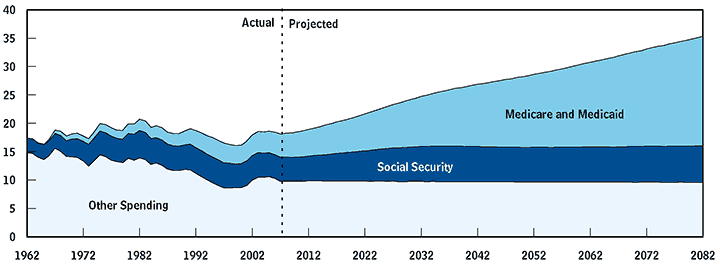
It’s obvious, and I’ve said it before, but I’ll say it again. The big long-term national debt problem is all about health care. This chart is from the January 2008 Budget and Economic Outlook of the Congressional Budget Office–for those keeping score, that’s one year before President Obama took office. It shows projected federal spending as a percentage of GDP.

Continue reading

Design or Incompetence, Part Two

Last week I wrote a post about how banks entice customers with promotions and then fail to keep up their end of the bargain, forcing customers to waste their time just getting the bank to do what it promised to do in the first place. As I wrote, then, the problem is by no means limited to the financial sector.

David Lazarus of the Los Angeles Times has a horror story about Aetna, the large health insurance company. The basic facts are:

  1. Aetna increased a customer’s monthly premium by $32 as of August.
  2. On September 30, Aetna sent her a letter saying her premium had gone up. (This is the letter supplied to the Los Angeles Times by Aetna, which I think is pretty clear proof there was no earlier letter.)
  3. Beginning in October, the customer began paying the higher premium.
  4. In November, Aetna rejected payment for a doctor’s bill.
  5. The customer contacted Aetna, who said she had missed payment for October–which wasn’t true (she had paid the higher premium for October).
  6. When the customer appealed, Aetna wouldn’t let her simply pay the extra $64 (the difference for August and September), and insisted on rescinding her policy.

The customer in question is a cancer survivor who needs regular medication and checkups–hence the kind of customer that health insurance companies want to drop if at all possible.

Continue reading

So This Is What an Election Is Like

Martha Coakley just called me for, oh, the fifteenth time over the long weekend. I get multiple fliers in my mailbox every day. People from other states are calling me and asking me to volunteer. I’m sure I would be seeing nonstop ads on TV, except I don’t watch TV. All this started within the last week when, as many news outlets have noted, the Democrats woke up and realized they might actually lose Ted Kennedy’s Senate seat.

We’re not used to competitive elections here in Massachusetts, certainly not competitive elections with national implications. But this one is huge. The Republicans have been admirably or distressingly able, depending on your perspective, to hold forty votes against more or less anything the Democrats and President Obama want to accomplish, including health care reform. I think it’s a fairly easy bet that if Coakley loses, health care reform is dead until 2013 at the earliest, since there is no chance the Republicans will allow anything that looks like an accomplishment to occur if they can possibly help it. So if you live in Massachusetts, and you care about health care reform one way or the other, you should take the time to vote tomorrow.

Update: A friend emailed to point out that should Brown win, the House Democrats could pass the Senate bill, which presumably would not then have to go back to the Senate to be voted on again. (If the conference committee modifies the Senate bill, then it would have to go back.) Then some provisions could be modified through the budget reconciliation process, which only requires 51 votes. So a Coakley defeat might not be the end.

As for the comment about whether the Democrats could have negotiated with the Republicans to pick off one or two votes, they tried that for months–first via the Baucus Group of Six, then later directly with Snowe. Snowe ended up pulling out saying that the Democrats were rushing the bill, when they had spent several months talking to her specifically.

By James Kwak

United States Health Care Spending

The vast discrepancy between what we spend on health care and what every other prosperous (or not-so-prosperous) country spends on health care–and the little good it does us–is so well-known that it’s not going to change any minds when it comes to health care reform. Opponents of reform have come up with their rationalizations (more spending on technology, someone has to subsidize cheap drugs for the rest of the world, etc.), some of which contain grains of truth. But even if people aren’t listening any more, that doesn’t make it any less true.

Ezra Klein brings us the latest reminders. Here’s the most amazing graph from National Geographic:

That’s a clever trick, putting the outlier above the title of the chart. I’ll have to try it sometime.

By James Kwak

Small Steps and Health Care Costs

Hey all you deficit hawks out there. Atul Gawande, the person of the year when it comes to health care, has a long article on the cost-cutting proposals in the health care reform bill (hat tip Ezra Klein). Gawande’s main point is that the long list of pilot programs and other initiatives in the bill are probably the best possible way to reduce costs in the health care system (which, if you missed the implication, is the only way to control long-term government spending–that or eliminating Medicare).

Indeed, it’s hard to see what else the bill could have done. Remember, we have a largely private-sector health care system (both insurance and delivery), which means the government cannot simply order providers to charge less. A single-payer system might be able to take such draconian steps, but Mitch McConnell, who claims, “Two thousand seventy-four pages and trillions of dollars later, this bill doesn’t even meet the basic goal that the American people had in mind and what they thought this debate was all about: to lower costs,” is the last person who would vote for single payer. And the Republicans are similarly against anything that allows the government to use the one big lever it does have–Medicare–to force lower cost levels.

Continue reading

A Few Words on Health Care Reform and Medicare Buy-In

From Ezra Klein:

“[Doctors] should be forced to work in a way that doesn’t hurt society. That, after all, is the guiding principle behind the insurance reforms: Insurers will have to live with a market that society can live with. Similarly, providers will have to live within a market that society can afford. That will mean a strict budget, at least within the federal programs (and over time, as the private programs become unaffordable, they will probably come on budget as well). …

“It’s that or national bankruptcy. And the problem, if left untreated, will only get worse, and the eventual correction, when it comes, will only be more severe. That, however, is exactly what they’re asking Snowe, and the rest of Congress, to permit. The fear with Medicare buy-in is that Medicare pays somewhat lower rates than private insurers because it tries to live within a budget, even if it fails. But like it or not, that’s the future, or one variant of it.”

Am I being hypocritical in allowing Ezra Klein to use the words “national bankruptcy?”

Continue reading

What’s Wrong with Our Health Care Debate

Uwe Reinhardt has a post on Economix that zeroes in on Senator Kay Bailey Hutchinson’s criticism of the new mammogram guidelines. Here’s the quote from Hutchinson:

“So this task force says all of a sudden we’re going to change the guidelines that we have had for all these years. And now the public option may not pay for those, and that means the insurance companies are going to follow. The key is that these are covered by insurance so women will not have to decide if they’re going to spend $250 to get a mammogram because they and their doctors believe it is right to do so.”

Basically, the critics of the mammogram guidelines* are bemoaning the fact that certain women may not be able to get mammograms paid for by insurance — without mentioning the fact that many women don’t have insurance to begin with.

Or, to paraphrase Reinhardt: If certain medical procedures are so important to people’s health — shouldn’t everyone get them regardless of income or insurability?

* On which, let me make clear, I have no opinion, nor any qualified basis on which to have an opinion.

By James Kwak

Free Markets and H1N1

In a free market, companies should be allowed to decide whether or not to offer paid sick leave to employees. At the margin, employees who value paid sick leave will flow to companies that offer it and employees that don’t won’t; also at the margin, companies that offer paid sick leave will be able to pay their employees a little less in other forms of compensation. Everything works out for the best.

Unfortunately, not offering paid sick leave creates a classic externality: People go to work even when they’re sick, infecting their co-workers (or customers); employers internalize some of that cost (co-workers), but not all of it (co-workers going home and infecting their kids, who then go to school — because their parents can’t stay home to take care of them — and infect their classmates, etc.). I’ve written before that we are far behind the rest of the developed world in requiring paid sick leave.

Continue reading

What Is Risk Adjustment?

I think I know what it is, and if I’m right it’s very important to health care reform, but it hasn’t gotten a lot of attention.

Risk adjustment is the solution to the following problem. Imagine you tell all the health insurers that they have to accept the healthy and the sick, and they have to charge each the same insurance premium. You may not have to imagine for much longer; this is at the core of all the proposed health care reform bills. (In the Finance Committee bill you can discriminate based on a small number of factors, like age and tobacco usage, but that’s it.)

If you’re a profit-maximizing insurer, what do you do? You try to cherry-pick the healthy, since the revenues will be the same as for the sick and the costs will be lower. If you can do this successfully — say, by only advertising in gyms and in Runner’s World, or maybe by offering additional benefits that only the healthy will want — then you can dump the sick on someone else. That someone else will eventually (after all the private insurers get smart or go out of business) be the public option or the non-profit cooperative, whichever we end up with, which will end up losing money; the net effect is a transfer from taxpayers to private insurers. Now, the fact that insurers participating on exchanges have to take everyone should mitigate this problem, but it won’t go away. In effect, insurers will compete by marketing in ways that attract the healthy and hide from the sick, instead of competing to offer better health care at lower cost.

Continue reading

The Good Part of the Baucus Bill

I’ve been generally critical of the Baucus Bill, primarily because of the reduced subsidies, which I see as an increased tax on the currently uninsured middle class. But luckily Ezra Klein has been providing detailed coverage of what’s good about it – notably, the proposed reforms to the health care delivery system. See his interview with Peter Orszag and his post about Chris Jennings and most of his other posts from yesterday. On my reading, the Baucus Bill will kick off a number of initiatives that will test different ways of reducing costs or improving quality, such as ways of linking payments to outcomes.

I think this is promising because, as I’ve said before, even though we have a general idea of what the problem is – economic incentives that are cut loose from outcomes – we’re not sure how to solve it. As a result, any master plan to reduce costs without sacrificing quality is easy to attack, and given the political dynamics people will be eager to attack it. The answer is that, in the medium term, we have to figure out what does work, and the way to do that is to try lots of different things. This is exactly what a smart business would do, so it’s good to see the government doing it.

By James Kwak