Month: July 2011

Hoisted from the Archives

By James Kwak

What was the budget debate about eleven years ago?
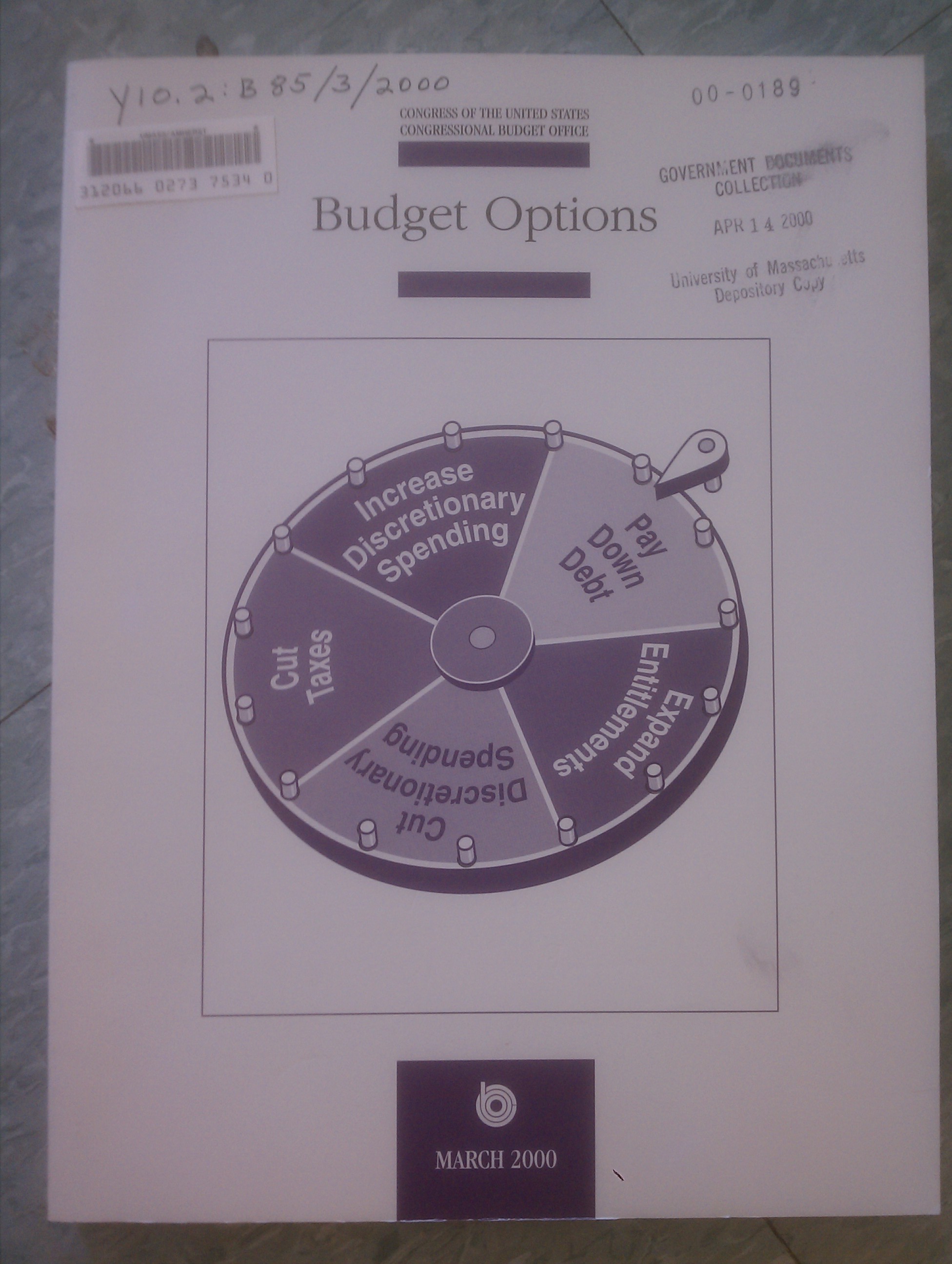
 

As you can see, that is the cover of the CBO’s March 2000 Budget Options report. (You can get it online, but without the cover.*) For most of the 1980s and 1990s, this report was called Reducing the Deficit: Spending and Revenue Options; this year’s version has reverted to that title.

The context for the picture above was the budget surpluses of the late 1990s. At the time, the CBO was projecting surpluses for at least the next twenty years, amounting to over $3 trillion in the first decade of the twenty-first century. (See the 2000 Budget and Economic Outlook, Summary Table 1.) And although most of the surpluses were off-budget (surpluses of Social Security payroll tax revenues over benefit payouts), there were supposed to be ten years of on-budget surpluses as well.

We all know what happened next: a (mild) recession, the Bush tax cuts of 2001 and 2003, the Afghanistan and Iraq Wars, and the Medicare prescription drug benefit, among other things. But the question for now is: did those surpluses really exist?
Continue reading “Hoisted from the Archives”

Long-Term Budget Forecasts for Beginners

By James Kwak

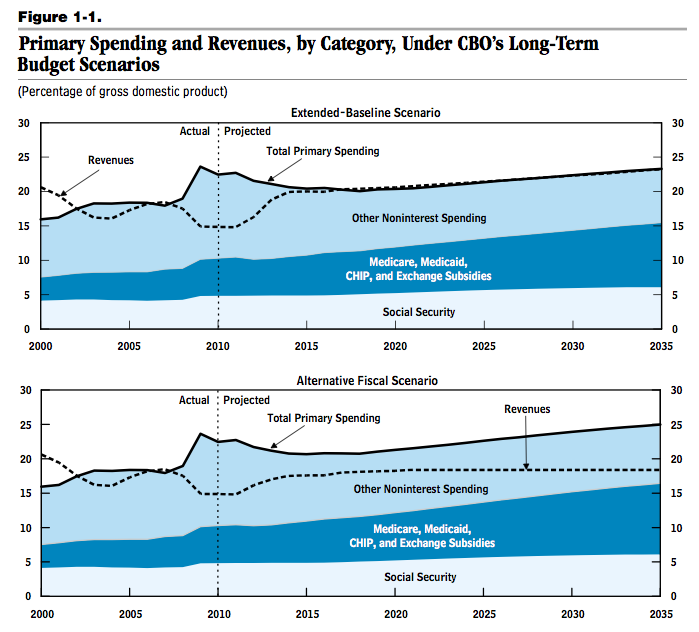
In this season of debate over long-term deficits, this is ground zero:

That’s the key chart from the Congressional Budget Office’s Long-Term Budget Outlook, published just last month, which I read from cover to cover. The CBO is generally considered the authoritative source of budget projections, and CBO “scoring” has been an important aspect of legislative debates over the past few years. Although politicians from both sides criticize the CBO when they don’t like its results, I think it’s fair to say that it is generally both respected and nonpartisan.

Now, when people say that the federal government faces a long-term budget gap, they (including me) are generally starting from the bottom half of this picture: the CBO’s “alternative fiscal scenario.” The alternative scenario is widely considered the most likely path the budget will follow under current policy (although the CBO itself makes no such claim*). That’s probably a close enough approximation for most purposes. But if you’re going to think hard about long-term budgetary paths, you need to be a bit more careful about what it means.

Continue reading “Long-Term Budget Forecasts for Beginners”

Italy And Systemic Risk In The United States

By Simon Johnson

In recent days, Greece’s parliament adopted new austerity measures and Europe’s finance ministers approved another round of Greek loans. So the European debt crisis is under control, right?

Probably not. One obvious reason is Standard & Poor’s July 4 threat to declare a default if banks roll over Greek government bonds coming due over the next year. That could force everyone back to the drawing board.

Less obvious, but no less worrisome, is Italy. With a precarious fiscal picture, it could be the next to come under pressure. And this time, U.S. banks are in the line of fire, with about $35 billion in loans to Italy and potentially more exposure to risk through derivatives markets.

U.S. regulators should call for a new round of stress tests that assume sovereign-debt restructurings in Europe and take a realistic view of counter-party risks in opaque markets such as foreign exchange swaps. Based on those tests, the biggest banks probably need to suspend dividends and raise more capital as a buffer against losses.

To read the rest of this post, click here (this link is to the full article on Bloomberg: http://www.bloomberg.com/news/2011-07-05/could-italy-be-next-european-domino-to-fall-commentary-by-simon-johnson.html)

Are Subsidized Student Loans Worth the Price?

By James Kwak

Previous guest blogger Anastasia Wilson has written a post on her own blog comparing the student loan racket (for-profit colleges help people take out lots of federally guaranteed student loans to pay for their tuition, then do a lousy job educating them, walking away with the money and leaving students to default) to the subprime loan racket. The flagbearer for this parallel is Steve Eisman, who has gone from shorting subprime mortgages to now shorting for-profit colleges.

In theory, for-profit colleges should not be able to do this. If too many of their former students go into default, the Department of Education is supposed to prevent their new students from taking out federally subsidized loans. (Since the government is ultimately underwriting these loans, it should have the power to make sure that the loans are being used to buy an education that will help borrowers pay back those loans.) But colleges have so far been able to get around the rules by pushing defaults outside the time period that matters for regulatory purposes, as described by the Chronicle of Higher Education.

Continue reading “Are Subsidized Student Loans Worth the Price?”