The Baseline Scenario

What happened to the global economy and what we can do about it

Archive for September 2009

G20 Summit, IMF Meeting: What To Expect?

As we wade through a long line of international economic meetings – G20 ministers of finance last week, G20 heads of government in Pittsburgh coming up, IMF-World Bank governors meeting in Istanbul early October (and all the associated “deputies” meetings, where the real work goes on) – it seems fair to ask: where is regulatory reform of our financial system heading?

Long documents have been produced and official websites have become more organized.  Statements of principle have been made.  And the melodrama of rival reform proposals has reared its head: continental Europeans for controlling pay vs. the US for raising capital vs. the UK not really wanting to do anything.  But what does all of this add up to, and what should we expect from the forthcoming summit sequence?

Nothing meaningful. Read the rest of this entry »

Written by Simon Johnson

September 8, 2009 at 6:34 am

Posted in Commentary

Tagged with ,

I Have a Big Head

That, at least, is the first thing you might conclude from my Bloggingheads debut, in which my half of the screen is almost completely filled by my head. I was on with Felix Salmon, who was gracious and charming as usual. If you read this blog and Felix’s blog, a lot of the ground we covered might seem familiar.

At the end, however, I did press Felix on the subject of wine, which is one of his favorites. Felix has written that who wins a blind taste test is essentially random, even with reputed wine experts doing the tasting, and he has verified this independently through his own blind tasting parties. Yet he says nevertheless that in an ordinary context, it is perfectly rational to enjoy an expensive wine more than a cheap wine, since you are not tasting blind; you are tasting with full knowledge of what you are drinking. I asked him why his knowledge of the empirical studies didn’t undermine the pleasure he got from drinking “good” wine. You can listen to his answer. The line I didn’t think of in time to use is that’s it’s like getting a placebo effect from a drug when you know it’s a placebo.

By James Kwak

Written by James Kwak

September 7, 2009 at 11:47 pm

Posted in Commentary

CFPA and Non-Banks

Elizabeth Warren has a new op-ed at New Deal 2.0 arguing for, surprise, the Consumer Financial Protection Agency, but this time with a different emphasis – non-bank lenders.

The opponents of the CFPA – not only banks, but the head of just about every current financial regulatory agency – argue that consumer protection should be combined with prudential regulation, so that one agency should be both making sure that a bank doesn’t collapse and that it isn’t abusing its customers. Many people have pointed out the flaws with this argument: first, consumer protection invariably slips down on the priority list; second, regulators become hesitant to crack down on abusive practices because those abusive practices generate the profits that make the bank “healthy” to begin with.

Read the rest of this entry »

Written by James Kwak

September 7, 2009 at 10:51 am

Consumer Protection Redux: The Lessons of History

For your Labor Day reading enjoyment, we bring you this guest post by Lawrence B. Glickman, who teaches history at the University of South Carolina and is the author of Buying Power: A History of Consumer Activism in America.

“We’re proposing a new and powerful agency charged with just one job: looking out for ordinary consumers,” said the president on June 17th.  The centerpiece of his proposed overhaul of the nation’s financial system, the Consumer Financial Protection Agency (CFPA), is designed to end what the president called “failure of…government to provide adequate oversight” by monitoring banking transactions, including mortgages, credit cards and checking and savings accounts. It did not take long for the predictable critics to denounce the agency with predictable rhetoric.  “It’s bad for the consumers,” said Steve Bartlett, president of the Financial Services Roundtable, a lobbying group for banks.  The institution will add “yet another regulatory layer” while advancing “the agenda of activist special interests,” according to the U.S. Chamber of Commerce.  The new agency represents “an unprecedented grant of power to mandate business practices” claims the American Bankers Association.

This is the language of conservative populism, a mainstay of the Republican party from Ronald Reagan to Newt Gingrich to Karl Rove. Conservative populism, wrote Jonathan Chait in the New Republic last year, “dismisses any inference that the rich and the non-rich might have opposing interests” and defines elites in cultural rather than economic terms as  “intellectuals and other snobs who fancy themselves better than average Americans.” Several decades of repetition have made this rhetoric familiar: federal efforts to help ordinary people–consumers–will inevitably hurt them; government is the problem rather than the solution; bureaucracy is “bumbling” (to use the words of a Crain’s New York Business poll about the proposed Agency); federal agencies designed to serve the public good actually serve narrow special interests.  It has been, in no small measure, through the ready deployment of this language that the Republicans have positioned themselves as simultaneously the party of big business and working Americans while denouncing Democrats as representing both intrusive government and elitism. This meme has been devastating for liberals since any expansion of government services can be dismissed with a quip–Bureaucrat!, Red Tape!, Nanny State!– rather than an argument. Recently, for example, Senator Lindsay Graham said that the American people would never tolerate the public choice option in health insurance because “you’ve got a bureaucrat standing in between the patient and the doctor.” For similar reasons, Senator Kit Bond dismissed the CFPA proposal as a “bad idea.”

Read the rest of this entry »

Written by James Kwak

September 7, 2009 at 10:22 am

The Myth of Consumer Choice

I’m such a public radio groupie that David Kestenbaum and Chana Joffe-Walt are minor idols of mine. I get excited on the very occasional occasions when David calls to ask me a question, and Chana . . . well, if I were in my twenties and single, I would probably have a crush on her. So I was disappointed to listen through their recent Planet Money episode on health care, waiting for them to tell the other side of the story, but finally being left to yell at my radio. (No, I don’t actually yell at inanimate objects, but you know what I mean.)

David and Chana use the metaphor of an all-you-can-eat buffet to illustrate the well-known problem in health care that end consumers don’t bear anything near the full costs of their choices, which ordinarily leads to overconsumption. One problem with our health care system is high costs, so it’s common to blame high costs on the all-you-can-eat buffet.

Read the rest of this entry »

Written by James Kwak

September 6, 2009 at 8:12 pm

Posted in Commentary

Tagged with

Good Finance Gone Bad

As the Lehman anniversary approaches, defenders of the financial sector struggle into position – partly in response to your comments (also here).  They offer three main points:

  1. We need finance to make the economy work.
  2. Financial innovation delivers value, although it’s not perfect (but what is?)
  3. Don’t kill the goose that laid the golden egg.

Point #1 is correct, but this does not necessarily mean we need finance as currently organized.  The financial sector worked fine in the past, with regard to supporting innovation and sustaining growth.  Show me the evidence that changes in our financial structure over the past 30 years have helped anyone outside the financial sector. Read the rest of this entry »

Written by Simon Johnson

September 5, 2009 at 4:42 am

Posted in Commentary

Tagged with

Krugman on Economics

This weekend’s New York Times Magazine has the 7,000-word article about the state of macroeconomics that Paul Krugman has been hinting at for some time now. It’s a well-written, non-technical overview of the landscape and the position Krugman has been presenting on his blog, which for now I’ll just summarize for those who may not have the time to set aside just now.

Like many, Krugman faults the discipline for its infatuation with mathematical elegance:

“[T]he central cause of the profession’s failure was the desire for an all-encompassing, intellectually elegant approach that also gave economists a chance to show off their mathematical prowess.

“Unfortunately, this romanticized and sanitized vision of the economy led most economists to ignore all the things that can go wrong. They turned a blind eye to the limitations of human rationality that often lead to bubbles and busts; to the problems of institutions that run amok; to the imperfections of markets — especially financial markets — that can cause the economy’s operating system to undergo sudden, unpredictable crashes; and to the dangers created when regulators don’t believe in regulation.”

Read the rest of this entry »

Written by James Kwak

September 4, 2009 at 10:46 am

Expert Panels and Bipartisan Consensus

Last week, Planet Money aired an interview by Adam Davidson with Barney Frank, the blunt and colorful chairman of the House Financial Services Committee. Davidson and Frank had a pitched disagreement over the question of whether it made sense to appoint a bipartisan, expert panel to take some time – figures between one and three years were thrown around – to study the causes of the financial crisis and, on that basis, recommend regulatory changes. Davidson thought it was a good idea; Frank thought it was nonsense.

I’m with Frank on this one, and the argument applies to the Financial Crisis Inquiry Commission, also known hopefully as the “New Pecora Commission,” appointed by Congress to study the causes of the crisis.

Read the rest of this entry »

Written by James Kwak

September 4, 2009 at 9:52 am

Football, Statistics, and Agency Problems

The most interesting part of Monday’s post on TARP may have been this little football example:

In honor of the changing seasons, imagine it’s the first quarter of a football game and you have fourth-and-one at the other team’s 40-yard line. Anyone who studies football statistics will say you should go for it; it’s not even close. (Some people have run the numbers and said that a football team should never – that’s right, never – kick a punt.) If the offense fails to make it, the announcer, and the commentators the next day, will all say that it was a bad decision. That’s completely wrong. It was a good decision; it just didn’t work out.

One of my friends was particularly intrigued by the theory that a football team should never punt. I recall reading this somewhere, but I couldn’t find it actually demonstrated anywhere, although this high school football team implemented the strategy – and won the state championship. That article cites “Do Firms Maximize? Evidence from Professional Football” by David Romer, who analyzes the punting question in detail.

Read the rest of this entry »

Written by James Kwak

September 3, 2009 at 10:48 pm

Posted in Commentary

Tagged with

What Is Finance, Really?

At one level and in most economics textbooks, this is an easy question with a rather encouraging answer.  The financial sector connects savers and borrowers – providing “intermediation services”.  You want to save for retirement and would obviously like your savings to earn a respectable rate of return.  I have a business idea but not enough money to make it happen by myself.  So you put your money in the bank and the bank makes me a loan.  Or I issue securities – stocks and bonds – which you or your pension fund can buy. 

In this view, finance is win-win for everyone involved.  And financial flows of some kind are essential to any modern economy – at least since 1800, finance has played an important role in US economic development.

Unfortunately, two hundred years of experience with real world finance reveal that it also has at least three serious pathologies – features that can go seriously wrong and derail an economy. Read the rest of this entry »

Written by Simon Johnson

September 3, 2009 at 8:33 am

Posted in Commentary

Revisionist History

Probably most of you have already read David Cho’s Washington Post article on how the Big Four banks (a) have gotten bigger through the crisis, (b) have increased market share (“now issue one of every two mortgages and about two of every three credit cards”), (c) are using their market clout to increase fees (while small banks are lowering fees), and (d) enjoy lower funding costs because of the nearly-explicit government guarantee.

I just want to comment on this statement by Tim Geithner: “The dominant public policy imperative motivating reform is to address the moral hazard risk created by what we did, what we had to do in the crisis to save the economy.” (Emphasis added.)

Um, no.

Read the rest of this entry »

Written by James Kwak

September 2, 2009 at 10:30 am

Posted in Commentary

Tagged with ,

Healthcare Rationing Is Good

This guest post was contributed by StatsGuy, a regular commenter on this blog.

In the current healthcare debate, Conservatives warn us that a single payer system will bring government rationing…  Progressives argue that we already have rationing, based on wealth.  Both sides are right, but both pretend that rationing is bad.  Yet as every economist knows, the allocation of scarce resources is the basis of economics itself.  The question is not whether we will have rationing – the question is how to structure a system of rationing that accomplishes our goals.

Two primary themes dominate this debate:

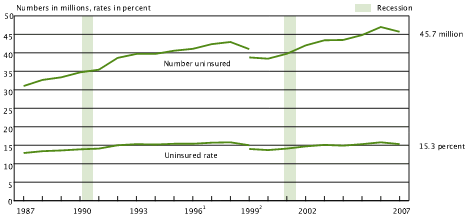
The Uninsured: In the past two decades, both the total number and the percentage of uninsured have increased in spite of some modest programs designed to expand coverage (like CHIP). (Original chart is here.)

hct_coverage_3_sm

The graph above, which extends through 2007, has surely worsened since 57% of US citizens are insured through their workplace (down from 63% in 2000) and unemployment increased from under 5% to 9.4% in the last couple years.

Read the rest of this entry »

Written by James Kwak

September 2, 2009 at 6:30 am

Posted in Guest Post

Tagged with

The March of Science and Health Care Reform

On a Planet Money podcast two weeks ago, economist Charlie Wheelan weighed in on the significance of genetic testing – the advancing ability of science to determine your genetic makeup, including your propensity to develop various serious or costly illnesses. This really crystallizes one dimension of the health care debate.

If insurers know what your projected long-term health care costs are, because they can read your genetic code, then they are going to price accordingly – and that’s exactly what insurers should do in an unregulated market. This produces the dystopian world where not only are some people unlucky because their genes make them more likely to suffer in various ways, but on top of that they can’t get health insurance and therefore health care.

Read the rest of this entry »

Written by James Kwak

September 1, 2009 at 11:00 pm

Posted in Commentary

Tagged with

“Paying for” Health Care Reform

This week’s Washington Post health care column is on the question of whether we can afford health care reform – meaning whether we can afford to subsidize poor and middle-class people who cannot otherwise pay for health insurance. This has a different meaning depending on you interpret “we” as the U.S. economy in general or the federal government, but in either case we think the answer is “yes.” Or at least, as far as the federal government is concerned, the answer is that we can’t afford not doing some form of health care reform, although it’s not certain that the reforms currently on the table will be sufficient to solve our government’s long-term fiscal problems.

In summary:

“If you are for fiscal discipline, you should be for health-care reform. If our government cannot produce some kind of reform, that will only reinforce the perception that our political system is incapable of resolving our largest, most difficult problem — and that is what will make investors think twice about investing in America.”

By James Kwak

Written by James Kwak

September 1, 2009 at 6:00 pm

Posted in Op-ed

Tagged with

The Nature of Modern Finance

Is modern finance more like electricity or junk food?  This is, of course, the big question of the day.

If most of finance as currently organized is a form of electricity, then we obviously cannot run our globalized economy without it.  We may worry about adverse consequences and potential network disruptions from operating this technology, but this is the cost of living in the modern world.

On the other hand, there is growing evidence that the vast majority of what happens in and around modern financial markets is much more like junk food – little nutritional value, bad for your health, and a hard habit to kick. Read the rest of this entry »

Written by Simon Johnson

September 1, 2009 at 6:02 am

Posted in Commentary

Tagged with ,

Follow

Get every new post delivered to your Inbox.

Join 340 other followers