Day: January 13, 2009

Why Fiscal Stimulus Is Not Enough

Ben Bernanke gave a speech today that will be discussed for, well, at least a few days, outlining the Federal Reserve’s response to the financial crisis. We will probably devote a couple of posts to it (Simon already mentioned it below.)

Although the Obama team and Congress have been focusing on the politically popular fiscal stimulus plan, replete with hundreds of billions of dollars in tax cuts, Bernanke emphasized that stimulus will not be enough (something that Larry Summers seems to agree with, as Simon noted). Here’s the relevant passage:

with the worsening of the economy’s growth prospects, continued credit losses and asset markdowns may maintain for a time the pressure on the capital and balance sheet capacities of financial institutions.  Consequently, more capital injections and guarantees may become necessary to ensure stability and the normalization of credit markets.  A continuing barrier to private investment in financial institutions is the large quantity of troubled, hard-to-value assets that remain on institutions’ balance sheets.  The presence of these assets significantly increases uncertainty about the underlying value of these institutions and may inhibit both new private investment and new lending. . . . In addition, efforts to reduce preventable foreclosures, among other benefits, could strengthen the housing market and reduce mortgage losses, thereby increasing financial stability.

In a nutshell: as the economy gets worse, more and more loans default, eating into banks’ capital cushions; investors are still nervous about all those toxic assets; and the continuing collapse of the housing market hurts all of those mortgages and mortgage-backed securities banks are holding. And as banks teeter toward insolvency, people stop lending them money, and they stop lending people money.

On the plus side, the famous TED spread dipped below 1 today, a sign that credit markets are doing much better than back in September. (The Calculated Risk article behind that link shows improvements in other parts of the credit markets, not just interbank lending.)

On the minus side, CDS spreads have shot up on Citigroup and Bank of America in the last week – here’s Bank of America:
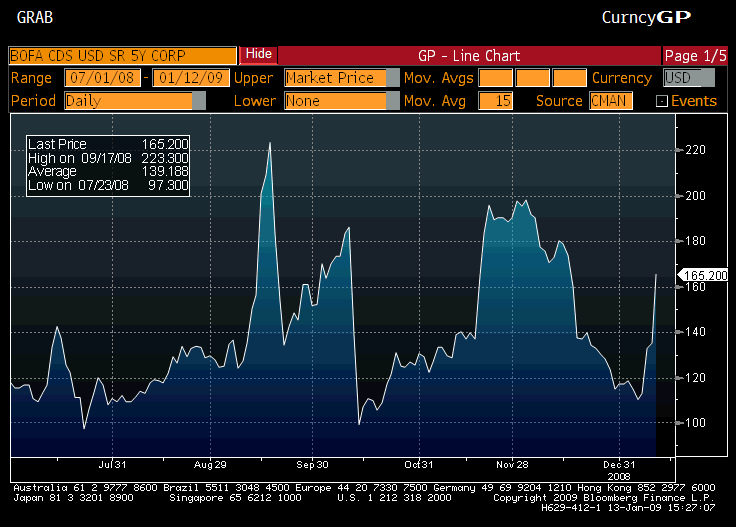
Bank of America

The main peaks you see are the Lehman bankruptcy, the buildup to the bank recapitalization announcement, and the Citigroup crisis. So while there seems to be general improvement in the credit markets, the underlying problems have not been solved.

Policy Parallels: Eurozone and India

I’ve had a chance, over the past 10 days, to debate the details of what’s next for the macroeconomy with leading policymakers in both the eurozone/EU and India.  I’m struck by some similarities.  In both places, there is little or no concern that inflation will rebound any time soon.  At least for people based in Delhi, there is as a result confidence that conventional policy can now act aggressively to cushion the blows coming from the global economy.  In the eurozone, all eyes are on monetary policy and the same is true for India – both places have almost the exact debate about whether fiscal policy can do much more than it is already doing, given that government debt levels are already on the high side.

The discordant note comes from people based in Mumbai.  They feel that Delhi does not fully understand that the real economy is already in bad shape.  Sectors such as real estate and autos are hurting badly.  Small businesses, in particular, seems to be bearing the brunt of the blow.  The banking picture seems more murky, but is surely not good.  And of course the Satyam accounting scandal could not come at a worse time.

Overall, my strong impression is that growth forecasts will need to be marked down for India and the eurozone.  Both will likely cut interest rates further quite soon (and have space for additional cuts), but we should not expect much more from the fiscal side in either place.  They will both start to look beyond standard macro policies  – although India may make progress on this front sooner.

I also heard strong and reassuring opposition to protectionism – although, I must say the case against any kind of trade restriction comes through more clearly in India than in the eurozone.

What If You Only Had $350bn To Spend?

Larry Summers made a convincing case yesterday that Congress should release the remaining $350bn of the TARP.  It’s good to see the Obama team emphasizing themes beyond the fiscal stimulus, including banks and housing.  Stronger governance and greater transparency are timely commitments for this program, and who can object to limits on executive compensation in today’s environment?  Some Congressional debate makes sense and could be productive, but it’s hard to see this request being turned down.

Still, what exactly should the money be spent on?  I’m tempted to say: housing, because this continues to be a major unresolved problem that looms over both consumers and their balance sheets.  Unfortunately, however, the banks remain a greater priority.  The latest developments for both Citigroup and Bank of America suggest the banking situation is (again) seen by insiders as more desperate than we outsiders wished to believe.

The next round of bank recapitalization (again) needs to be big and bold, for example along the lines we have been suggesting for some time (but I’ll take another comprehensive plan, if you have one, with strong expected taxpayer value).  The problem today is that we just don’t know if any major bank is well capitalized; there are too many black boxes that may contain toxic assets.  At best, this is a brake on the positive effects that should come from the fiscal stimulus.  At worst, we still have a major system issue on our hands.

And there is no reason to think that $350bn is enough to handle this problem.  The original $700bn was obviously an arbitrarily chosen number, and the money has been spent so far in a rather unplanned manner.  What we do next should not be constrained by the fact that there is a check for $350bn waiting to be picked up.  We should design a systematic recapitalization program, figure out what it will cost, and get on with it.  My working assumption, based on the published analysis of the IMF regarding losses relative to private capital raising, is that $1trn – properly deployed – should do the trick. 

Then we should get to work on housing (yes, this needs more money).

Update: Ben Bernanke seems to be thinking aloud along similar lines.